

Some may raise an eyebrow when they hear of a charity that supports professors, like Global Scholars Canada. Why donate money to a group of PhDs—an elite bunch if there ever was—when poor people without any formal education are struggling with food, shelter, health, and urgent spiritual care?
Organizations like our Global Scholars Canada are deeply convicted that raising up a professor with a Christian worldview and practise can make a world of difference. Highly educated people are often leaders in the field, and if they believe their learning was for sacrifice and service, and not for their own status or self-aggrandizement—they can help transform lives and communities worldwide, by educating the illiterate, teaching food security, devising new kinds of affordable housing, researching cures and care for disease, and cultivating leadership for a community of faith that nourishes the soul and strives for justice. Such teaching in turn invites the student to give their lives in sacrifice and service to others–and so on down the generations.
The one big issue here is that, like a great tree, it can take decades to grow a good Christian professor, not to mention a whole educational system. Investing in an educational mission like ours requires a vision and investment for the long-term. Take for example Jan Habl (b. 1975) a local pastor, professor of pedagogy associated with the Comenius Institute in Prague, and author of numerous books on education and philosophy, including Even When No One is Looking: Fundamental Questions of Ethical Education (2018). He studied education at J.E.Purkyne University in Ústí nad Labem, theology at EMF School of Biblical Studies in England and philosophy of education at University of Wales. He is now shaping up to be a public intellectual in Czechia who offers faith-based commentary on social institutions like the education sector in Europe. He’s pressing for moral philosophy in schooling children! But it took decades for him to develop his Christian perspective and then to attain his wider public reputation. Unlike internet fame, academic wisdom doesn’t manifest in 15 minutes.

“How can we teach a person to know the good, desire the good, and do what is good, and do it ‘even when no one is looking?'”
– Jan Habl
So: how does a good Christian professor grow?
The Desert of Graduate School
Jesus Christ did not start his ministry until he was 30 years old, and Christians believe he was the Son of God. He did not rush into becoming the controversial public figure who healed the sick and told wildly imaginative stories to the crowds. The gospel of Mark emphasizes how he often told people to keep his ministry quiet. Don’t forget he also spent 40 days in the desert being tempted by Satan. His journey to becoming a great teacher was a patient one.
St. Paul was trained under Gamaliel, at his school in Jerusalem. Many believe he also had a Pharisaic background, learned Stoic philosophy, and eventually attained Roman citizenship. After his conversion on the road to Damascus, he spent at least 3 years in Arabia (2 Cor. 11:32-33), which many suspect meant living in the desert, listening and learning his way into his new Messianic faith. Paul, too, took decades to become a great Jewish evangelist to the Gentiles.
The desert can be a metaphor for the place of transformation and growth. The solitude, the testing, and the temptations in the shadows can be a furnace of refinement, a season of preparation. It is not a luxurious experience, but it can be deeply enriching, and from this experience one can develop a depth of spiritual maturity and thus have a storehouse of gifts to share.

“Solitude is the furnace of transformation. Without solitude we remain victims of our society and continue to be entangled in the illusions of the false self. Jesus himself entered into this furnace. There he was tempted with the three compulsions of the world: to be relevant (‘turn stones into loaves’), to be spectacular (‘throw yourself down’), and to be powerful (‘I will give you all these kingdoms’).”
– Henri Nouwen The Way of the Heart
Often one’s academic education begins with crowded classrooms, but it usually culminates in individualized, self-motivated study that takes years of intense reformulation and lots of generous guidance from conscientious mentors and brilliant colleagues. It means learning to teach cold turkey–typically without a formal education in pedagogy. It means getting by on meagre wages and juggling marital and family responsibilities. Really, if you want to grow a tried and tested Christian professor, first plant him or her in the desert of graduate school!
A good graduate school experience actually includes both intense solitude and a supportive network of trustworthy colleagues. This can become a healthy dialectic for life: moving from solitude to community, and again, from community to solitude. The one enriches–and provides relief from–the other.
Double Duty in Doctorate
A Christian academic, to truly be a “redemptive influence” in their field, has to do twice the reading, studying and researching of the average emerging scholar. They need to study their discipline and understand the current research at the highest level; but they also ought to pursue what the worldview assumptions are in their discipline and how that compares with a Christian worldview. They should have some basic theological understanding and know the Christian scholars who share their field and have written discerningly on that area from a Christian perspective.
They can of course start with books like The Outrageous Idea of Christian Scholarship by George Marsden, Richard Mow’s Called to the Life of the Mind or Canadian Robert Sweetman’s Tracing the Lines: Spiritual Exercise and the Gesture of Christian Scholarship. My own Christian framework for academic life came many years ago from a small book that basically uses the story arc of the Bible as its cue: Creation Regained: Biblical Basically for a Reformational Worldview by Albert Wolters. This author and his book were the inspiration for the the new Albert M. Wolters Centre for Christian Scholarship at Redeemer University in Hamilton Ontario.

There are Christian organizations that have worked out some basic curricula for young scholars to follow. Our partner organization, the Society of Christian Scholars, has a curriculum that Christian scholars can follow to deepen and hone a fuller understanding of the intersection of their faith and their academic vocation. The six areas to explore include: theology and the academy, loving God with the mind, growing spiritually, pursuing vocational excellence, interacting with cultures and society, and engaging unbelief. They are developing now a “Sophia Series” of study guides that follow similar categories, which are geared towards faculty on a public university campus, and seem to fit into related areas of vocational mentoring.
The American Intervarsity Faculty Ministry, which also has faculty on public university campuses in mind, talks about the “four faculty loves”:
- God and One Another (Spiritual Formation)
- Your Campus (Your Academic Community)
- Your Academic Discipline (Faith and Scholarship)
- Our World (bringing Kingdom Shalom)
Like the SCS curriculum above, pedagogy isn’t directly mentioned as a specific area of personal development, as the areas are organized around the different sectors of one’s professional life. Being part of a church community may factor in #1, but its not given the prominence of its own independent sector.
The De Vries Institute for Global Faculty Development at Calvin University has its own set of modules available on-line for growing academics anywhere, which seem more focused on faculty in a Christian university. The current list of titles seems more theologically attuned and includes: “Sin: Learning in a Fractured World,” “Educating for Shalom,” “The World as God’s Creation,” “Hospitality to the Stranger,” “Faith and Pedagogy,” “Faith, Community, and Learning,” “Humanity in God’s Image,” and “Engaging Responsibly with Scripture.” There is lots to learn, and maybe that is why the book of James discouraged people from becoming teachers: “because teachers will be held to a higher standard” (3:1).
First Things First: Becoming Christian
Those are just three examples from thoughtful organizations that serve Christian faculty members. Basic to all, is that to become a Christian academic, one must first of all be a Christian. It is possible to be theologically astute, prophetically influential about justice issues, and have a fine-tuned Christian perspective on one’s discipline, and still slide into the scholarly default of becoming an arrogant intellectual elitist who bears no likeness to Jesus Christ.
That suggests a living contradiction. Its possible, though, because spiritual formation is always a counter-formation against a default subculture: in academic life, that can mean being competitive, critical, and beleaguered by professional jealousy and status anxiety. Some of the structures of the academy direct life toward self-focused ambitions, even self-aggrandizement: publish or perish. It’s hard to resist the temptation to be relevant, spectacular, and powerful as a professor.
Jesus always focused on the heart first and foremost. The integration of faith and learning must first of all be grounded in a character that seeks to follow, imitate, and have union with Jesus Christ and his kingdom, and that means first of all a deep sense of being loved and forgiven in spite of one’s own bumbling bedevilment. When asked what the four chief virtues of the Christian were, St. Bernard of Clairvaux allegedly replied: humility, humility, humility, and humility. From this receptive heart all the other virtues flow, gifted by the Spirit, nurtured through spiritual disciplines–in a congregational community. There are no individual Christians, strictly speaking.
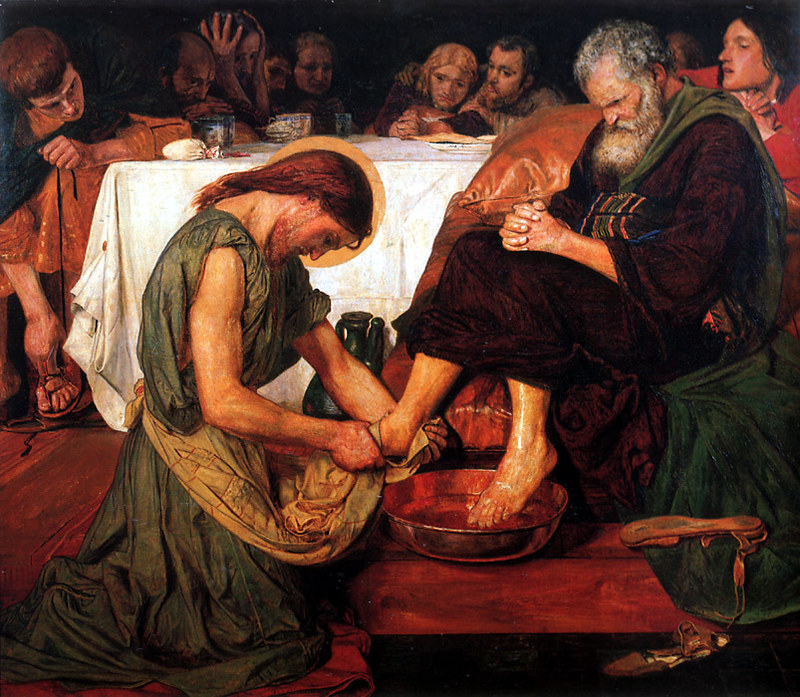
Jesus washing Peter’s feet
Ford Madox Brown 1852-1856
Let me end by offering another example of a Christian scholar. David Koyzis is one of our exceptionally gifted scholars at Global Scholars Canada, with over 30 years of teaching experience in a Christian liberal arts university. He learned his discipline of political science through years of doctoral research at the University of Notre Dame. As an undergraduate at Bethel University (Minnesota), he had stumbled on the rich implications of Christian philosophy for his political insights from Dutch neo-Calvinist scholars like Abraham Kuyper and Herman Dooyeweerd, which he imbibed and made into a second language of sorts for his research. He has since written seminal books in the area of faith and political science, including Political Visions and Illusions: A Survey and Christian Critique of Contemporary Ideologies (IVP 2019). This book is now in its second edition, has been translated into Spanish and Portuguese, and is being read and taught in universities worldwide.
Our world desperately needs stable, democratic governments that seek the welfare and justice of their citizens within our globalizing international scene. Good governments help people secure the food, shelter, health, education, and freedom of religion that they need to flourish. Koyzis’ writings are no doubt having a redemptive influence in this direction in many different political contexts. But it has taken over 40 years to grow someone as informed, reputable, and erudite as Koyzis, and this is not to mention his deeply Christian gentlemanly character. He is currently preparing to publish a new versification of the Genevan Psalter, a collection of metrical Psalms first compiled in Geneva during the Reformation. Hopefully, this will be sung soon by lungs across the Reformed landscape of our planet.

Koyzis’ title in Portuguese for the Brazilian edition of 2021.
For Koyzis, work, scholarship, and worship are integral parts of a holistic Christian world and life perspective and practice. This is indeed a high standard, to recall James. And so it should be, because professors have tremendous influence through their teaching, research and writing. That influence ought to be forged over years of guided instruction in something equivalent to the desert. Academic culture can certainly be that dry and arid. Ask any recent graduate about their experience writing a dissertation! But it can also be a rich time of personal, spiritual, and intellectual growth.
So when you are asked to share some of your wealth with institutions of higher learning or to support a professor in their vocational pursuits in an under-serviced region of the planet, don’t think so much of the privilege that can come with such status. Think of the decades of preparation that were necessary, and the variety of ways in which higher learning can inspire another generation for learning and serving for the sake of the gospel and the common good: for better food, shelter, health, education, and spiritual care. Ultimately, to quote a classic title in Christian pedagogy, we are always educating for shalom.
 Sensus Divinitatis