
What is happening in Russia that it would sacrifice its young men, military budget, Ukrainian relatives, and Western relations in an attack on Ukraine? Global Scholars Canada asked a few of its scholars and some academic friends to weigh in on the larger historical, political, and ecclesiastical context behind the war that continues to rage in eastern Ukraine. A video of the symposium is available here.
Our symposium began with Psalm 47:8 “God reigns over the nations; God is seated on his holy throne.” While this conviction can be a source of comfort, it also begs the question: why does God not do something when armies and their overlords refuse to stop the bloodshed?
While this question was not part of the discussion on June 10th, our deep dismay about the war in Ukraine was part of the motivation for this event. The other reason that brought us all together was the completion of Drs. Wendy and Adrian Helleman’s compilation of their “Moscow Letters”—letters they had written to their friends and supporters when they ventured into Russia in 1995 to teach philosophy at Moscow University, just four years after the dissolution of the USSR. We thought the completed letters could serve as an occasion for a discussion on the opening and closing of Russia to the West and the current war against Ukraine.
The Helleman’s first letter home asks, “Why teach in Russia?” The answer:
In a country where many professional opportunities have been closed to Christians, and universities have been used to promote atheism, we felt challenged to reach students with a vision of Christ, and thus impact future leaders of Russia in heart and mind. It is possible, at present, to teach openly from a Christian perspective in the public universities of Russia, and to present an alternative to the prevailing atheistic/materialistic worldview. The door is now open, but no one knows how long this opportunity to teach the Good News will continue.
When the Hellemans arrived, Gorbachev’s promises of democratization, perestroika, and glasnost were still ringing. Now we know how short-lived these notions would be, and we brought three other professors into a 2.5-hour panel discussion on the historical, theological and political context of the closing of Russian society and the related invasion of Ukraine. What follows is a summary of the exchange with an audience of about 30 people present and another 35 people on-line at Faith Baptist Church, Oakville, Ontario (moderated by myself).
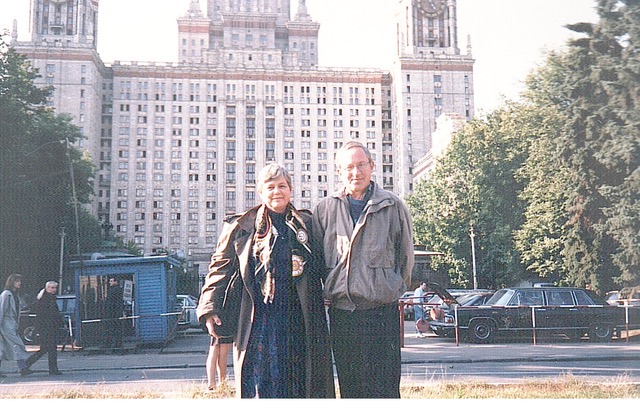
Adrian and Wendy Helleman at Moscow University, 1995
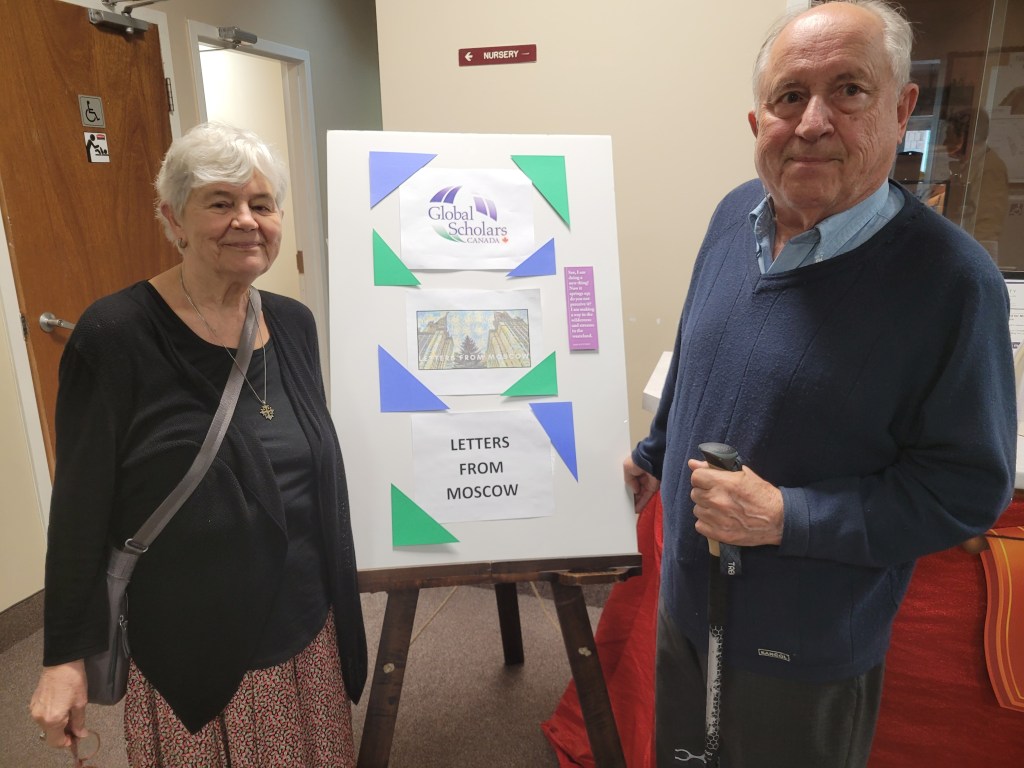
Wendy and Adrian Helleman at our Symposium on June 10th.
Opening and Closing Faith Conversations
Wendy Helleman set the stage for our dialogue by describing the openness they felt when they first arrived in Moscow, especially “the amazing opportunities we had to network with Russian Colleagues who were also working for real change at the time.” They replaced the Marxist Leninist textbooks with their own philosophical texts in English, and helped write and edit new textbooks and prepare new research proposals with faculty. Learning Russian, they were able to participate in meetings and conferences at the university, opening more doors for meaningful conversations about worldview, ethics, and faith. In particular, their academic conversations circled around “The Russian Idea”—the notion of Russia as the centre of Christendom, a “Third Rome” after era of Rome and Constantinople had passed (see the book here).
While this leaned into some nationalistic ideology, it also encouraged a retrieval of Russia’s Christian past. Not only could the church offer stability, the faith offered foundations for human dignity characterized by the imago Dei. Facilitating discussion groups around books like Richard Niebuhr’s classic Christ and Culture prodded Russia’s philosophical elites and graduate students on such things as church-state relations and Christian apologetics.
Adrian Helleman then spoke of the 1997 Law on Freedom of Conscience and Religious Associations, which was more about restriction than freedom. Only registered religious groups were allowed to hold property, open bank accounts or publish literature, and to be registered was a 15-year process. This 1997 Law has been amended since with further restrictions, increasing its list of banned “extremist literature” which by 2010 had 550 titles including both Jehovah Witness and Muslim materials.
Putin further amended the law in 2021, requiring all missionaries, clergy and religious teachers educated abroad to receive additional “State-authorized” education in Russia. “The closing that we describe here,” concluded Helleman, “became more apparent after we left… If Gorbachev helped to usher in the opening, Putin aided the closing. He helped turn back the clock by reverting to many aspects of the old Soviet Union.”
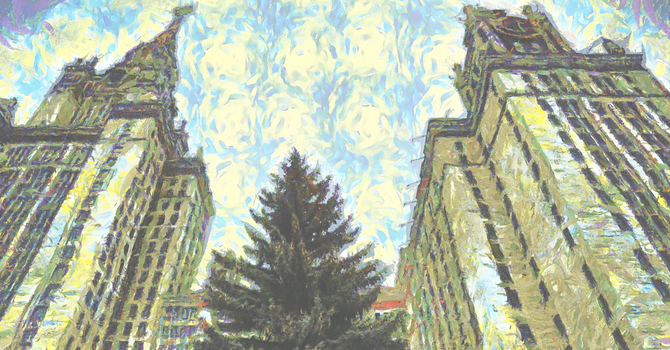
Moscow University, Moscow
Strong Men with a Divine Mission
Next Global Scholar Dr. David Koyzis, a political scientist from Hamilton and specialist on political ideology, spoke of the perennial tension between Russia as empire and Russia as a culture, language and people. Part of the ambiguity between the two is the fact that Russia has no natural geographical boundaries (like between Spain and France) and neither does it have a national identity centred around political institutions and constitutions (as does UK and Canada). Comprehensive legal codes, like the Napoleonic Code in France, “remained abstractions in Russia that never filtered down to the local level.” Russia, said Koyzis, has been always run by a series of strong men (and women). In this sense, Putin is nothing unusual. Russia perceives itself to have a divine mission—to unite the diverse peoples of Eurasia into one Empire, and notions of law and equality are less important.
Russia perceives itself to have a divine mission—to unite the diverse peoples of Eurasia into one Empire, and notions of law and equality are less important.
– David Koyzis
Koyzis made a comparison with Canadian politics, where during the referendum in 1995 billboards in Ontario said “My Canada includes Quebec.” Similar sentiments could be found in Russia, although certainly more unwelcome: “My Russia includes Ukraine.”
Then Dr. Andrey Kordochkin spoke live on-line from Spain. He is a priest in a Russian Orthodox Church—St. Mary Magdalene cathedral in Madrid. He was originally from St Petersburg, studied in England, and has been under some discipline from his church for speaking out against the invasion of Ukraine. He has written one of the few critical books on Russian patriotism.
He began outlining some framework for understanding religion in Russia. He said people either see religion as a useful ideology that serves the needs of empire in some syncretic way, or they see it as a cult that has nothing to do with the dirty business of politics. In either case, there is little sustained investigation into the meaning of faith for life, or a felt need to confess the complicity of the church for the offences of the Soviet era. Russians do not share the Western suspicion for government, although the government is suspicious (ironically) of civilian solidarity and the notion of sacrifice for the cause of peace.
Two things Father Kordochkin said stuck out. One was his mention of the concept of “collective narcissism,” which he said American psychologists have described as people with high opinions of themselves who demand constant validation. Any challenges to their perceived greatness are considered a threat and demand retaliation, which they deem to be merely self-defence. He didn’t name Putin here, but he concluded that “the violent person is always the perceived victim, and it is the fault of the true victim, deemed to have provoked the violence.”1
Kordochkin also explained the sacred narrative of the contemporary Russian identity as formed by the World War II victory over fascism. “This is a global war in which Russia has been involved with from the beginning—a war of good versus evil,” he said. “It’s a crusade, because it’s a war over sacred geography, as Kiev and Crimea are sacred locations formed in the origins of Russia.” It is a war the ex-president of Russia declared was ultimately against the anti-Christ.
He worries that such a narrative, if assessing the West as morally corrupt, will cut itself off from dialogue with the outside. “The only alternative then is isolation. And isolation is where monsters grow.”
When asked how the Russian Orthodox Church can read the Sermon on the Mount and support the invasion of Ukraine, Kordochkin gave a long answer, with many caveats, but ultimately said that the Russian Orthodox hierarchy sees itself in the tradition of the Just War, defending itself and its neighbours from harm.
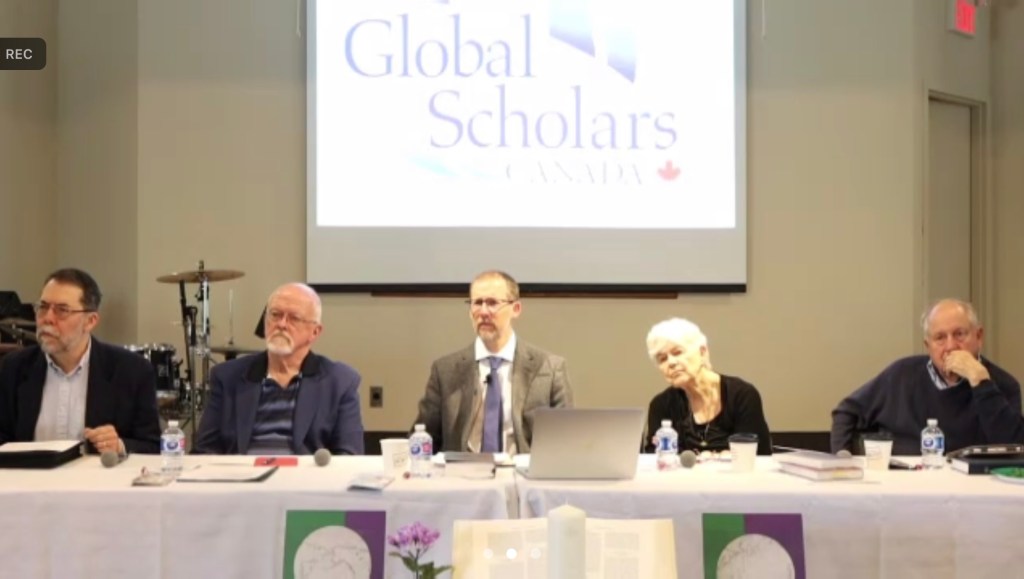
Our symposium panel: David Koyzis, Jim Payton, Peter Schuurman, Wendy Helleman, Adrian Helleman (Andrey Kordochkin was on-line)
Empire Nostalgia, Wounded Pride
Finally comes the historian, Dr. Jim Payton, professor emeritus of Redeemer University and author of a number of books on Eastern Orthodoxy and Eastern European history. After noting most Western students are poorly educated when it comes to the history of lands beyond Europe, he spoke of Kievan Rus’—“the most powerful, largest and sophisticated state in all of Europe from 900 to the mid-1200s.” He elaborated: “It was far larger than what became the Holy Roman Empire, much stronger than England and France, and more sophisticated than anything that was anywhere else in Europe.”
One of its famed rulers was Yaroslav the Wise, known as “the father-in-law of Europe” because he married his children off to the royal houses of six European states. He had both boys and girls educated, and in fact they were taught in three languages. This was the 11th century, when most of Europe, including its rulers, were basically illiterate.

1997 monument to Yaroslav the Wise at the Golden Gates of Kiev. This 4m tall statue gazes to the Sophia Cathedral, of which he holds a prototype in his hands. (Photo by Gerry Lynch, Flickr)
Now this empire was crushed by the Mongol invasion, and “Moscow in due course claimed the Kievan Rus’ heritage as its own.” Over the next few hundred years, Moscow “grew into a Russian state and in due course the Russian Empire.” Payton makes the dream clear: “It was a sole free-standing self-governing Orthodox state which saw its duty to defend and protect the faith against all the corruptions coming from the West, to reclaim the glories and territories of Kievan Rus’.”
At the same time the West was leaping forward with the Enlightenment, and in comparison, Russia looked a little backwards. “Russian culture developed what you might call a collective inferiority complex,” said Payton. So a dilemma confronted them: Should we be Westernizing or following more local Slavic patterns? “The argument was never resolved,” concluded Payton, “because the Russian revolution, and the adoption of communism, shelved it.”
One of the questions from the audience asked about the influences on Russian national identity today. Wendy Helleman spoke of the humiliated superpower and “wounded pride.” Payton cited a survey that found over 90 percent of Russians claim their faith tradition as being Orthodox and about 40 percent report “atheism.” “They hold this contradiction,” said Payton, “a confused cultural overlap undermined by communism. They hold this notion together without a sense of fracture.”
When the panel was asked how the war would end, some said in a stalemate. “I hope all the Ukrainian territory can be returned,” ventured Payton. Koyzis offered that Ukraine best not join NATO—it would only further irritate the Russians. “I see this war as a proxy war between the United States and Russia,” said Adrian Helleman.
“Little Brother doesn’t want anything to do with Big Brother anymore.”
Jim Payton
One thing is for sure, which Payton made clear: “Ukrainians have come collectively to hate what the Russian government is and what the Russian people through what the army are inflicting on them. Little Brother doesn’t want anything to do with Big Brother anymore.”
GSC board member Deborah Bowen closed our symposium in prayer. “Thank you that we are called to love because you first loved us, not because of our earthly nationhood, but because of our holy nationhood. As your people, please increase our understanding of our earthly circumstances so that we can pray and act in hope for the coming of your kingdom, not ours.”
Plans are now underway for another symposium on an equally relevant topic of global significance next spring. Please stay tuned through our newsletter by giving us your email address.
- Baumeister, Roy F.; Bushman, Brad J.; Campbell, W. Keith (February 2000). “Self-Esteem, Narcissism, and Aggression: Does Violence Result From Low Self-Esteem or From Threatened Egotism?”. Current Directions in Psychological Science. Psychology and Behavioral Sciences Collection. EBSCO. 9 (1): 26–29. doi:10.1111/1467-8721.00053.
 Sensus Divinitatis
One thought on ““Letters from Moscow”: The Opening and Closing of Russia, a Thousand Year History”