
When I saw the presentation title “Climate Change as a Wicked Problem,” I was instantly intrigued. I had known about this term “wicked problem”—referring to a problem with incomplete assessment, with divergent opinions on solutions, and proposed solutions which lead to other problems. Such wicked problems may sound threatening, but it is in fact a motivator for many to research, write, and discuss their findings with others on possible ways to mitigate and manage the perplexing issues that plague our world.
“Moving Forward Together: The Future of Science and Faith” was the title of the annual conference for the ASA and the CSCA July 28-31 2023 at the University of Toronto Mississauga campus. Attendees engaged each other over a host of wicked problems that confound and intrigue humanity today, and did so with a depth of realism and hope. The Canadian Scientific and Christian Affiliation is a partner to the American Scientific Affiliation and while the ASA is a few dozen years older, the CSCA hosted the conference in Toronto because they were celebrating a 50th anniversary this year.
The invitation to the conference included this introduction, which enticed over 230 people to attend:
This conference will explore the intersection of science and faith across a broad range of frontiers. It will be chock-full of lectures, workshops, and discussions on important issues such as climate change, the environment, and artificial intelligence, along with continuing developments in astrophysical cosmology, geology, cutting-edge technologies, evolutionary biology, renewable energies, human psychology, and public health. Our meeting will include attendees from our counterpart Christians in Science in the UK and ISCAST from Australia.
– CSCA Conference Webpage
True to this word, the conference was certainly “chock-full” of both provocative lectures and a rich diversity of academics from around the world—with over 50 paper presentations in three days.
Four out of the five plenary speakers were women, including Canada’s own Nobel Prize winning physicist, Donna Strickland. While the scientific side of her lecture was fascinating and informative, the brief moment she left for the metaphysical lacked a comparable level of robustness and depth (she seemed to dismiss theological distinctions between world religions, for example). Many I spoke with were disappointed with that part of her lecture. The other plenary speakers offered much more constructive insight into the conference’s faith/science conversation.
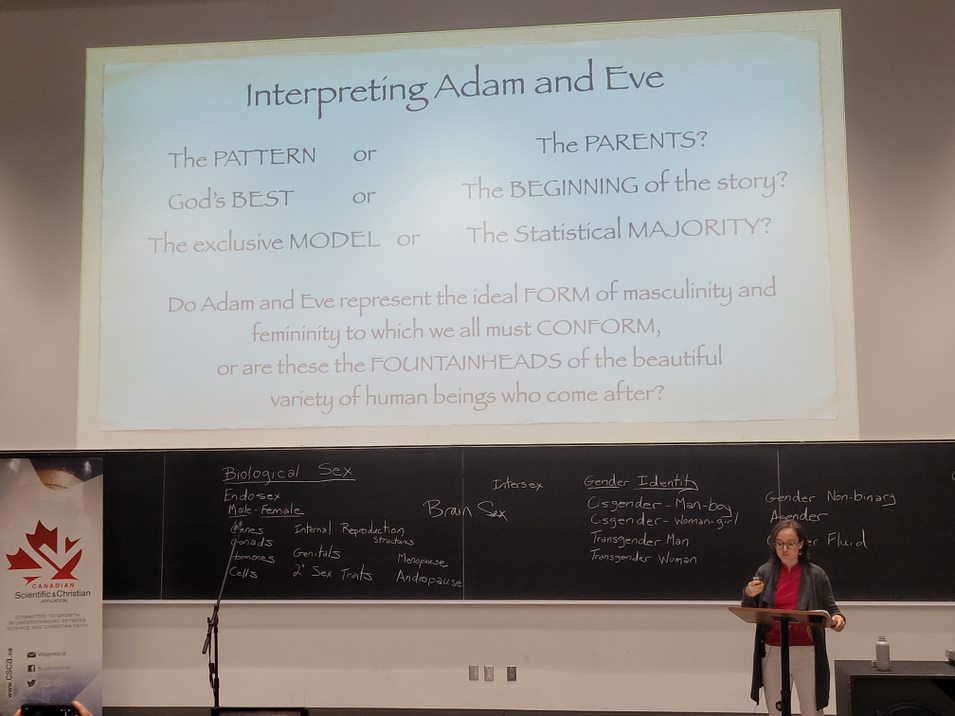
Megan DeFranza on the theological ethics and inter-sex persons.
- Joanna Ng is CEO of a tech company in Markham, Ontario and she offered a dizzying fireworks of analysis on the realities and hype of AI and helpfully put them in the context of what she called “kingdom values”—neither fearing nor idolizing the power of AI and recognizing divine wisdom will always be greater. She also recommended government regulation of AI—the equivalent of the FDA for drugs.
- Victoria Lorrimar is a theologian from the University of Notre Dame, Australia, and building on her Cambridge University Press book on Human Technological Enhancement and Theological Anthropology (2022) entreated us to find ways to dialogue with transhumanists rather than just dismiss them. The Creator created creators in human beings, and we were inspired to craftmanship—creativity within limits. Our faith in a God beyond us, however, is much more audacious than technological enhancement will ever be.
- Megan DeFranza, author of Sex Difference in Christian Theology: Male, Female, and Intersex in the Image of God tackled the ethics of inter-sex persons, whom she called “pawns in the culture war.” She exegeted the eunuch comments by Jesus in Matthew 19 and then returned to creation to suggest Adam and Eve are “not the pattern, but the parents” and “not the model, but the majority.” She warned against “corrective” surgeries that idolize gender binaries and advocated for more medical caution and social acceptance.
- Denis Alexander spoke from the Faraday Institute at Cambridge, UK, asking (as his book title does) Are We Slaves to Our Genes? He explained that nature and nurture are not two rarefied entities: our development is a dynamic system where both genes and environment are operating at 100 percent all the time. Even in the womb, there is a micro-environment of DNA life and the macro-environment of the fallopian tube that interact in the complex “symphony of life.” Many of our behaviours are polygenic in their origins—it rarely comes down to one single influential gene. In sum, we are predisposed, but not predetermined.
Patrick Franklin gives a meditation in the Sunday worship service.
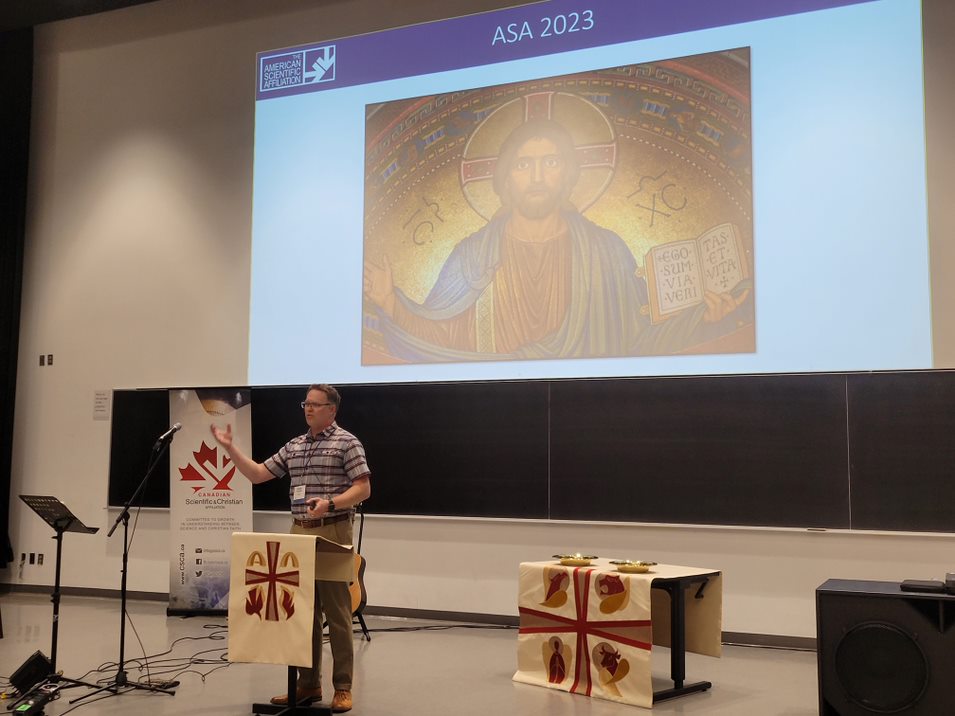
Academic conferences can be heady affairs, and one might imagine that a gathering of scientists would be especially cerebral. But there were scheduled walks and a run, ultimate frisbee, regular social gatherings during meals, and a celebratory 50th anniversary BBQ. Furthermore, a significant moment in the conference was the Sunday morning worship service, with singing, an offering (for GSC!) and a sermon by Dr. Patrick Franklin, a theologian from Tyndale Seminary and past president of the CSCA.

Chloe reflecting on the nexus of faith and science in her cancer research.
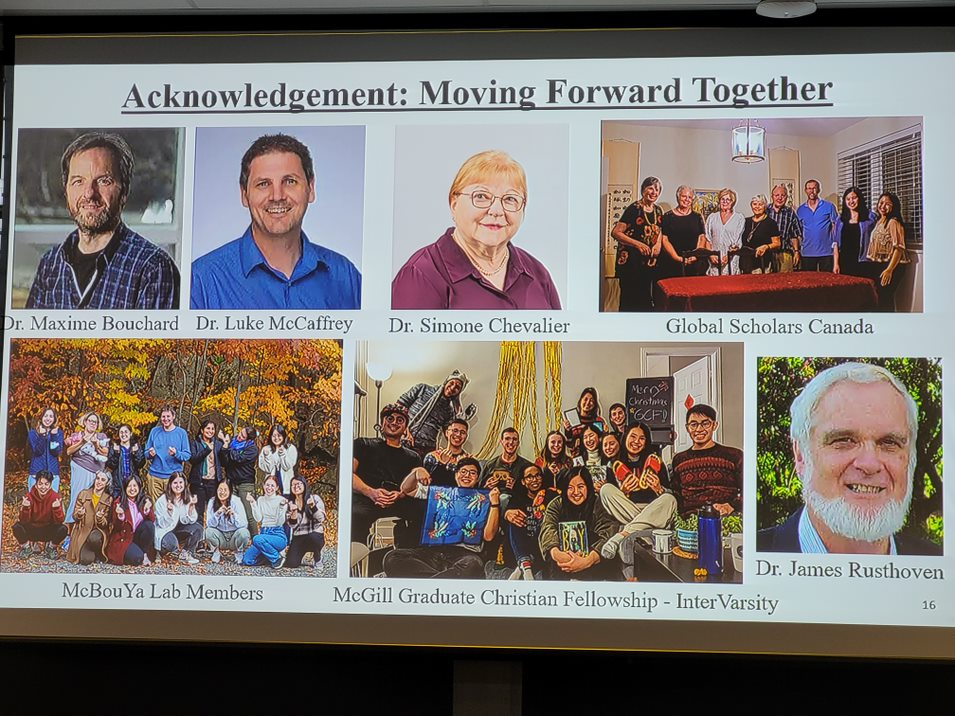
While I presented a paper on “Brain Drain” and international development discussed here, our own GSC student intern, Chloe Liu, presented a paper on her cancer research, which drew an appreciative audience. There were some helpful questions about her cancer research which she fielded well, and there were also comments on one of her last powerpoint slides. She had displayed photos of all those supporting her during her PhD: her lab partners, her family, her IVCF graduate fellowship group, GSC staff and board, a mentor named Dr. Jim Rusthoven, and most significantly, her PhD supervisor who died of cancer last year. It was a moving testimony to the fact that no one accomplishes great things alone. We are each other’s best first aid kit.
Chloe’s “acknowledgement” slide.
This sort of scholarly collegiality could have been a sub-theme of the conference: that while the nexus of science and faith is a fruitful and invigorating academic conversation, it is only made worthwhile by conscientious people who are honest with their data, pose incisive questions to each other, listen carefully and respond patiently, knowing that we are all wiser for having met and puzzled over such wicked problems as climate change, transgenderism, technological dependence, global pandemics and human origins together. This kind of humility is proper to our species, and the recognition of a divine Other adds to our curiosity, wonder, lament, and inspires prayers for healing in our own lives and in our troubled but resilient world.
 Sensus Divinitatis