
I teach World Religions at Redeemer University and require my students to visit a non-Christian house of prayer: a temple, mosque, gurdwara, or synagogue. Many of them are conservative Christian students, and many have never been to such a place, and some are worried and anxious about the assignment. It’s normal to be trepidatious about strange things, and so that’s OK.
I’ve been doing this for many years, and while most students are a little nervous about it, their feelings afterwards have always been overwhelmingly positive, as you will see. But the odd student will resist, and one in fact declared, “I will not set foot in an other’s religious building.” It took a long series of emails to understand exactly why, and below I’ll review some of the concerns. I’ll end with my conjecture of the real reason before sharing some student testimonies from the required report on their observations.
Biblical and Historical Precedent
While the Bible contains many prohibitions against worshipping other gods and idols, this class exercise is not about worshipping with religious others. The assignment is explicitly about observation and education. To worship in this setting would be disingenuous and potentially offensive as an act of cultural appropriation or simply ignorance. Their job is to be a guest, ask questions, listen, and report, all the while being exceptionally courteous.
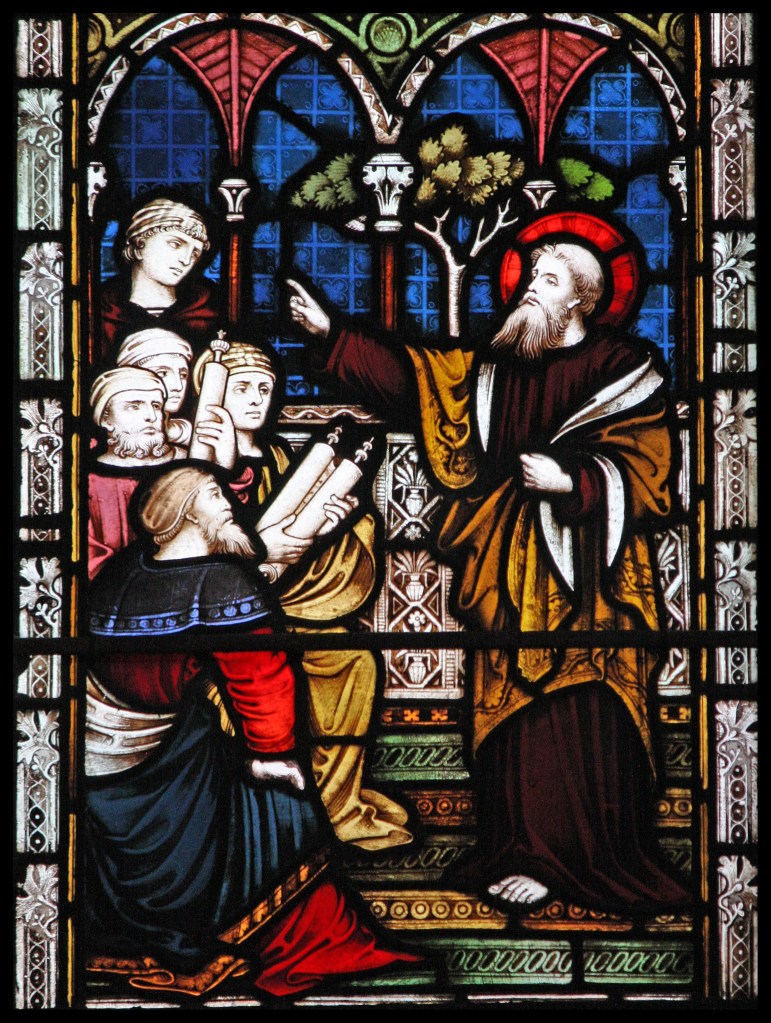
Entering into a non-Christian house of prayer is something the apostles did as a habit, if you include their visits to the local synagogues. Religious buildings are the place where people gather, and it’s a natural place to meet and have conversations about faith. Of course, all the apostles were Jews already. But they knew the Messiah, and so they entered into the synagogues with a different set of assumptions about God.
Paul did not seem afraid of inter-religious conversation or observing others material religion. He says at Mars Hill in Athens “I see that in every way you are very religious. For as I walked around and looked carefully at your objects of worship…” (Acts 17). He respectfully and boldly engaged pagan believers.
St. Paul disputing with the Jews in the synagogue. (Flikr)
Missionaries throughout Christian history have entered the religious spaces of others. They learned their language, studied their religious stories and practises—all with the purpose of being a faithful witness. Matteo Ricci in China, William Carey in India, David Livingstone in Africa, and Bartolome De Las Casas to South America—all were extremely interested in the religious lives of their hosts, and their host’s general welfare to boot.
The TV series The Chosen shows Jesus bringing the disciples to a place of pagan worship, and the disciples protest. But the Jesus character there insists that they must witness the alternative to his Way.
The purpose of this assignment, however, was not to be a missionary, but to practise the art of guesting, which I explain here. Its not a time to argue religious matters, although some dialogue often takes place. It’s a school project and we bear witness by doing guesting well.
Alert to Spiritual Warfare
Some conservative and certainly charismatic/Pentecostal groups are especially sensitive to what they call “spiritual warfare.” This is the belief (based on passages like Ephesians 6) that Christians are engaged in a spiritual battle with supernatural forces like demons and Satan, who are trying to thwart the good and lead people away from faith in Christ. More liberal Christians interpret this in economic/political terms, but for some of my students it’s purely spiritual.
What is important to understand here is that the people of other religions are not the spiritual adversaries named when Paul speaks of “the rulers of this dark world.” He is referring to spiritual powers, not particular people, and while this may include institutionalized systems like greed, violence, or lust, it is not directly a reference to other religious people at their worship. Paul’s concern is that his followers develop the protective virtues of truth, peace, faith, and the life of the Spirit. The powers in question seek to challenge and destroy such character. Most of what my students report is in fact a growth in virtue when they visit these places, as you will see below.
Incidentally, the passage on spiritual warfare in Ephesians comes directly after instructions on how to live at home—parents and children, slaves and masters. This may suggest that one of the most dangerous places for spiritual warfare would be the home. This is where ego erupts, where love is twisted and torn, and where peace is so easily disturbed, and violence even becomes a habit. In other words, we may be worried about the demon in our neighbour’s house while ignoring the devil in our own.
This includes church. Much of my current research consists of interviewing people who are deconstructing their faith. Most of them have stories of toxic church environments, where questions are shunned, judgement is swift, and leaders abuse their authority, including incidents of clergy sexual abuse. Again, there may be a log in our own eye here. In this Ephesians passage, Paul was writing to the church; his focus was not the pagan temple down the road. All Paul’s letters address twisted behaviour in churches.
The devil is much more subtle than we suppose. We are at a heightened state of spiritual awareness in our neighbour’s house of prayer, but our guards are down in other places arguably more dangerous to our souls and to the cultivation of virtue. Think of the mall, the internet, a bank, or a university classroom. If you want to watch your secular neighbour at worship, some of the best places to go are music concerts or sports events, if we are going to be honest. There is more praise in some stadiums than in church. There is a reason our pop culture celebrities are also called idols. How many Christians have watched American Idol, completely unaware of the contradiction?
Most students seem oblivious to such spiritual warfare. That seems selectively critical.
Red Hot Chili Peppers concert 2014. (Flikr)

Religion is not just about identifiable deities, but about what pulls most powerfully at our heart: money, success, status, beauty, and plain old inanimate stuff. Think about casinos, resorts, trade shows and political rallies. Nefarious spiritual powers, if they are at all wise to our ways, will work more shrewdly–where we are really tempted and at the same time blissfully unaware of our compromised allegiances. The religious nature of offering a banana to a statue of Krishna is much more obvious to us than seeing thousands of fans solemnly raise their cell phones at a Taylor Swift concert. But both are acts of worship, or if you prefer, a form of idolatry. But they are religious acts.
So beware. Better yet: be more aware.
Raising Doubts
It may be that entering our neighbour’s house of prayer raises some doubts in our mind. What if I was born in India, Libya or Japan? Would I be just as convicted, but about a very different deity? My neighbour’s temple confronts me with the relativity of my own faith: could it have been otherwise, and just as fervent?
Doubts are the underside of faith. They keep us restless, seeking, learning, dependent on others. If faith is never challenged, never tested, never made vulnerable to outside influence, is it even faith? It may just be socialization, custom, or family tradition. Without some shake up from our complacence, can faith ever grow? Jesus talked about burying our talent in the ground to keep it safe. We can also try to bury our faith in a spiritual compound that never sees the light of other faiths. But that’s not good stewardship.
That is why my University (Redeemer) has a core curriculum, and it requires students to take courses outside the familiar world of their major. My World Religions course is part of that core: it insists students need to learn about people and places beyond their own home turf.
Can visiting another house of worship become the “stumbling block” that we are told to never put in the path of a fellow Christian? (Romans 14:13) This objection has been raised by one student. While no student has ever reported “stumbling” and no student has ever gotten close to being persuaded that their Christian faith is a mistake, I think that is possible one could stumble, and so this is why I have allowed an alternative assignment for the rare student. A certain spiritual security and maturity is necessary to be a guest to another’s place of prayer, and if that maturity is not present, then alternatives are possible. Such visits should be voluntary and come with an openness to learn and grow.
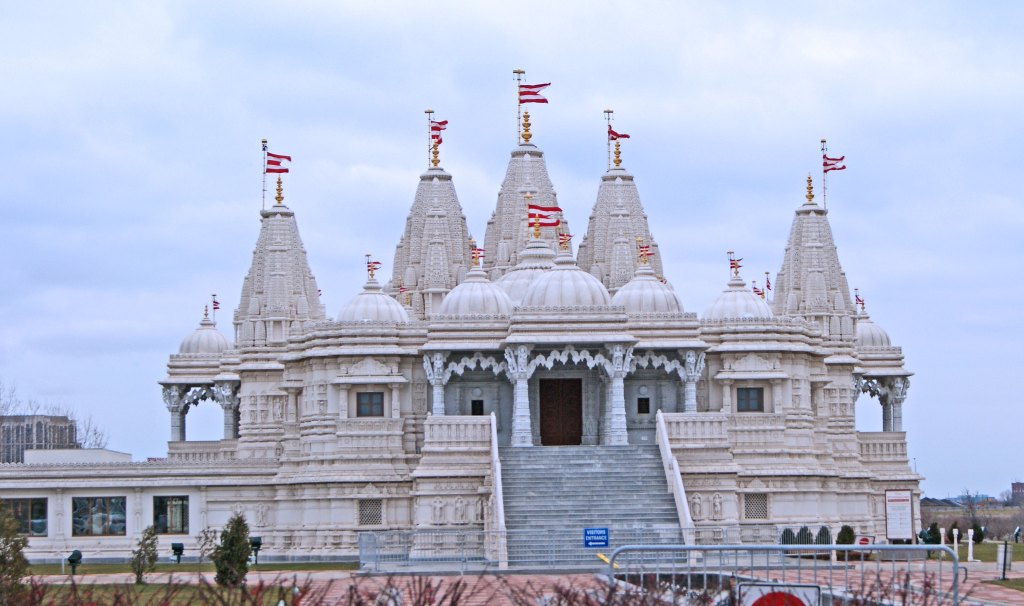
Hindu temple in Toronto, Ontario. (Flikr)
Theological Reasons For Guesting
I hope no Christian believes that these temples and mosques are 100 percent evil and demonic. If they would just open their eyes for a moment, they would see there is goodness, truth and beauty in a mosque, for example. For sure! It is a fundamental Christian doctrine that God is omnipresent and omnioperato: Psalm 139 says “If I make my bed in Sheol, you are there.” As some translations say, even in hell, God is there, and a mosque is not anymore hell than a nasty congregational meeting over sexual ethics. I have experienced generous hospitality in a number of mosques over the years. We should not be surprised.
This is reiterated in the doctrine of general revelation: God reveals himself in some way to everyone from every culture in every era of history. Nature, culture, and conscience display God’s presence and glory and religion is a response to that self-disclosure. There is a sense of the divine (Calvin’s sensus divinitatis) in all human beings—a capacity to worship God that is wired into all human beings, although many today do not engage that capacity.
Furthermore, the creation story emphasizes that the image of God resides in all people. Humans have a certain dignity worthy of respect because something of God’s likeness is part of who they are. In other words, there is goodness and beauty in all people if you look for it, and that goodness is evidence of God. He made people and said, “Very good!” and some of that goodness always remains. There is also some things that are quite different from Christian ethics or worldview, and that is also part of the assignment: spiritual discernment is the goal.
My Reformed tradition also elaborates on the Biblical notion of “common grace”—the idea that God’s favour is distributed to all people to some degree, and that divine generosity restrains the work of the dark powers. He sends nourishing rain on everyone (Matthew 5:45).
We are also all human, more human than otherwise. We all fall under the curse after the Fall, and so we share a common brokenness. Our lives have a tragic edge to them, and there is a depravity that takes hold of us all at times. That’s worth talking about together, and it may lead to a good conversation about the solution to our human predicament, even if we name that crisis in different ways. We all know sin and evil and resist it in some way particular to our faith practise.
Naming the Elephant
Some students are genuinely convicted about the spiritual danger of the sacred space of another faith, and that is legitimate. But I would ask those avoiding their religious neighbours to probe their own heart because often the language used to talk about their hesitancy sounds like nothing short of ordinary fear or prejudice (pre-judging).
They are afraid of demons or afraid of confusion or afraid of losing their faith. They are afraid of different smells, bells, and strange objects and people who speak a different language and dress differently. They are afraid of losing something or having something taken from them that is precious, and this response is undoubtedly a strong human emotion.
“I never enter another house of prayer because I thought that would be ‘cheating’ on my own faith,” wrote one student.
John told the early Christians, surrounded by pagan worship, that love is an antidote to fear (1 John 4:18). Loving God–believing that Christ is Lord over all, and that God watches over us so that our foot will not slip (Psalm 121) is foundational to Christian faith. Christianity is not a dualism of two equal powers—good and evil—engaging in cosmic battle without assurance of which side will be victorious in the end. You cannot have your faith stolen from you involuntarily.
Loving your neighbour is key in the greatest commandment, and that means knowing your neighbour, listening to your neighbour’s deepest hopes and fears, and learning about the stories that frame their lives. You enter your neighbour’s dreams as it were. Entering their house of prayer to observe their ways is an opportunity to love and grow in virtue. Sure it’s strange and different and unfamiliar. But its a way to cultivate curiosity, build courage, and develop a gentleness born in the security of knowing to whom you belong, body and soul, in life and in death.
There is an old saying in world religion teaching: He does not know England who only England knows. You will understand your own faith better by learning about another faith. If you know only one faith, you know none. You are a fish in a small pond, never having ventured down river to discover where you are from.
One final comment: many Christians hope to have their non-Christian friends and colleagues visit their church. It seems more fair and generous if we are also willing to visit their house of prayer, too. Friendship assumes a mutuality and equality, not home turf advantage and invulnerability. If we want to be a good host, we must learn to be a good guest. You may find you have at least a few things in common.
Student Reports
Here are a few examples of student reflections on their visits. While there are a few that have been less gracious, these remarks represent the majority of students’ responses, which are overwhelmingly positive about the experience as an opportunity to learn: a critical appreciation that can build both walls and bridges. I warn them before they write to be completely honest about what they saw and heard: “Do not bear false witness against your neighbour. It’s the ninth commandment!”
Student A: “One thing I really enjoyed about this class was the fact that we had to attend a religious encounter. Going into this class, I had never had such an experience. When I first heard that this was required, I was honestly very anxious about it. The idea of going somewhere new and seemingly uncomfortable did not sit right with me. After I completed these encounters though, my mindset shifted greatly. I realized the beauty and importance of other religions. I realized the importance of reaching outside my bubble to learn more about the world in which I live. I had an attitude of ignorance towards other religions; I was taught that they were all wrong and I should stick to what I had been taught. But now, I want to visit more places and I plan to do so over the summer! This class pushed me to place myself in a position of vulnerability, but that opened up a whole new world of curiosity and beauty for me.”
Student B: “The religious encounters were also eye opening to me, especially the Buddhist temple I visited. The temple contained a lot more Caucasian people than I expected. I was more expecting it to be full of people with darker skin, Asian people, since that is where Buddhism is most common. However, when I walked into the temple all of the people looked like people you might find in a church.”
Student C: “A meaningful learning moment for me in this course was when I went to the synagogue for the project. This experience forced me to gain more respect for religions other than Christianity. I had a massive blind hubris about my identity as a Christian. I always saw Christianity as more robust, more reverent, more devout than other religions, but boy was I wrong. My experience at the synagogue forced me to look inward at the way I worship God and ask myself if I am giving him as much of myself as he deserves. I have been in a Christian bubble for so much of my life that I have never been able to have an experience like this before. Since then I have done much self-work to further challenge my negative perceptions of other religions and look inward at how well I am doing at devoting my life to God.”
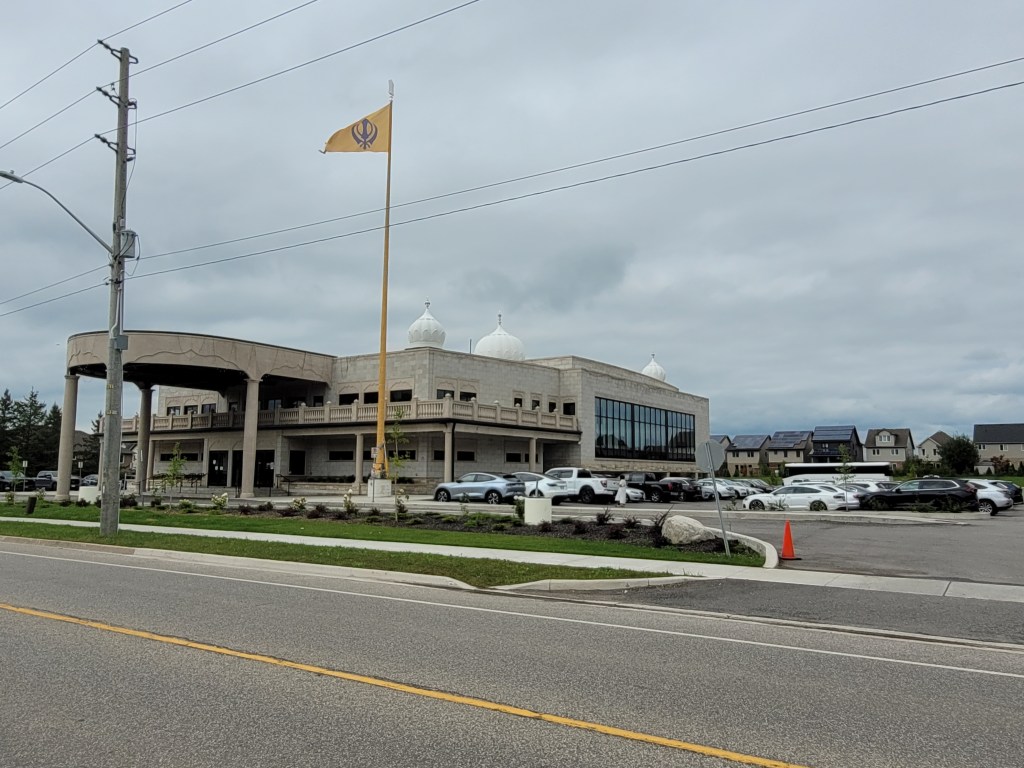
New gurudwara in Guelph. Ontario.
Student D: “My heart kind of broke for the people in those communities. Not because of a superiority that I believe I have the truth, but from a place that I want to see them come to know the Joy that I have in knowing Christ, and the Hope of future Glory rejoicing with my identity forever.”
Student E: “I felt a sense of sadness when I visited and saw many people bowing down and giving offerings to what I believe to be inanimate objects. I am confused as to why Hinduism has gods of war. Unlike Christianity the gods of Hinduism are not always filled with grace, mercy, and love, but as a religion of peace, why would Hindus ever worship a God of death?”
Student F: “This helped to change my view on other religions as I did not think that they would be welcoming. Instead, I feel as though I can have more conversations with people of different faiths in ways that are not arguing or aggressive, but that are constructing and helpful.”
Student G: “A meaningful learning moment for me in this class was the realization of how religion is so closely tied to culture in a way I took for granted, coming from the West. In Canada, to be Canadian does not mean one must be Christian, and I know this. However, when looking at religions like Islam, people believe in it because they are Muslim, because it is tied with their culture. This caused me to rethink my views on other religions by not disregarding them as evil things of the devil. This is crucial to do when interacting with people of different faith because faith is associated with their culture. Culture is identity, at least to some extent, and if religion is associated with culture, then by calling their faith evil, of the devil, or wrong, I’d also be calling their identity those things. One must be careful, humbler, and must be kind when engaging with people of different faiths.”
Student H: “I found that my sense of awe, and their deep sense of reverence brought me to worship more than I expected I would. I think that I will treasure that experience for a long time and will find new moments of insight in reflection on my experience at the synagogue and in this class.”
Student I: “My attitudes toward other religions have changed. I no longer see other religions as enemies or ‘dumb’ for not following God. My encounter with the Hindu temple showed me this as people truly believed what they worshiped. Therefore, mission cannot involve forcing people to come know God but inviting them to the table and alongside your own journey with God and hopeful through prayer and the Holy Spirit’s work they will see Jesus through me.”
Student J: “Other religions are much less forceful of their beliefs. I am specifically thinking about my visit to the Jewish synagogue and the Hindu temple. At both of these places, the message I received was that we are thankful you are here, just listen to what is being said. Whereas, within a conservative Christian church, I feel like the message if often directed as ‘If you don’t believe this, you will not receive this.’”
Student K: “Before this semester, I had most often looked at other religions as simply false and didn’t understand how people could believe in something that, to me, was so blatantly untrue. It’s easy to criticize or undermine a religion in a comfortable, classroom setting. I was somewhat shocked when I went to the Hindu temple and Jewish synagogue because the people became real to me. For the first time, I saw them as being the same as me, only not having the relationship with Jesus that I had. It was sad but also emphasized the importance of really getting to know people and learn their stories.”

The mosque behind my house is expanding their building prayer space.
Finally
Christians have been used to playing the host, but this exercise required they become a guest. We are familiar with the call to hospitality, but less so with the call to be guested. This is the legacy of Christendom. We are used to privilege and power.
At the centre of our faith is the story of God leaving his home in heaven and coming to earth in the person of Jesus Christ. Vulnerability and guesting is baked into our dearest convictions about what life is all about. God moves into our neighbourhood. This is important because in Canada today Christians are no longer the privileged, popular, and prestigious religious persons in town. That’s uncomfortable and maybe even scary. But God is bigger than our fears and even bigger than our limited understanding of our own faith. His goal is not to fix us with an unalterable faith but to realize our whole-hearted transformation. We should not measure our life by how unchanged it’s been but by how much it has been reconstructed through testing and trials. This experience could also help us empathize with the Christians who live in countries where Christianity is the minority, or even persecuted.
One way to grow is to visit your neighbour’s house of prayer and just sit and listen and observe. It may be a mirror to your own faith, and stir you to make a few adjustments. I have a friend who sets up tours of houses of prayer here (Encounter World Religions in Guelph). He says that contact with people of other faiths increases religious literacy and builds healthier organizations and neighbourhoods. It will also strengthen your own faith and help you see it more clearly. If such visits become seriously negative experiences, you can say you tested the project, and it failed. But my experience tells me that for 99 percent of students, it was something that blessed their Christian formation and stirred them to deeper understanding of God’s mission.
 Sensus Divinitatis
One thought on “Why Enter A Temple of Another Religion? Crossing the Threshold into Your Neighbour’s House of Prayer”