
Not that long ago church leaders were abuzz with Tod Bolsinger’s book Canoeing The Mountains: Christian Leadership in Uncharted Territory (IVP 2018). It is a helpful book that presses home our current ecclesial predicament. It is grounded in the parable of the historical figures of Lewis and Clark, who navigated American rivers their whole career, but then met with the mountains on the west coast. Canoes would no longer work. This was uncharted territory, off the proverbial map, and they needed a totally different approach. They needed a guide, and in this case it was an indigenous woman, Sacajawea who lead them over the topographic obstacle. Thus the subtitle of the book.

Post-COVID we are still meeting up with unexpected obstacles, and the need to radically change our way of operating as church. The old maps no longer work, and we are navigating unknown waters of Post-Christendom and some would say a Neo-paganism. That the church might learn from indigenous people is certainly a good thought, as our planet warms and burns. This is a significant theme in a book I am writing with Angela Bick just now on faith deconstruction. But Bolsinger’s book is addressed to church leaders in organizational management language with a missional theology. It is prescriptive, telling the old guard how to strategize, what to do to renew the church. He is trying to map what is off the map, while tapping into the frontier mythology of the Old West.
I like to think as a former campus minister and denominational leader who studied megachurches up close, I’ve done some ground-level fieldwork, talking to those for whom the old map is no longer working, and who have ventured a least a little off conventional topography. We recognize the map was never the territory. Maps are always provisional, for a time and purpose. Landscapes shift with time and human use. We see the empty pews and decreasing budgets. We know something is not working anymore.
Bolsinger’s canoe parable of the explorers Lewis and Clark resonates because we want to have hope. But where is that hope grounded? I wonder if it is still stuck in our own ingenuity and some aging metaphors that shape it. You see, it is an American frontier story with white men as the main characters, forging ahead to “discover” new lands. The story carries a colonial impetus, and it suggests the church is empowered and still bound to claim new territory, expand its boundaries, and gather in new peoples.
However, the church is no longer forging ahead, winning new ground, gathering in new peoples in the West. The era of the Church Growth Movement and its frontier vision may not have been a good strategy in the first place. We need a new parable without the colonial edge. We are not just facing mountains to conquer: we are lost in an ocean after being divided from our familiar places and the people we thought we would travel with together.
The church is not expanding its borders; it is in decline in the West.
The Other Side of the Globe
I wonder if a Canadian story, with a colonized child as the main character might prove a better parable. Perhaps a fictional story that draws us deeper into something true about being human, about the power of nature, and about faith and resilience in the face of profound devastation.
There is such a parable, and it is worth another look from this different angle.
In The Life of Pi by Yann Martel, the main character Pi is a deeply spiritual East Indian boy, and there are no white characters to be found. This boy grew up in India, where his father owned a zoo, but when they immigrate by boat to Canada–with many of their animals aboard–they meet with shipwreck in a storm. He is not an explorer boldly going where “no man has gone before” but rather a sole human survivor, a refugee, who has lost everything: his family, his home country, his own shelter and safety. The story is apocalyptic: a story about someone whose civilization has been vanquished, and he is lost on a life boat with companions he would not have chosen to travel with: a zebra, an orangutang, a hyena, and a Bengal tiger.
Google books records that this book was first published on September 11, 2001. That’s rather uncanny. The day many things fell apart for the West.
The book however is about the months after the disaster: how will they all survive? How will they cope with their incredible loss?
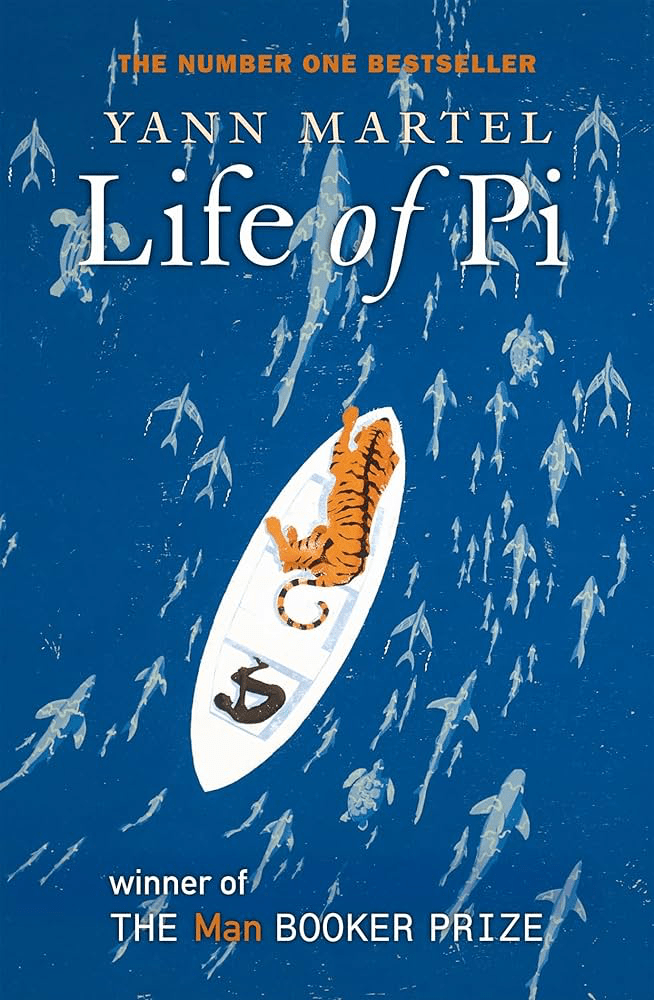
First of all, they have to confront the situation they find themselves in. One of the main antagonists is nature–the overpowering force of the waves, the sharks, and the sun. Yet nature also blesses them in miraculous ways–with fish to eat, rain to drink, and for Pi, a tiger named Richard Parker to protect him (at first) and inspire him (in the long days at sea).
Like the church today, he has experienced a profound loss: of privilege, power, and protection. The way forward is unclear, and he is tossed into the currents of the mighty Pacific Ocean with only wild beasts as his companions. He is a minority on the boat, and he must respect his fellow passengers. He must learn to live with them and get along.
As Canadian Christians, we are not just confronted with intimidating mountains; we are tossed upon the ocean waves of unprecedented change. This is not just a new frontier, it is an apocalypse. Pi is initially horribly depressed and homesick. He is at a loss in every sense of the word. Let me add here the fact that the main character is a racial minority (in the West!) is appropriate, as it is the Global South where the church is thriving and growing today. If we are white Christians, we need to see ourselves through the Other now. We are not erased, but decentred.
Incidentally, Yann Martel is white! This book is an exercise in seeing the world through a refugee from the Global South.
Reconciling Oneself
I want to draw attention to two other parts of the parable. The first is the necessity of dealing with disorientation and difference.
Pi has no choice but to give up and die or desperately come to terms with the situation he is in. At first he scans the horizon every minute, hoping for the quick rescue. Then its once an hour, and soon it is never. Then he gets to the work of survival, knowing he is in this for the long haul.
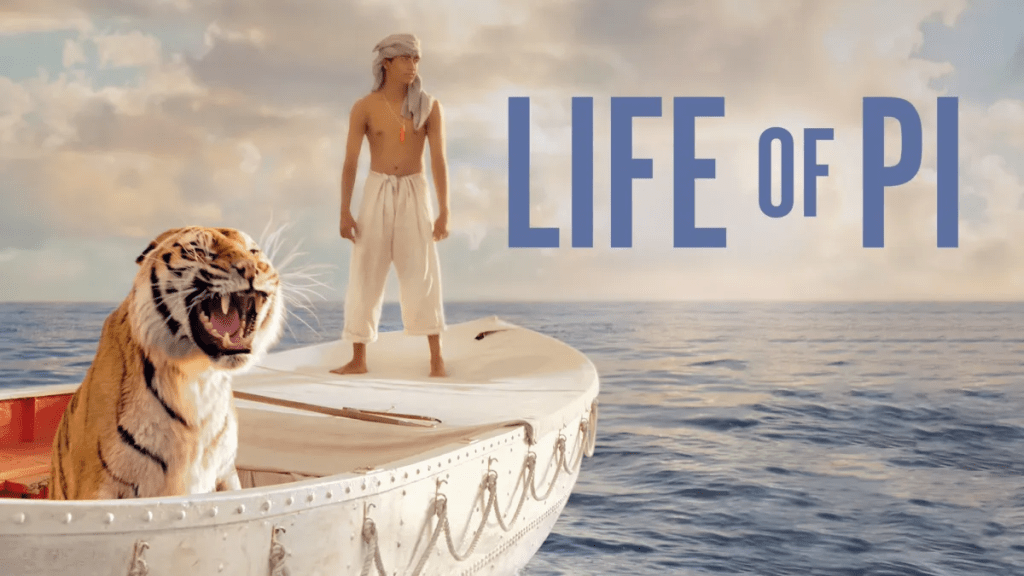
Pi has to reconcile not only with his unusual situation, but with other animals, and especially the giant Bengal tiger Richard Parker. Very soon, it is just two of them on one small lifeboat in a vast ocean, far from the security of land. They drift for 227 days, which is some sort of record (even if it is fiction!).
They can’t ignore each other: they work together, each necessary for the other’s survival. They never hug and become tame friends: they keep their distance, but with a working relationship in which Pi feeds Richard Parker and Richard Parker inspires Pi and keeps him sharp, wary, and hopeful. Near the end of the book (spoiler alert!) they part ways, and Richard Parker doesn’t even look back. They never see each other again.
Christians today have been handed by history a mixed legacy with festering wounds: between indigenous people and settlers, blacks and whites, science and religion, male and female, leaders and followers, and the planet and its people. We have been called by God to be “ambassadors of reconciliation” in a world where we are not the mediators but the culprits in many eyes. As with The Life of Pi, reconciliation does not guarantee an endearing friendship. But it does require encountering difference and coming to terms with it. It means allowing true, deep diversity to push and prod us in uncomfortable ways. Our current polarization could end in more brutal wars. It is a live option. The better alternative is that we may bless each other on our separate ways, knowing God is bigger than either of our worldviews or pathways.
Make Believe God
The other part of the parable I want to draw your attention to suggests there is hope for the church. To be sure, Pi is a Hindu, and his religious pluralism is uncomfortable for an orthodox Christian (The New Yorker called this part of the book “howlingly presumptuous and vapid”). But he is an advocate of Christianity in his own childlike way.
Here is a bold claim: Yan Martel’s book The Life of Pi promises the reader “a story that will make you believe in God.” Of course, no one can be made to believe in God; but you can “make believe God.” What I mean by that is since God is invisible, he can be imagined. Faith to a large degree is about imagination and that doesn’t mean what we imagine is unreal.
The book confronts the reader with a choice: is the book really about colourful wild animals in a boat like Noah, and magical islands that are themselves alive creatures, or is it about reductive scientific explanations of much more mundane things that have been erroneously embellished to be inspiring? The Japanese men who find Pi assume he is mistaken about the animals in the boat, and that the animals are in fact metaphors for humans that Pi’s psyche cannot reconcile in the face of tremendous violence and its resulting trauma.
Colourful wild animals and flying fish, or human selfishness in face of extinction? Which story do you prefer? In other words: you may embrace a story “that won’t surprise you. That will confirm what you already know. That won’t make you see higher or further or differently… a flat story. An immobile story… dry, yeastless factuality” (336). Or you can embrace a “better story.”
The book is quite adamant about this choice. The arts and religion point us to something that transcends the visible and measurable and enriches our life and relationships through symbols, story, music and ritual. Without the arts and spiritual practises, “we sacrifice our imagination on the altar of crude reality and we end up believing in nothing and having worthless dreams” (xi). Yet let’s not fool ourselves: if an encroaching reductive nihilism is sacrificing parts of ourselves on an altar, it is not so much science as an alternative religion.
This argument does not endorse some sort of dualism of art and science. Pi appreciates the sciences, as he delights in zoology. But he is also a deeply spiritual man, and for him religious boundaries are blurry in the way of the mystics. He is deeply critical of the agnostics. “Doubt is useful for awhile,” he writes. “We must all pass through the garden of Gethsemane. If Christ played with doubt, so must we. If Christ spent an anguished night in prayer, if He burst out from the Cross, ‘My God, my God, why have you forsaken me?’ then surely we are also permitted doubt. But we must move on. To choose doubt as a philosophy of life is akin to choosing immobility as a means of transportation.” (31)
So if life and our current historical moment can be seen through the metaphor of a journey, a journey by boat, we may be facing something on the level of a giant flood soon, a planetary catastrophe. Certainly at least the civilization Western Christians knew and ruled is vanishing, and we are now off the old maps. As Bolsinger says as he speaks of “canoeing the mountains”: “once we realize the losses won’t kill us, they can teach us.” (14)
We are not heroes canoeing the mountains but refugees after a great calamity, lost at sea. The good news is that both Pi and Richard Parker survive their ordeal. They have some gifts from the past that Pi retrieves from the boat that enable him to go on. He wholly depends on these artifacts in the same way the Western church must retrieve its best practises for the current moment of fragmentation and decline.
An apocalypse is both destruction and revelation, and we must face this moment with both realism and hope. Disorientation, deconstruction, and disillusionment, yes; but also resilience, ingenuity, and faith. This is not the simple faith that we have before the experience of complexity and utter disaster; it is the simple faith that comes after the disaster and persists, come what may.
I’ve read this book to my kids, and they delight in it. The movie is second best (2012). In an era of impending doom, this book is a parable of hope and faith. And the sensus divinitatis, the title of this blog.
 Sensus Divinitatis
Thank you for this very profound take on where the church in the west now finds itself. I really appreciate the Spirit in which it is written.
LikeLike
Peter, thank you for parting some of the fog so we can see our current state of religion/faith/culture/struggle. Without seeing, we cannot find a way. Though like Pi sometimes we might only be able to see in our own boat and survive the best we can, feed and be fed, by our fellow passengers. I might note that Pi is not a racial minority in the world sense. Whites account for around 10%. East and South Asians around 60%. We have been wearing some strange glasses.
LikeLike