
Soon I will be flying across the planet to Korea, to be part of a global mission congress called Lausanne 4, and I feel a certain tension. The day I fly out is the same day my new co-authored book comes out on Amazon—Blessed are the Undone: Testimonies of the Quiet Deconstruction of Faith in Canada (New Leaf Press). Here is the tension: publishing a book on deconstructed faith while participating in a global conference on cultivating faith.
Is the tension real? In one sense, Lausanne should be global enough to encompass the dying of Christendom in the West. It should be a gathering where we can be honest about failure, lament where the church is shrinking, and still celebrate where fresh faith is being found. In fact, the best dreams we have may arise from the ashes of what is broken, bruised, and bent.
We shall see. Maybe this tension doesn’t need to be resolved, but kept taut, so that some creative response might arise from the discomfort. While the church is exploding in the Global South, all is not well in the West. So the West is not the centre of the global church now—it is ironically now marginal, even if leaders and resources often still come from the West. We are not the Majority World.

Other issues may be more important than those we face here in Canada; this may be an opportunity to listen. Will the focus include the hopes and fears of the persecuted church in China and many Islamic countries? Will we address the distortions of the prosperity gospel in global Pentecostalism and the abuses of celebrity pastors? What about the promise and peril of AI, or the looming threat of climate change? How does Christian mission address the mental health crisis, shifts in sexual ethics, the proliferation of cell phones and social media, and the huge issues surrounding war, migration, and refugees?
50th Anniversary of Lausanne
To be realistic, this conference is not trying to address every global issue. It has been traditionally focused on the matters of evangelism, discipleship, and social action and they will function best if they keep within the boundaries of their objectives. Consider that Christianity has not grown on the planet in the last 100 years: we have remained at 33 percent of the total population. How best to steward what we have been given?
This year marks the 50th anniversary Lausanne, which launched in Lausanne, Switzerland in 1974 at the prompting of the American preacher Billy Graham and the British theologian John Stott. At that time 2700 people from 150 countries convened to explore the state of world evangelization, what TIME magazine dubbed “possibly the widest-ranging meeting of Christians ever held.” To be clear, Catholics, Orthodox, and mainline Christians are not included. Evangelicals form only about 15 percent of Christians worldwide, and they can be a diverse bunch of Baptists, Pentecostals, Reformed, and Missionary Alliance, etc., but they are not even a third of global Christianity.
The motivation for the original meeting was said to be that too many churches, leaders, and organizations were working apart from each other, and the gathering was to facilitate better coordinated efforts. They fostered a particular spirit, described as one of “humility, friendship, prayer, and partnership” and they say that spirit lives on.
One of the most significant results of the congress was the Lausanne Covenant, a statement that has become a key identifier of evangelical unity around Christian confessions while also celebrating cultural diversity as part of God’s plan for the global church. Avoiding comments on evolution, gender roles, or baptism, it focuses on the theme of “the whole Church taking the whole gospel to the whole world.” So the document is not a creed—a statement of belief—as much as it is a pledge focused on something that must be done.
Key to the Covenant was its conviction that the “whole gospel” includes both social action and teaching about the way of Jesus. “Integral mission” has been the language that the conference has used through the decades, keeping “word and deed” together as Jesus did.
The Lausanne Covenant was “seeking an expansive community across differences,” wrote S. Joshua Swamidass in Christianity Today the summer of 2024. Against the modernists, but not quite satisfying the inerrantists, it uses the language of Scripture as being “without error in all that it affirms.” Like the progressives, it states Christianity has social responsibility, pressing for liberation, reconciliation, and justice. It declares the inherent dignity of each person, all made in the image of God, “regardless of race, religion, colour, culture, class, sex or age.” While also declaring that political liberation is not salvation, it insists that Christian must “spread righteousness in the midst of an unrighteous world” because “faith without deeds is dead.”
Additionally, Swamidass writes that the covenant turns its attention toward non-Western Christians. “We rejoice that a new missionary era has dawned. The dominant role of western missions is fast disappearing,” declares the covenant. “The responsibility to evangelize belongs to the whole body of Christ.” So those who can afford larger fees at the Seoul conference are offsetting costs for those who have less resources to draw from. The privilege of my attendance at this conference was not cheap!
While deft in its ability to bring evangelicals of different convictions and nationalities together, the document also sets up boundaries. Liberal traditions and other religions are clearly out-of-bounds as it maintains: “we reject as derogatory to Christ and the gospel every kind of syncretism and dialogue which implies Christ speaks equally through all religions and ideologies.” Jesus is the only mediator to God, it insists, which does not “affirm that all religions offer salvation in Christ.”
Other Lausannes
There have been two Lausannes since the first, one in Manila, Philippines in 1989 and one in Cape Town, South Africa in 2010, each in dialogue with the last and with their own strengths and weaknesses worth investigation. Seoul hopes to have 40 percent of delegates being under 40, and 40 percent being women.
| Year | Location | Attendees | Countries | Virtual Participants |
| 1974 | Lausanne, Switzerland | 2700 | 150 | – |
| 1989 | Manila, Philippines | 4300 | 173 | – |
| 2010 | Cape Town, South Africa | 4000 | 198 | hundreds |
| 2024 | Seoul, Korea | 5000 | ? | 5000 |
It is important to understand that Lausanne is not trying to be its own organization, but rather the catalyzer and facilitator for Christian ministries. Still, it does have a staff and structure. The Lausanne Movement is led by a global polycentric team including the executive leadership team and global executive director named Dr. Michael Oh, a Korean American educated in the US and who served as a missionary in Japan for 12 years. Lausanne has its own regional networks and national committees, including Lausanne Canada, which is directed by people like Dr. Robert Cousins and Joel Zantingh.
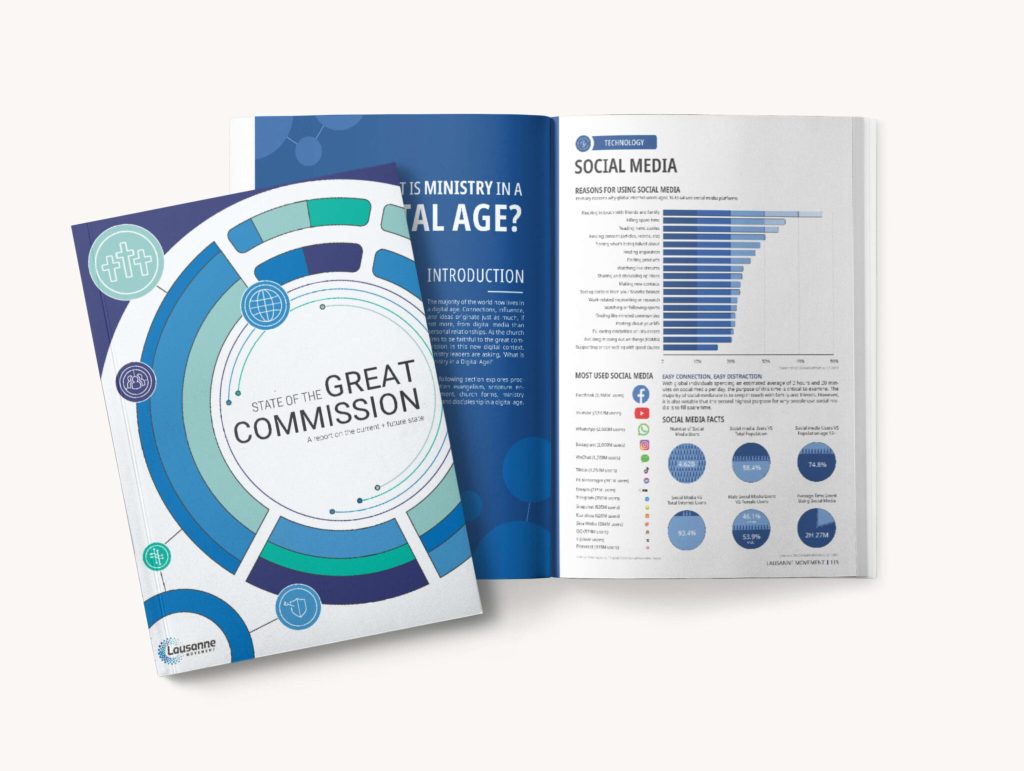
In preparation for the congress, a team of researchers released a study of global trends called The State of the Great Commission. It identifies 25 gaps in mission, like the new middle class, Islam, the next generation, narcissistic leadership, on-line communities, and social trust in the church. The congress will divide people up according to which gaps they are most interested in collaborating around, and half of the conference will be working in small groups to address those gaps together.
“Lausanne is a place of convening for listening together in humility to the Spirit of God,” says Joel Zantingh, Director of Engagement for Lausanne Canada. We shall see how that plays out from Sept. 22-28 in Korea. I hope to report back in good time on what transpires.

 Sensus Divinitatis
So exciting that you’re going to the Lausanne Conference, Peter! As someone who was deeply influenced by John Stott as a young Christian, Lausanne always has a dear place in my heart.
And NB, Stott was of course an Anglican evangelical, that mix that often seems odd to N. Americans but is still completely normal in the UK– and even for some of us in N. America! So, when you say “mainline Christians are not included,” I’m delighted to say that’s not altogether accurate…! 🙂
Blessings, Deborah.
LikeLike
Yes, I suppose if they are evangelical mainline folks, they will be included and present! The World Council of Churches tends to represent the bulk of mainline churches…
LikeLike
Interesting observation, Peter. Hope to comverse with you at the congress. See you in Incheon. Greetings from the Philippines!
LikeLike