
“Mentoring is a sacred trust,” said Luis Palau, an Argentinian-American evangelist. Especially when long distances divide mentors and mentees, trust is especially sacred and potentially precarious.
One of the things I do is connect people to the global network of Christian scholars that I know through my work with Global Scholars Canada. If you want a mentor in auto mechanics, there are probably a dozen in your own neighbourhood. But if you are looking for a Christian mentor in say, bio-chemical medical research in oncology, there might only be a few on the planet that would fill a role like that.
AI generated image…

In what follows below, you can see a case study unfolding between an experienced Christian oncologist and bio-medical ethicist and a PhD student in bio-chemistry. I got both their permission for this post, but took the names out of the mentee and mentor just to give them some measure of confidentiality. Still, all the names and books mentioned are real people who are working in the field.
Note how the mentor invited the student into foundational questions of the discipline, connected her with key figures in the field, with conferences and guilds and special programs, and provided encouragement at every step of the way. Sure the student has a PhD supervisor already, and other leaders in the field and lab that have given her helpful advice. But this relationship has enfolded the interdisciplinary nature of any Christian’s academic development: between Christian philosophy, theology, ethics, and the discipline in question.
I was just so impressed with the quality of this mentoring that I thought I would post it for all to see. I wish I had a mentor like this for my PhD. I also wish every PhD could have a mentor like this. It would enrich, stabilize and help set trajectory for any academic vocation.
Here is a short response from the PhD student: “My mentor testifies to God’s power and faithfulness in fulfilling the adventurous desires of individuals who are passionate about science and the Kingdom of God. His humility, compassion and integrity in Christ also set an excellent model of success for me. I thank God for his wisdom and his generosity to share it with me.”
Thank God for good mentors!
- At our first meeting in March 2022, we introduced our interests and life path thus far. Talked about importance of common grace (God’s goodness that persists in a people and cultures) in working in the natural sciences and in medicine.
- I mentioned recent book by Matthew Kaemingk entitled Reformed Public Theology: A Global Vision for Life in the World and my review of the book in Ethics in Conversation, summer 2022, a publication of the Kirby Laing Centre for Public Theology.
- Read and discussed sections of Wisdom and Wonder: Common Grace in Science and Art by Abraham Kuyper. Focused on excellent introduction by Vincente Bacote, at Wheaton College and Part 1: Science. Concentrated on sections on Wisdom, Knowledge, and Understanding and less intensely on section on Sin and Education.

- Recommended Creation Regained: Biblical Basics for the Reformational Worldview by Albert M. Wolters (2nd ed., Grand Rapids: Eerdmans, 2005) to get a ground-level exposure to basis of Dooyeweerd’s Reformational philosophy in distinguishing structure and direction in understanding our world and our role in it as Christians. I touched on the irreducible modal aspects as a core framework of the structure component and stressed that the establishment of various sciences have been distinguished by the core meaning of each modal aspect. (For more information on “modal aspects” see the work of Dutch philosopher Herman Dooyeweerd. Fundamentally, it takes God’s word in creation as foundational to all disciplines).
- In the first 6 months since we first connected in March, I sent her a number of articles to review and discussion on the controversies over the misuse of gene editing, particularly with CRISPR, written by Christian and non-Christian biologists and sociologists. Of 9 articles sent, a few of these included:
- CRISPR Democracy: Gene Editing and the Need for Inclusive Deliberation by Jasanoff, Hurlbut, and Saha about previously poor models and the need for better models for governing newly emerging gene-editing technologies. Also A Global Observatory for Gene Editing by Jasanoff and Hurlbut, calling for an international network of scholars and organizations to support a new kind of global conversation about the appropriate application of gene editing.Comment: Science Can’t Solve It by D. Sarewitz. Nature 2015, 552:414.Geneva Statement on Heritable Human Genome Editing: The Need for Course Correction. Trends in Biotechnology 2020, 38:351
- These articles were chosen to give her a sense of the international struggle in trying to give guidance to the development and implementation of gene editing technologies that are both ethically and socially for human good. A common thread was the need to diversify the leadership of such developments and take it out of the hands of only scientists themselves.
- Discussed two articles on the need to ‘slow science’ progress for more intentional societal reflection on its development and use (Religion and Public Reason in the Politics of Biotechnology by Ben Hurlbut, Notre Dame Journal of Law, Ethics, and Public Policy2015, 29:101).
- Introduced her to ASA / CSCA (American Scientific Association and Canadian Scientific and Christian Affiliation) and reviewed my article in the PSCF on Covenantal Ethics in medicine and went through my path of learning and developing a Christian perspective for medicine. (https://network.asa3.org/default.aspx).
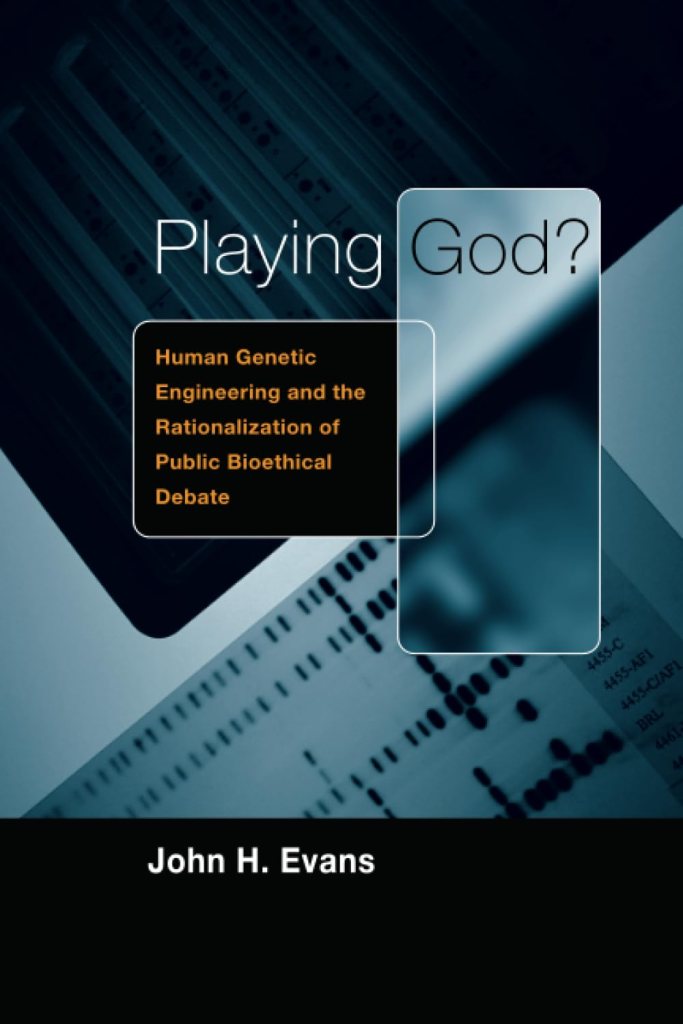
- In the late summer and fall of 2022, we talked about several articles including a Society of Christian Ethics special symposium held in 2002 about the book Playing God? Human Genetic Engineering and the Rationalization of Public Bioethical Debate by John H. Evans, sociologist from UCSD (Journal of the Society of Christian Ethics, Spring/Summer 2004, Vol. 24, No. 1 (Spring/Summer 2004), pp. 183-217)). Participants included Stanley Hauerwas, Gil Meilaender, James Childress, Jeffery Stout, and introduced by John Berkman, professor of ethics at Regis College, U of Toronto, friend and colleague of mine during my PhD studies. Excellent symposium on how scholars from theology and philosophy in bioethics critiqued a sociologist (daring to cast a critical eye on their turf!) and how Evans humbly but thoughtfully responded. Also sent article by Richard Gunton (A General Theory of Objectivity: Contributions from the Reformational Philosophy Tradition, published in Foundations of Science, 2021)) and an excellent exploration of objectivity for Christians. Richard was supported by the Kirby Laing Centre and I got to know him through my visit at the West Yorkshire School of Christian Studies in Leeds in 2011, just after my PhD defense at Trinity College, U. of Bristol, UK. I sent three other articles as references to the student mentee but didn’t discuss.
- In 2023, I recommended Bioethics: A Primer for Christians by Gil Meilaender which she read. We discussed sections on clinical research and ethics.
- At the same time, a new certificate program was offered at McGill in Translational Research. After discussing the courses, I encouraged her to apply if she had the time. She was admitted to the program and we discussed various issues that came up in the program over the next 9 months or so. I personally know one of the contributors to the program. Eric Meslin produced some very good work while at Indiana University and is now in Ottawa in a research administrative position. I think the program will give her a good foundation in understanding clinical research that evolves from the kind of basic science research she is doing for her PhD.
At various times we discussed ethical issues regarding clinical research and her interactions with her professors and fellow students. I brought my work as medical officer and reviewer of new cancer biologics at Health Canada for concrete examples of ethical issues relating to pharmaceutical companies, clinical investigators, and regulators.
- I helped the mentee develop an abstract for the ASA conference in the summer of 2023. It was accepted and she felt it was a good experience for presenting her work to a Christian science audience and sharing with them her developing Christian perspective on her work and the natural sciences as a whole. Her presentation was very well received.
- At the end of 2023 I sent her a link to a symposium sponsored by The Hastings Center, an influential center begun by Daniel Calahan in the late 60s at Georgetown U. It included a series of linked articles on the need to develop more trust in science (https://onlinelibrary-wiley-com.libaccess.lib.mcmaster.ca/toc/1552146x/2023/53/S2.) The article covers a wide range of perspectives including those of Christians from Duke and Gordon College.
- Spring 2024 – knowing that the mentee is nearing the end of her PhD program, is not interested in a post-doc or lab career at this point, and is looking for where the Lord is leading her, I suggested that she speak to a friend and colleague of mine, Heather Zeiger. Heather is co-editor of a book on Overtreatment of the Frail Elderly, to which I am contributing a chapter on the contribution of regulatory medicine to this problem. Heather has an MS in chemistry with an emphasis on organic synthesis and material science. However, she works as a free-lance science writer with a focus on technology, medicine, science, ethics, and culture. She is on the staff of Dignitas, journal of the Center for Bioethics and Human Dignity at Trinity International University as well as a research analyst for the Center. I linked her up with the student, with the hope that the student can learn from her as to how Heather has used her advanced science background to communicate how her faith and science intersect and how she has developed a Christian perspective for the natural sciences. I’ve suggested that she discuss her interests with Heather and particularly her interest in communicating the application of science to the public and the Church.
- I met a graduate student at our local church who is originally from Nigeria, and is currently in his second year of PhD in Health Science and Education at McGill. His wife is a pharmacy assistant. I mentioned the student and asked him if he was interested in meeting her virtually about her work in developing a Christian perspective for the natural sciences and translational research. Since he was interested in meeting her, as was the student, I passed in contact information to both. While he is able to reside in our city at this stage of this PhD work, the student does go to McGill for various meetings and the hope is that they can be mutually helpful in their efforts to grow and mature in their Christian perspective and perhaps in securing leadership positions.
- I planned to attend the student’s graduation from her translational research program at the end of May. However, she notified me just before the date that the university has delayed participation in the ceremony for her and others who completed the program due to an administrative problem. She expects to formally participate in a graduation ceremony at a later date.
- I hope to continue to help the student in whatever way I can as she prepares for her thesis defense and completion of her degree program. I met with her on June 12 of this year at her request to discuss some thoughts she has had about future study after her PhD is completed. While she had previously felt that she did not want to apply for medical school as well as not apply for a post-doctoral position, she recently visited Harvard University and met with some who worked at the Dana Farber Cancer Center. After engaging with students in doctoral and post-doctoral programs in areas similar to her own research, she is now realizing that she would like to do post-doctoral research that allows interaction with patients as she has done with her PhD work but primarily engage in post-doctoral lab research rather than study to become a clinician. I think it was a productive discussion and I offered my time and support to discuss these issues further. Completion of her PhD requirements must now be her focus.
- I hope that we can continue contact after her graduation and follow her vocational path as the Lord leads her with our help.

 Sensus Divinitatis