
“We have this hope as an anchor for the soul,” says Hebrews 6:19, resting on God’s covenantal promises. Hope is not certainty, but a leaning into the future with a deep sense of trust. Such trust allows for a baseline of expectation–that despite disease, decay, and death, ultimately “All shall be well, and all shall be well, and all manner of thing shall be well” as Julian of Norwich wrote.
The bible has a very simple narrative arc that nurtures such a hope: creation, fall, and redemption. Such a trajectory corresponds with the emotions of wonder, heartbreak, and finally, hope. I’ve come up with three simple prayers that further correspond with those three movements of the soul:
Wow.
Oh no.
Yay!
What I want to do is use this simple three-part structure of history, with its corresponding human emotions, and our prayers to reflect on 2024. My emphasis, however, will be on the third movement–hope.
I. Wonder or “Wow.“
The “good” and “very good” that God built into creation gives birth to wonder. In 2024, there remains much evidence of beauty, magnificence, daring, or exceptional performance that puts us in a state of awe or astonishment.
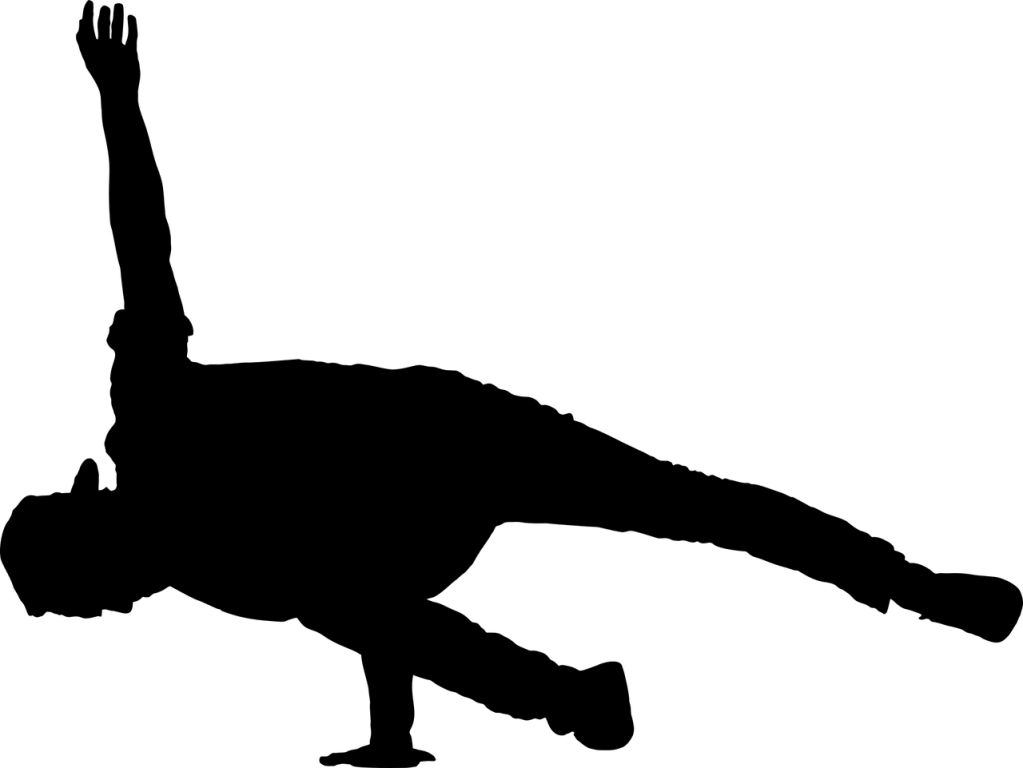
Recall the 2024 Olympics in Paris, a display of exceptional skill and athleticism. I’ll only mention the gold medal of Canada’s Philip Kim, the first person to ever win in Olympic breakdancing–a spectacular display of twists, spins, and contortions that elicit the response: “Can the human body do that?” You can see why the word “break” is in breakdancing.

We also cannot forget the total solar eclipse on April 8th. The world ran out of protective glasses as everything paused, including some school closures, to see the sun disappear at midday. We were surprised as neighbours and strangers came together to bear witness to this rare astronomical event.
Sports, the starry sky above, and high-tech. The liabilities of artificial intelligence are vast, especially for educators like myself, but the speed, volume of analysis, and applications are rather stunning. Exposition, pictures, photographs, sounds, music–the things that AI can do are endless. The implications for deceit, cheating, and mistakes are also awe-inspiring, although toward the awful, rather than the awesome.
Rich or poor, wonder is forever available to us all. St. Augustine said in his Confessions that “People travel to wonder at the height of mountains, at the huge waves of the seas, at the long course of the rivers, at the vast compass of the ocean, at the circular motion of the stars, and yet they pass by themselves without wondering.” And we might add, we pass by our neighbours, friends, and spouses, too.
II. Lament or Heartbreak: “Oh No.”
The Scriptures shift from the “good” and “very good” of creation to the corruption that comes with the “Fall”–the condition by which sin, brokenness, and failure and its accompanying heartbreak taint all things to some degree.
The floods, fires, and droughts this year remind us that the creation groans, and calls for our attention and care. It seems there is less snow in my hometown every year. And more ticks every spring.
I hardly need mention the places of conflict and war, which loom large in the news and in our consciousness. It is hard to forget how easily our moral compass can be lost and the most brutal of acts can become part of our daily list of things to do. We know about Gaza, Lebanon, Syria, and Ukraine, but there are many more that do not make the news. The mass shootings, too, continue to shock us despite their regularity in the news.

Then we just heard of the Jeju Air crash in South Korea, killing 179 people. Horrific.
How would you summarize 2024? One angle is to find one word that encapsulates it. Merriam-Webster Dictionary’s word for the year is “polarization.”
You may have noticed the election this past November in the world’s superpower to the south of us. Without saying anything about the controversial candidate or the oligarchy that is forming the next government, it was evidence of a horribly polarized nation, torn by culture war. Some of that polarization exists in Canada, too, even though we have more than two parties and a multicultural mosaic rather than a cultural-political binary.

To come a little closer to home for some Christians, without commenting directly on sexual ethics, the consequences of decisions made this year by denominations like my own (the Christian Reformed Church in North America) with regard to the meaning of marriage have divided many in the church. The ways in which the decisions are being implemented has divided congregations, divided families, and have even left many people feeling torn up inside. You could say: Undone.
Church should be a place open to lament, like we see in the Bible itself, especially the Psalms. People need to complain, cry out, and express their hurt. Yet there is a hope that can be the deep “anchor for the soul” even in the storm of polarization. In Hebrews 6, the foundation of that hope is the life, death, and resurrection of Christ, whose kingdom makes all things new. This is the promise of redemption.
III. Hope or “Yay!”
I had a world religions professor come as a guest to my world religions class this past semester, a friend who does not share my Christian faith. My students asked him, “What do you see as distinctive about Christianity in the midst of the diversity of religions?” he responded by saying that more than any other religion, Christianity, with its story of the life and death of the Messiah opening a way of truth and grace, offers an exceptional hope.
In fact, to start off the year with good ecumenical relations, I will note that Pope Francis himself has declared the year 2025 to be the opportunity to become “pilgrims of hope.” He urged such pilgrims “to silence the sounds of arms and overcome divisions” and “tear down all walls of separation,” mentioning specifically children in war zones, the elderly trapped in solitude, those cut off from their homelands, and those imprisoned for their faith. The theme of hope, he said, includes “recovering lost hope, renewing that hope in our hearts, and to sowing seeds of hope amid the bleakness of our time and our world.”
In the clutter of stories of doom and depression, we usually don’t hear the good news of hope. We don’t know that this past year Egypt eliminated malaria from the country through vaccinations, or that Jordan did the same for leprosy. We don’t hear that solar power is developing at an “unprecedented rate” or that the drive to electric vehicles is sweeping the planet. You probably didn’t hear about the huge shift in deforestation in the Amazon, where companies are rushing to buy up land with reforestation potential. Reports say the Brazilian government has helped decrease deforestation in the Amazon by over 30 percent.

If that is not enough good news, CBC featured the founder of fixthenews.com, where reporting on positive change is the goal of the website and podcast. Here you find that “hope is a verb” and “the end of inevitability.” Now much of this may be a deep faith in human ingenuity, but people of faith can see God’s promises coming through positive human initiatives, too. God’s common grace preserves the world for the good of all creatures great and small.
Hope is what animates my local congregation and its Clothing Closet, which made CBC news this year. It is what motivated my daughter to help clean a neighbourhood in Winnipeg with our church youth group. It is also what drives Global Scholars Canada, Redeemer University, Tyndale University, and Christian Courier–all organizations I work for in some manner. Hope comes in all these sorts of everyday ordinary packages.
Hope in Broken Things
If I would share one thing I’ve learned about in the last year, it would be the Japanese art of kintsugi, something I learned about through Japanese Christian artist Makoto Fujimura when he came to speak at Redeemer University. This is the art of mending broken pottery or chinaware with a special golden glue so that even the jagged imperfections become beautiful.
Fujimura said this shows “a new creation is breaking through,” because “New Creation fills in the cracks and fissures of our broken, splintered lives, and a golden light shines through, even if only for a moment, reminding us of the abundance of the world that God created, and that God is yet to create through us.”
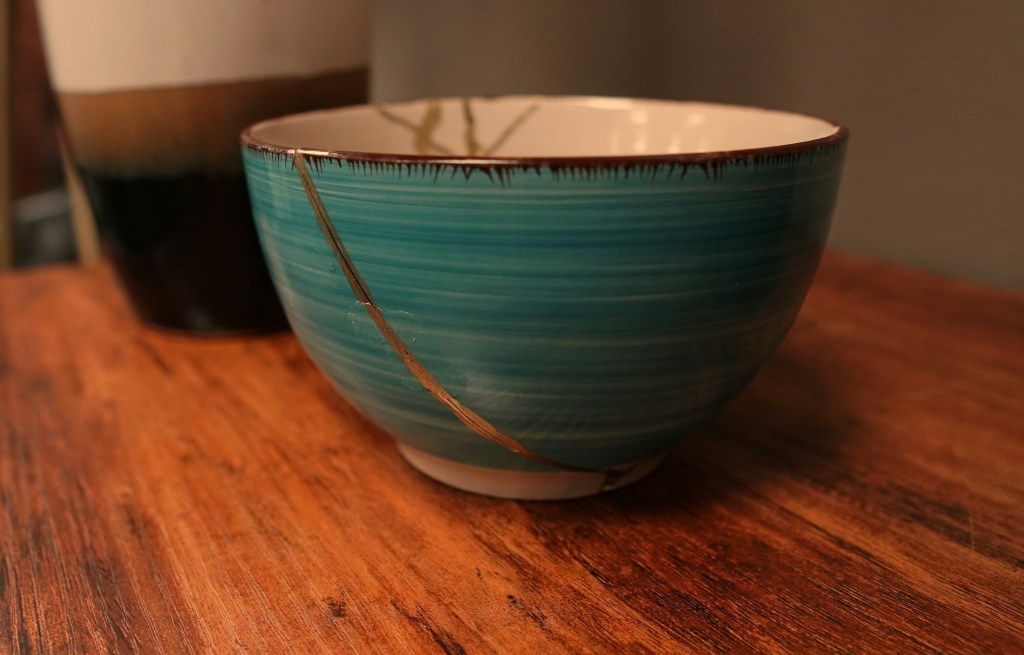
Makoto and his wife Shim spoke of the practice of “beholding” in the process, which means the shattered pieces are not immediately put back together again. You have to sit with the shards and let them speak to you. This is not just artwork, it is heartwork that addresses the broken parts of the artist’s life. Some keep the broken pieces for years or generations before they start the repair. Anger, bitterness, pain – they swirl and eventually settle inside the artist like poured wine. “Hold the fragments until the fragments become beautiful,” they said. “The mended bowl will be more valuable than the original.”
This is the testimony of faith: in a fragmented world, even when polarization escalates, God picks up the pieces.
Here is something to rely on: God’s covenant with us stretches across the panorama of history, and echoes of creation, fall, and redemption continue to reverberate. One way to see redemption, is to see it not as perfection, but as working well with the pieces. Our hope is not a different creation, but a renewed creation, a creation reconciled, as the prophets foretold.
I’m looking ahead to 2025, with this kind of hope as an anchor for the soul.
 Sensus Divinitatis