
“Closeness to people who are different from you – in disability, in worldview, in faith, in any of the myriad of ways that humans are different – teaches you things you could not learn otherwise.”
- Andrew Barron, Human Difference: Reflections on a life in Proximity to Disability
This book review was written by a guest blogger, Sara Pot. Influenced by her family’s journey through both the hospital and pediatric rehabilitation systems with two of their four children, Sara is involved with training and developing patient & family engagement strategies in health research and health practice. Much of her work is with RareKids-CAN, Canada’s newest paediatric rare disease clinical trials and treatment network and CanChild Centre for Childhood Disability Research’s Family Engagement in Research course instruction. Sara’s personal and professional experiences provide both the push and the possibility for her writing on faith, disability & belonging with the Christian Courier. You can find her writings here.
In his newly published work, Barron shares warm, personal stories of learning from and loving his son Rafi, born with Down syndrome. His experience as a father understanding his son’s difference pushes him to wonder about our own differences and mutual dependence. Interchanging the terms difference and disability, Barron explores how they shape our perception of various aspects of life, including the body, time, hospitality, and sexuality. The questions Barron asks about how his son Rafi views time, love, and others all resonate with me, as a parent of two children with a developmental disability.
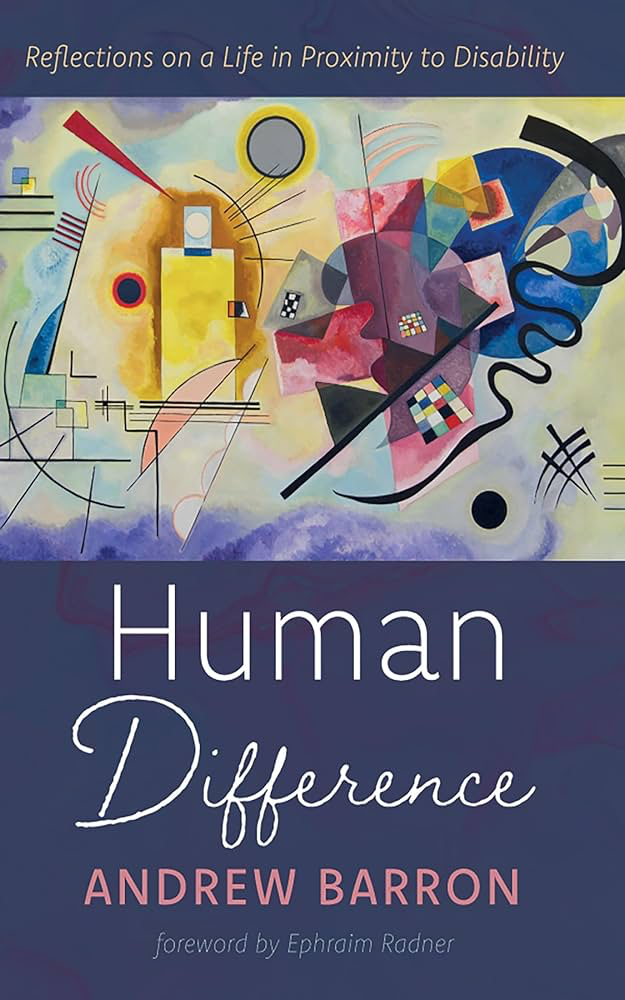
The book reads at a gentle, meandering pace, following Barron’s wonderings and reflections. Using examples from Scripture, he highlights both the contextual and cultural influences on difference, from Old Testament to New Testament, and its impact on faith and belief in the modern world. His first chapter opens with encouraging words from Maimonides, Mishneh Torah, Laws of Blessings, 10:12, and he ends by challenging the reader to think about humanity’s definition of normality in light of the Creator’s intentional design.
It’s not a book that precisely defines disability nor offers a fulsome description of disability. Barron’s use of disability is specific to his son’s diagnosis of Down syndrome, a developmental disability. At times, he overgeneralizes with reflections such as
“People with disabilities do not cry out for power or success; their energies are used for seeking out the warmth of relationships.”
I’d be curious to know what disability advocates such as Emily Ladau or Amy Kenny would say in response. Much of what we access today in terms of resources and services for children and adults who are disabled is because of the incredible effort and energy directed at capturing the attention of leadership and influencing policymakers. (Elsewhere in the book, Barron offers gratitude for the work that was done ahead of Rafi through disability advocacy to create opportunities for individuals like his son, so I wonder if he were to rethink his statement, he might reword his reflection.)
Yet, his overall perspective of disability and difference adheres to a welcomed approach, hinting at what the World Health Organization defines in the International Classification of Functioning, Disability and Health. Instead of trying to fix people, we ought to embrace and accept each other, as we are, focusing on addressing external factors that can support full participation in life. I particularly enjoyed Barron’s recollection (and quiet rebuke) of an interaction with an ER doc about an ear infection who listed Rafi’s diagnosis as “one of the things wrong.”

Barron writes, “Being close to people and their specific situations engages all our reasoning and demands the courage to listen to people in their unique physical, social, emotional, and economic sufferings.” I appreciate this reflection and would emphasize the phrase demands the courage to listen. Proximity is not the guaranteed single solution to better understanding each other and, in some cases, has been the very fuel for pushing people apart. Proximity for some families whose children with developmental disabilities that include unfamiliar behaviours and exhausting support has led to isolation from families and friends. Barron’s reflections on difference with sexuality and gender remind me of how many individuals who identify as queer have been pushed away and even hated by the very people who ought to have remained close, such as their parents.
A few years ago, our local library began lending out telescopes during the summer. Our oldest was eager to explore the sky with the borrowed lens, zooming in on breathtaking views of the sky, still-faraway planets and constellations. I wonder if we have the same sense of awe with viewing the universe when we turn and look around at each other. With Barron’s book, we are invited to see proximity as a gift that impacts our perspective – and with courage, helps us see more clearly the beautiful and intentional design of our diverse created world.
Afterthought: If you want to read more about disability, difference, and caregiving, Barron references a number of books in his text. Furthermore, I would suggest My Body is Not a Prayer Request by Amy Kenny, Formed Together: Mystery, Narrative and Virtue in Christian Caregiving by Keith Dow, and Demystifying Disability: What to Know, What to Say and How to Be an Ally by Emily Ladau.

 Sensus Divinitatis