

“The writing of many books there is no end,” said the tired Preacher in the book of Ecclesiastes. While writing books is an intense task and if you notice the long list of thanks in every acknowledgements section at the front of books, you’ll know the Preacher’s feelings come from honest experience. But for book lovers and people passionate about the world of education and education around the world, this making of many books can actually be something to applaud. There is always more to learn! Students will always have something to read and guide them in faith and service! May the making of books never end!

We had an enjoyable evening on February 6th–a feast of scholarship and of cheesecake and chocolate to celebrate the moment! Taking place in the sanctuary of Faith Baptist Church Oakville (and online!), it was a chance to celebrate God’s grace in our 3 decades of mission in higher education, and to do so by showcasing some recent publications from our own people from Global Scholars Canada. The crowd was some 3 dozen folk, with another 25 online—enough to make good conversation on faith and scholarship.
The table was set: six courses of scholars’ books to share thoughtfully together. Each subtitle below features another recent book mentioned at the anniversary evening.
Elmer Thiessen, Healthy Christian Minds
I started by introducing a book written by a friend that just so perfectly fit the occasion. Elmer Theissen (who was going to attend but then was unable to come) wrote the book entitled Healthy Christian Minds: A Biblical, Practical, and Sometimes Philosophical Exploration of Intellectual Virtues and Vices just out with Cascade books this past fall.

He writes: “We are facing a crisis today, a crisis in the way we relate to each other in the realm of ideas” (140). It is an urgent situation: “In a world where there is growing fragmentation and polarization, where sloganeering and demonization dominate our discourse, we need to think more carefully about intellectual virtues and vices” (27).
Thiessen’s book goes on to implore us with a Biblical call to love knowledge and embrace truth, to think with a deep humility, and a combination of commitment and openness, and finally, to practise forbearance with ideas we find repugnant, to be fairminded in characterizing the ideas of others, and to foster intellectual courage to speak up in the face of opposition and hostility to our Christian worldview and practise.
It is a short and practical book much in need today, in our age of post-truth, echo chambers, fake news, identity politics, cancel culture, and alternative facts. He quotes Alan Jacobs as saying the central problem of our day is “a settled determination to avoid thinking.” We too quickly take sides, follow the algorithms, and wave a flag. Thinking, says Jacobs, is “the power to be finely aware and richly responsible.” That means discerning rather than just “liking” on Facebook.
Dr. Harry Fernhout, our former board chair and former Executive Director, then gave a brief history and record of our contextualized strategy through the years. He showed how our work began, and how it has shifted and diversified as needs arose. Describing the work of many of our past and present scholars, he unveiled a small but very nimble organization that has enabled many academics to flourish in faithful work in higher education.
Rudy Wiebe and Robert Lillo, A Greek Grammar for Africans
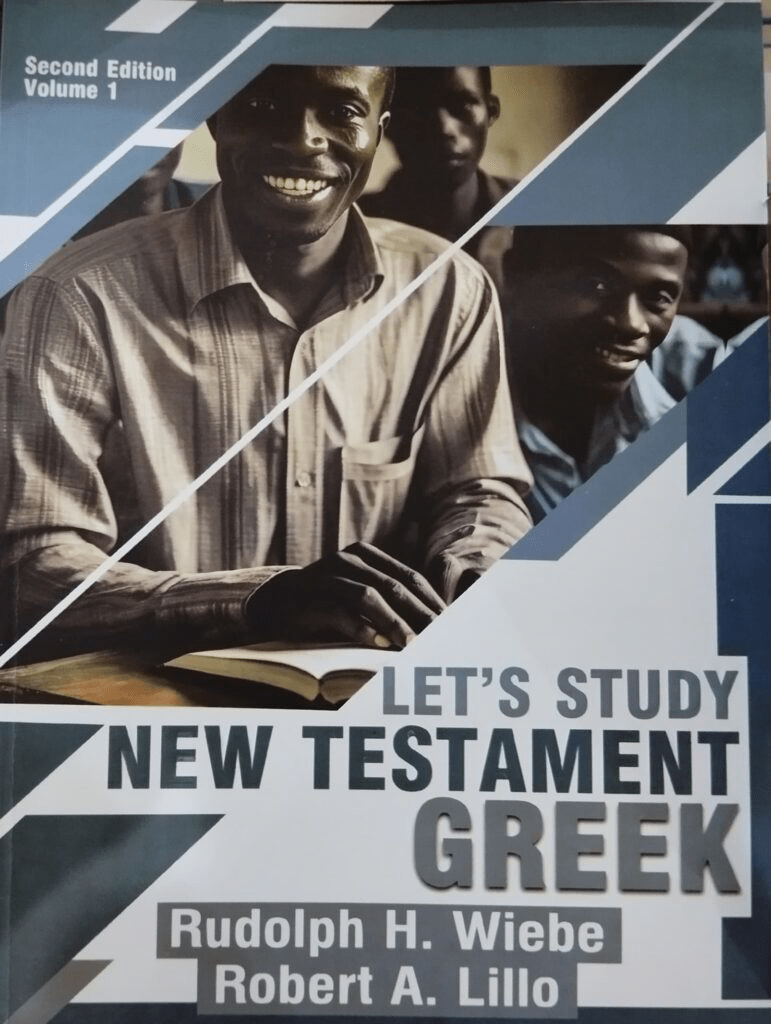
Then Robert Lillo Zoomed in from Minnesota to describe the journey that he and Rudy Weibe traveled to bring a series of Greek Grammars to African seminary students—study guides that fit their context and their need. He explained the vital importance of good Bible translation for the hundreds of African tribes, sharing how a poor translation of a verb can lead to news that “the farmer died after coming to faith” instead of “while dying, the farmer came to faith.” Rob continued the work that our late GSC scholar Rudy began with him (Rudy died in November 2022).
We then received greetings by Zoom from our partner Global Scholars USA. Dr. Keith Campbell is the Vice-President of this agency, and reminded us to see our work in the terms of passing faith down the generations, an apt comment following on our mention of the late Rudy Wiebe. He then said a prayer for our continued work.
David Koyzis, Citizenship without Illusions

Dr. David Koyzis then described his book. Citizenship is more than voting during elections, he insisted. But can Christians participate in public life without getting caught up in various ideologies—which become forms of idolatry? In his new book, Citizenship without Illusions: A Christian Guide to Political Engagement (IVP 2024) David writes, “A strong sense of loyalty to a political community is needed if citizens are to fulfill willingly the responsibilities that accompany citizenship. Citizenship is not only about rights and the protection of those rights. Any membership comes with a set of responsibilities for the community of which you are a part.”
In this practical guide that includes examples from around the world, David shows how Christians can faithfully work for the common good without compromising their commitment to God’s kingdom. In fact, he insists, citizenship is one of the offices that Christians are called to fulfill as faithful servants of God.
Andrew Barron, Human Difference and Disability

“Different is normal,” pronounced Dr. Andrew Barron when it was his turn to talk about his recent book Human Difference: Reflections on a Life in Proximity to Disability (Wipf & Stock 2024). Both a personal story and a theological analysis, Andrew’s book meditates on living with his son Rafi, who has Down syndrome, and the differences that come with that intimate relationship. Difference, he insists, is a construction that we fill with various meanings, from those that stigmatize to those that romanticize. His concern is to see difference as “central to God’s heart” and as a call to a deeper sense of human dignity. In just over 100 pages he explores this difference in our bodies, in our perception of time, in our sense of belonging, and in sex, suffering, and death—all with reference to Rafi. “Rafi is the ongoing source of my ethics and sense of responsibility,” he concludes. This different vision requires some proximity to difference—a proximity we must both notice and seek.
We then called a break and shuffled into the church hallway. Our administrator Dr. Brenda Goranson set the table perfectly for our event–with a decor that was befitting of our guests, our anniversary, and our mission. It was compete with book displays, 30th anniversary toothpicks, and even special academic loot bags to take home. The pièce de resistance was the varieties of cheesecake, including cheesecake cupcakes on layers of silver serving trays.
Michael Wagenman, The Power of the Church
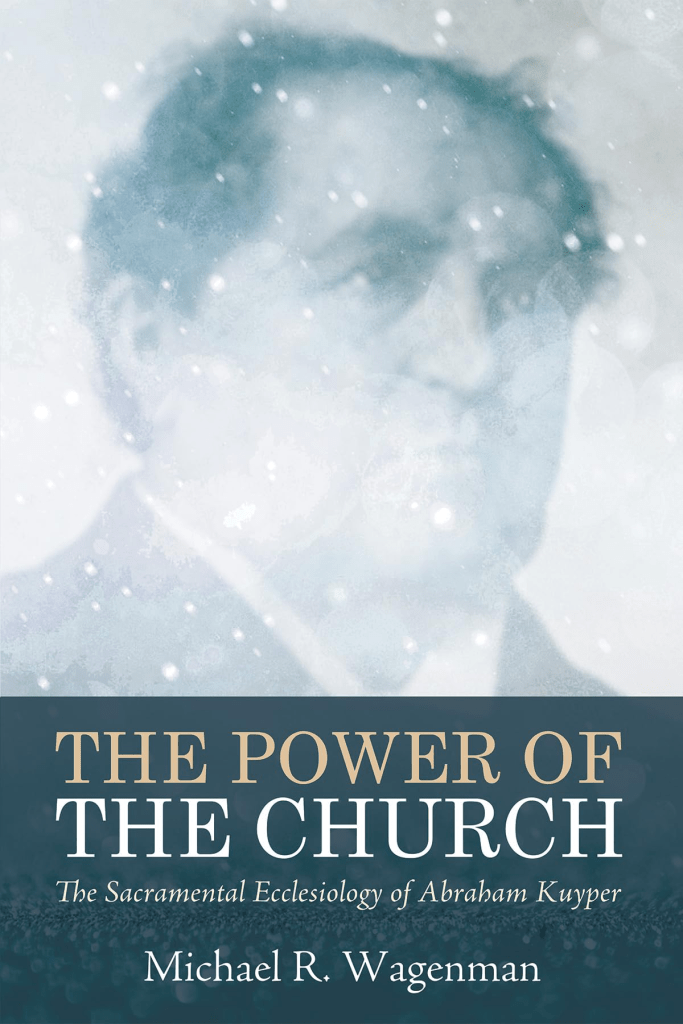
Dr. Wagenman was unable to make the event at the last moment, but we read a section of his book to those gathered. “What power does the Christian Church have left in a largely post-Christian culture?” he asks in The Power of the Church: The Sacramental Ecclesiology of Abraham Kuyper (Pickwick 2020). While in our current age power is seen primarily in a negative light—primarily as abuse or oppression—Michael demonstrates such does not negate the proper use of power.
He examines the thought of Dutch theologian and Prime Minister Abraham Kuyper to demonstrate that as a social institution and cultural force, the church has constructive offerings to bring to public life. “Failures of ecclesial power are due to failures of theology,” writes Michael. Unlike most discussions on the subject today, “Kuyper has a uniquely positive and constructive view of power.”
Peter Schuurman, Blessed are the Undone

I was the last to speak, and explained that my book, co-authored by Christian Courier editor Angela Bick, was all about the spiritual stories of Canadians. “Christianity is going to die completely,” said one disillusioned Christian, “unless we wake up to the harm we caused and try to find our way back.”
The percentage of Canadians self-identifying as Christian has been plummeting since the 1970s—from 90 percent in 1971 to half that number today. Of late some Christians say they are “deconstructing their faith”—a trend that is especially popular online. Angela and I interviewed 28 such Canadians for our book Blessed are the Undone: Testimonies of the Quiet Deconstruction of Faith in Canada (New Leaf 2024). Using a canoe trip as an analogy for the faith journey, we explain how humans set up camp (construction), break camp (deconstruction) and move camp (reconstruction) as a normal part of growing up in faith. To quote Ecclesiastes again, “There is a time to tear down, and a time to build up.”
The book then unveils the stories of Canadian Christians and what sort of things they are deconstructing today, and where hope might lie for reconstruction. A significant theme in the book is how much of what is being deconstructed is “made in America” and we call Canadians to imagine more localized and contextualized Christian ministry for the future. Deconstruction need not be the destruction of faith; it can be a life-giving transformation to a more authentic witness.
Spurs to Action
One theme of the evening was the range of the Christian’s call: to faithful citizenship, disability awareness, critical power analysis, and understanding sociological research in light of the evolving religious landscape. Life before the face of God is not always simple, but that also offers more for us to discover and learn.
The evening ended with Wendy and Adrian Helleman offering some GSC stories, a prayer for all our scholars, and a blessing. In the prayer, Wendy remembered all our scholars across the planet and the challenges they were facing, some rather serious. Adrian’s blessing took into account the height and breadth and depth of scholarly work done before the face of God.
“The event certainly felt like a ‘feast’ for Christian scholars,” remarked the GSC Board Chair Gang Li, professor of leadership at TWU, “filled with deep wisdom and insight from the presenters. It was not only inspiring but also a beautiful reminder of why we do what we do at Global Scholars Canada. Seeing so many voices come together in celebration of God’s work through academic mission was uplifting and deeply encouraging. Our God is indeed good and great!”
Thanks to all who came out to honour these scholars and thank God for three decades of passing on faith to student leaders who serve with wisdom and joy in the making of many books. While it is true that any task can seem “meaningless” and vain, for nothing is ours to keep forever, the irony of the Preacher’s weariness about books in Ecclesiastes is that such sobering wisdom comes to us in nothing less than a book! Everything has a season, and there is a goodness that things offer in their season.
And hopefully, books spur us to action, to social change, and global blessing.
“The wise man’s words are like goads that spur to action. They nail down important truths. Students are wise who master what their teachers tell them.” Ecclesiastes 12:11 (TLB)
 Sensus Divinitatis
One thought on “A Small Feast of Scholarly Work Celebrating 30 Years of Global Scholars Canada”