

GUEST BLOG: This blog was written by Dr. Justin Cooper, former President of Redeemer University (1994-2010) and former Executive Director of Christian Higher Education Canada. He also served on the board of Global Scholars Canada, Trinity Christian College board, Langham Partnership Canada board, and the boards of many other Christian organizations. He lives in Ancaster, Ontario, with his wife Jessie.
What a privilege to be able to celebrate and thank the Lord for the life and work of Dr. Calvin Seerveld, the humble son of a fishmonger from Long Island NY, whom the Lord gifted and raised up as a prophetic voice in our time. I’m sharing my tribute today as one of the many students whose lives, vocations and outlook were deeply shaped during his 13 years at Trinity Christian College.
As new students arriving in 1968, we encountered returning students anxious to tell us how Dr. Seerveld’s Intro to Philosophy course would be challenging, but also a life changing part of our first year. And so it was. Philosophy 101, led by this earnest professor in his rumpled tan corduroy suit jacket was indeed gripping, as Dr Seerveld led us on a journey that was not just intellectual, but one that touched our hearts and souls.
An inspiring teacher, he introduced us to a Biblical world and life view that came alive from notes scribbled with fountain pen on the back of recycled mimeos. He used visual illustrations with uniquely crafted names like God’s “cosmonomic theatre” with Christ’s redemptive work as its centre-piece and the “tin-can man,” later paired with the tin-can woman at the urging of his daughter, Anya, to convey the spiritual core and multi-dimensionality of human life.
The cosmic scope of Christ’s saving work opened before us, as he gave us tools of analysis and discernment and challenged us to new obedience and cultural engagement as disciples of Christ. He also stressed that this was a world and life view, foundational not just for academic learning, but also for our future vocations and for the God-ordained richness of daily life.
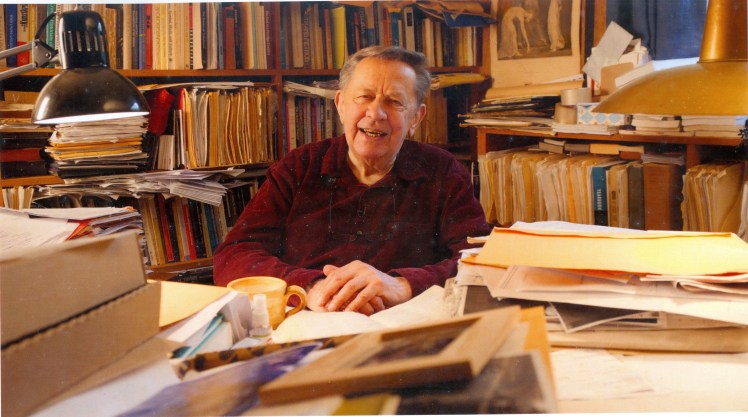
What made his teaching so powerful was his deep faith and devotion to God’s Word. The perspective he taught us was infused with a keen awareness that the Bible is the living Word of God, something he experienced as a graduate student in Basel while wrestling in prayer with Romans 8. His monthly meditations in chapel amplified this, as overflow crowds of students gathered to hear him read and expound on a Scripture passage freshly translated from Hebrew or Greek in his expressive phrasing. Scripture reading was always prefaced by reminding us that we were listening to the God-breathed Word of the Lord, kneeling as it were in his very presence.
We thank God that Dr. Seerveld not only spoke to us in lectures and chapels, but also modeled for us faithful Christian living with his humble and caring demeanor. He would sometimes ask to work on a student’s question before answering it in the next class! Though more of a private person, he opened his home to students for class tutorials in the basement den. He also demonstrated what a public and corporate Christian witness looked like: a dramatic presentation of The Greatest Song, performed by Trinity students; Social Action Seminars at Trinity to foster dialogue on public issues; and launching a Christian Institute of Art.

These efforts were always couched in Biblical wisdom, as he reminded us to do the hard work of sifting wheat from chaff in any school of thought and to be aware of the limits of Christian insight that could also become misguided by sin. Our task was to raise “signposts,” seeking to witness to God’s grace and renewal rather than trying to usher in a Christian utopia.
This was brought home vividly at our graduation breakfast in 1972 as he spoke about King Josiah, who led the greatest revival and reformation in the history of Judah. God sent his prophet to encourage him to carry on, with the promise that Judah’s decline and eventual captivity would still come, but not in his lifetime. As Dr. Seerveld himself also experienced, our best efforts are provisional in the wider perspective of the coming fullness of God’s Kingdom.
46 years later in 2018, he joined many of us at an Ontario Trinity Reunion. He and Ines blessed us with a booklet of the addresses he had continued to give at Trinity over the years, including the heartfelt meditation he delivered that evening, again with a freshly translated Scripture passage as his focus. He concluded, voice cracking, with a final farewell, acknowledging that they would not see most of us again on this earth.
Some of us were in touch with him occasionally or received notes sent in his trademark recycled envelopes and special stamps. Now God has taken Cal home where he is at peace, having heard his “welcome, good and faithful servant.” We are blessed to be able to give thanks to God for his life of service. We are also challenged to carry on his legacy.
Trinity and Redeemer
I’m sharing these additional reflections as someone who taught and gave leadership at Redeemer University, the other undergraduate Christian institution with whom Dr. Calvin Seerveld developed a lasting relationship over the last 35 years of his life. Having also studied with him at Trinity Christian College, I bring a unique perspective, bookends of his career as it were, leading up to the donation of his (and Ines’s) art collection to Trinity and the gifting of his personal library to Redeemer, when ICS was unable to provide a suitable home for it.

It is noteworthy that both Trinity and Redeemer were founded in the Reformed Christian tradition and based on a Biblical world and life view. Both institutions had founding faculty that gave this perspective a Neo-Calvinist flavour, which in turn generated debates about the institutional place, particularly of Dooyeweerdian philosophy. Nevertheless, both developed not on the basis of a philosophical orthodoxy, but rather as a “Kuyperian neighbourhood,” taking seriously the claims of Christ’s redemption and Lordship over all of creation, culture and scholarship. At bottom, I believe this ended up being an important factor in the relationship that Dr. Seerveld eventually developed with both, though not without a hiatus in the case of Trinity.
As I continued my studies in Trinity’s core curriculum and beyond, I began to experience this perspective in various expressions from the different professors who taught me. They were not all Dooyeweerdians, but they were committed to the integration of faith and learning in general and also taking seriously the Lordship of Christ over all of life. In my philosophy major at Trinity, I also saw more of the depth of Dr. Seerveld’s scholarship as he led us through various philosophy courses, using his historiographic approach to the history of philosophy as a framework. As Trinity decided to expand the curriculum from a two- to a four-year program, another dimension came to the fore in the philosophy program. First one, and then a second, instructor were hired to cover the additional courses required, both of whom had some familiarity with Dooyeweerd’s philosophy.
We, as students, were not aware of all the tensions with the Trinity Board that led to its official decision about not having a single philosophy be dominant at Trinity or how that related to Dr. Seerveld’s decision to leave. But as I have learned of this more recently, I’m left wondering if the decision was related to the profile of the Philosophy faculty or with that of the Trinity faculty in general or both. Regardless of what occurred, in the decades that followed, Trinity maintained its character of being a Kuyperian neighbourhood that included faculty who sought to work out of a Biblical worldview with a Neo-Calvinist flavour, honouring the Lordship of Christ over all things.
In God’s providence, the graduate-level position that Dr. Seerveld took up as a Senior Member at the ICS provided him with the context that allowed him to shift his focus to more specialized teaching and scholarship in the areas of a Christian approach to aesthetics and art history, which were his real strengths along with Biblical interpretation, and to make the major contribution in both popular and scholarly writing that has become his legacy.
Redeemer Connections
Meanwhile, as Redeemer University, then College, was developing in Ontario around 1980 there were parallels to Trinity, except that Redeemer was not based on the three Forms of Unity. Its basis was in Scripture and Scriptural principles for education which were Reformed Christian (not denominational) that were to be given expression in a Biblical perspective, or worldview, by faculty members. This perspective tended to take on a Neo-Calvinist flavour, since a number of the original faculty members, including myself, were familiar with this tradition and Dooyeweerd in particular. But Redeemer was not wedded to any specific philosophical system.
Interestingly, it was Dr. Al Wolters who, as an original member of the Redeemer Board, helped to shape this approach at Redeemer. And perhaps somewhat ironically, he had also been selected to be the successor to Dr. Seerveld at Trinity, although this didn’t work out because of immigration issues. He ended up instead being hired by the Institute for Christian Studies, where he became one of Dr. Seerveld’s colleagues until 1984, when he shifted his scholarly focus to Biblical Studies and became a member of Redeemer’s faculty.
Thus Redeemer also developed, though not without issues and discussions about the unofficial role of Neo-Calvinism in hiring, as an institution committed to being a “Kuyperian neighbourhood.” As an example of this, a Dooyeweerd Centre for the translation of his philosophical works was established, but that was alongside a Pascal Centre for the study of the role of belief in science again maintaining a range of approaches. A variety of faculty were also hired, some with a Neo-Calvinist bent and others who took other approaches to relating faith to learning and making explicit the claims of Christ over all areas of life. It was in part through these hiring processes in which I was involved as Vice-President (Academic), as well as our faculty discussions, that the notion of being what I called a Kuyperian neighbourhood became clearer to me, something I also articulated in my Presidential interview in 1994.
As a four-year liberal arts and sciences institution, majors in art, music and theatre were also developing. And through the faculty that were hired, links to Dr. Seerveld began to develop, as I note below, even as his ties to Trinity were strengthening around the same time. Perhaps my role in leadership helped in building this trust, together with another of his former students, Dr. Jacob Ellens, who also later served as Vice-President (Academic). I also studied at the ICS under Dr. Bernard Zylstra (at the time when Dr Seerveld also arrived). Later as President, my interactions with Trinity and its faculty began to develop, and I was asked to speak to the Trinity faculty about Redeemer’s approach to relating a Biblical worldview to learning. In this context, my reference to Redeemer’s functioning as a Kuyperian neighbourhood was well received. When I joined the Trinity Board in 2016 and had further opportunity to interact with faculty members, it was clear that this approach continued to be a reality.
As stated above, Dr. Seerveld’s relationship to Redeemer began to grow in a variety of ways. He and Redeemer art professor, Dr. Mary Leigh Morbey knew one another, and through this he was invited as a speaker at Redeemer various times. Former Trinity student, Dr. Thea Van Til Rusthoven, who also stayed in touch with Dr. Seerveld, was appointed as a professor of French. In addition, a retrospective exhibition of the works of Henk Krijger (formerly at the Institute for Christian Art in Chicago and then Patmos) took place at Redeemer and included some art from the collection of the ICS. This relationship with Dr. Seerveld continued when Dr. Chris Cuthill, who was his last doctoral student at ICS, was appointed as an art professor at Redeemer. The productions of The Greatest Song and also Eccelsiastes both came to Redeemer/Hamilton as well, with the cooperation of Redeemer theatre professor, Ray Louter.

Thus with his position as Senior Member at the ICS, Dr. Seerveld had interactions not only with Trinity, but also with Redeemer, which cemented a level of respect and trust that eventually led to the significant donations to each institution. And in the case of Redeemer, his library will be housed in the same special collections room as that of his former colleague, Dr. Al Wolters, whose leadership at Redeemer was recognized in the naming of its Centre for Christian Scholarship after him. The conjunction at Redeemer of the libraries of these two Reformed Christian scholars is very fitting, as Redeemer seeks to be an institution that promotes not only undergraduate (and soon some graduate-level) teaching, but also serious academic scholarship based on a Biblical worldview, which is their shared legacy.
 Sensus Divinitatis