
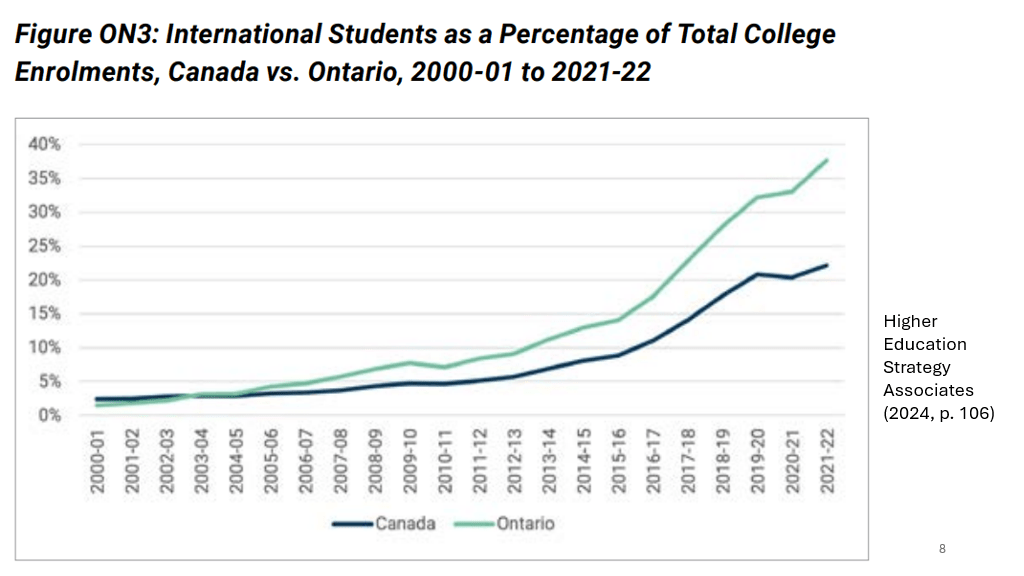
International students make up 30% of Canada’s enrolment in colleges and universities – a share higher than any other hosting countries in the world (The Institute of International Education, 2023). This surge in students from abroad has created a complex of crises in Canada, triggering a largely negative response from the Canadian public and significant policy shifts from the Canadian government.
On a Friday evening, November 14, 2025, Global Scholars Canada hosted its 3rd Annual Word & World Symposium at Knox Presbyterian Church, Toronto entitled “The Crisis of International Students in Canada and Christ’s Call to Peacemaking.” Past symposiums investigated the religious aspects of the war in Ukraine, the rise of the Christian faith in Chinese universities, and multiple books recently published by GSC scholars. This year we thought it appropriate to attend to a growing public issue related to our globalized universities, and to do so from an intentionally Christian perspective.
The hybrid event was co-sponsored by the Canadian Scientific and Christian Affiliation (CSCA), Christian Reformed Campus Ministry at University of Toronto, The Missions Hub & Knox Church’s University & Young Adult Ministry. Leaders from the Intervarsity Christian Fellowship international student ministry at U of T were also supportive in the event.
We offered a primer to our symposium here by Dr. Gang Li, that lays out some basic issues. But in our symposium, we built from this introduction. One question raised was this: are international students a crisis, or do they present Canadians with an opportunity? Specifically, is there an opportunity here to serve, to learn, and to make peace in our troubled world?
50 Years of Student Exchange: Dr. Ruth Hayhoe
“As the international student movement launched in the 1970s, it espoused United Nations values of equity, autonomy, solidarity, and participation,” said the first panelist, Dr. Ruth Hayhoe, Professor in the Ontario Institute for Studies in Education (University of Toronto) and a GSC board member. Decades ago Canadian institutions invested in international students as a means of providing educational support—with scholarships and institutional partnerships. There was an idealism that motivated these exchanges in their genesis in the 1970s.
Hayhoe herself was involved in these partnerships with China, and said they were characterized by collaborative research, genuine exchange, and “strong positive feelings” that resulted in the development of some key leaders in China’s educational system. She has worked with numerous international students over the years and written extensively about the promise of comparative education (see for eg. “Lessons from the Legacy of Canada-China University Linkages,” Frontiers of Education in China, May 2013, 8(1): 78–102).

She contrasted that pioneering experience with the current neo-liberal industry of international students in Canada, where tuitions are extremely high and support and care are limited. She ended by noting the vicissitudes of visa provision and how geo-politics affect such vital aspects of international student experience.
She has urged educational leaders in the past, writing “Where there is no vision, the people perish” (Proverbs 29:18). Demonstrating her commitment to reciprocal global education, she adds a similar proverb from Confucius: “The master focuses on what is fundamental, and the way grows once the foundation is established” (君子务本, 本立而道生, Analects 1:2).
Intensification of Institutional Procedures: Yixin Jiang
“Canada’s international education policy is shifting in a new direction,” explained Yixin Jiang, PhD Candidate at OISE and International Student Immigration Advisor at the University of Toronto. Her perspective is shaped by her own experience as an international student at U of T from 2015 to 2017 – a journey that inspired her passion for supporting others and her research on the professionalization of this role across national contexts.
Yixin outlined the complex relationships international students must navigate: provincial Attestation Letters (PALs), federal study and work permits, university admissions and funding, and permanent residency pathways. Since 2023, IRCC has introduced major changes – verification systems, enrollment caps, and new restrictions that add layers of paperwork. “The new government direction seeks to restrict entry and tighten eligibility for international students,” she noted.
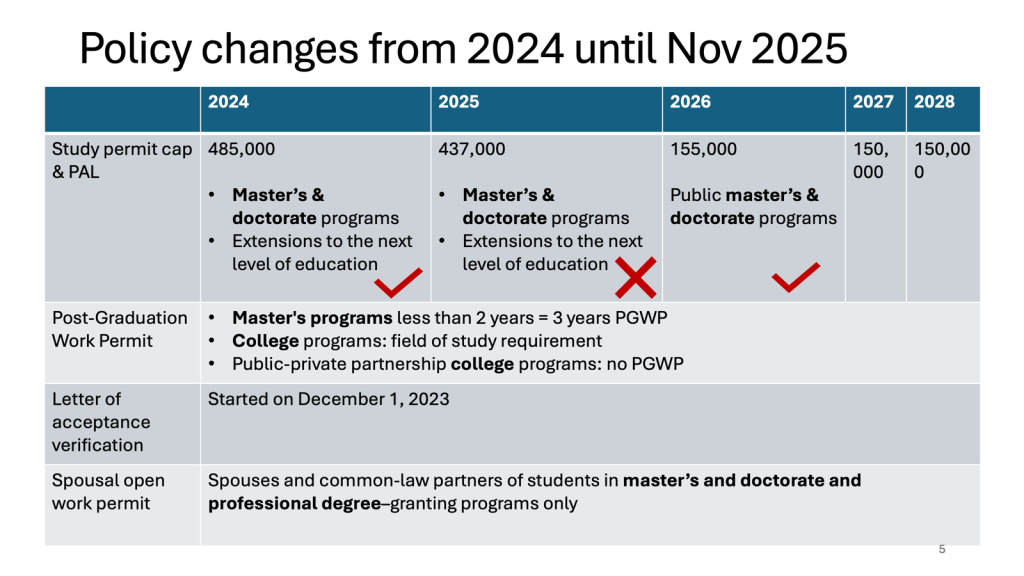
She presented data showing how declining provincial funding has made Ontario’s institutions increasingly reliant on international student fees. Recent caps have triggered layoffs and program cuts, making headlines in the Fall 2025.
Limited PAL allocations have pushed some colleges to purchase private immigration advising services to boost approval rates, signaling a trend toward privatizing student services and raising accountability concerns. The cap also affects returning students whose permits expire abroad, creating dilemmas over PAL distribution: Should weaker applications be supported, or should PALs be reserved for those most likely to succeed? These policies have shifted institutions from their academic role toward immigration gatekeeping, introducing fairness concerns and compliance burdens they were never designed to manage.
Yixin reminded the audience that during COVID, IRCC allowed international students to work full-time in frontline jobs – contributing not only tuition dollars but their labor and lives to Canada. She ended with a call for compassion and fairness: “We should advocate for the unseen, the unheard, and the underprivileged.”
A Personal Story: Isaac Bekoe from Ghana
Next we had an international student share his personal story. Isaac Kofi Bekoe is currently a Master of Arts student in Economics at the University of Waterloo, and holds a Masters in Philosophy in Finance from the University of Ghana. He is the first in his family to pursue graduate education and he used all his personal savings (6 years of work) to get to Canada. When he arrived, he realized he didn’t have enough to cover the basics of food and shelter and took out a $13,000 (US) loan. At the same time, his family was expecting him to send money home from his new found land of plenty.
“Some international student debts can take a lifetime to pay back after you go home,” he added.
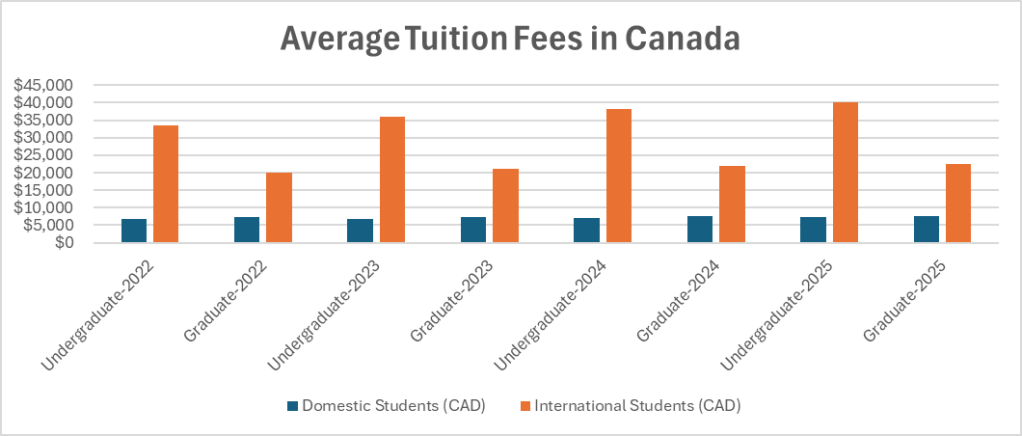
His research shows that while domestic tuition rates have increased by 15 percent in the last four years, international student rates have increased by 24 percent, and now international students pay up to 5 or 6 times the amount of domestic students. Often these are students coming from much poorer countries than Canada.
On a more personal level, he said social life in Ghana is very relational, warm, open, and friendly. By contrast, he found people in Toronto to be very individualistic and private; he didn’t see anyone from neighbouring apartments until six months after his arrival. He spent Christmas alone for the first time in his life, and he said “the isolation is very emotionally heavy” for him. As a Christian, he testified that he has found comfort in God’s presence, and he urges international students to keep their faith alive. He asks Canadians, and especially Christians, to foster places of welcome and belonging, and so be peace-makers for the world.
Mental Health and Mental Illness: JesusMiracle Chiadika
This personal story segued nicely into a presentation from JesusMiracle Chiadika on mental health and international education. “Mental illness actually refers to an inability to function over a prolonged period of time,” she explained. JesusMiracle is a PhD Candidate (OISE), and Regional Lead (Health Employment), International Research Officer at the Office of the Vice-President International, University of Toronto. Her research is directly in the area of mental health and education. “Mental illness is the leading cause of disability worldwide,” she began, “and in Canada, 1 in 2 persons will have or have had a mental illness by age 40.”

She then explained that while universities offer a full-range of support services, students who are struggling—even with such serious issues as self-harm or suicide—often do not take advantage of such resources. Often there is stigma attached to mental illness and the reality is that not all cultures are equally literate in acknowledging mental health issues. She explained how often international students who are racialized on campus, and while struggling with financial, academic, and communication issues, feel the tremendous pressure often expressed as “You need to be amazing; failure is not an option.” This is more than many can bear alone.
“Then imagine being admitted into a psychiatric hospital where you don’t know anyone,” JesusMiracle invited the audience. “You have to figure out where to get your medication, you don’t know how to navigate the system, and you have to get your groceries, do all the things, and of course, stay on top of your academics.”
“There are a lot of diverse languages, including from my own background,” she added, “that don’t even have a word for mental health.” JesusMiracle is Nigerian-Canadian, and while English is her first language, she also speaks Yoruba.

Since the onset of most major mental health issues begins in the age range of 15 to 24, and the support networks for international students are often meagre, international students are very vulnerable to challenges with their mental health. Some simple things that anyone can do is to just acknowledge the pressures, champion the enhancement of supports, and demonstrate compassion by destigmatizing and normalizing the experience of mental illness. There is hope for those who struggle with isolation, loneliness, anxiety, depression, and other debilitating health issues.
She ended with a quote from 3 John 1:2: “Beloved friends, I pray that you are prospering in every way, and that you continue to enjoy good health, just as your soul is prospering.” This is our wish for all international students: that they are able to access the support they need in a way that is culturally appropriate for them.
Sojourners Within Your Gates: Dr. Gang Li
“By 2023 there were over a million international students in Canada,” said Dr. Gang Li, Board Chair of Global Scholars Canada and Assistant Professor of Leadership at Trinity Western University. “Public sentiment is shifting, as 55 percent of Canadian want less immigrants,” he added, “the first time a majority of Canadians have felt this way in 25 years.”

That said, Dr. Li wants to shift the conversation from numbers and metrics. “International students should be viewed biblically as image-bearers of God, neighbours, and sojourners,” he insisted, “rather than mere statistics or economic units.” This recognizes an “inherent dignity and sacred worth” in each and every person who travels to our country looking for education and training.
The primary call to Christians to love our neighbour is intensified by the Biblical theme of seeking justice for the sojourner in your land, said Dr. Li. The bureaucratic trend to dehumanize students as numbers and the institutional trend to exploit these international visitors to meet failing university budgets must be met by compassion, advocacy, and justice. This is a “crisis of values” declared Dr. Li, and a shift in values will lead to more robust support systems and better policies that address root causes and not just rely on enrollment caps.
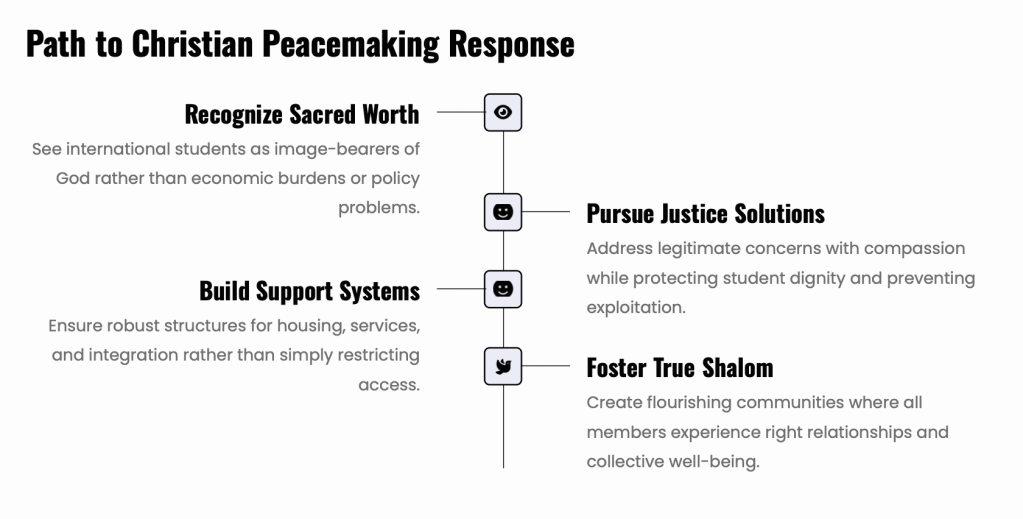
“When we look at international students, we will see a million problems,” ended Dr. Li. “But we will also see neighbours to love, burdens to reduce, and sojourners to welcome.”
Off-Campus Supports: Dr. Grace Karram
“We need counter-narratives to the awful anti-immigration rhetoric that is out there,” began Dr. Grace Karram. “These speakers today are not pursuing lucrative research projects. They are studying something that will make a difference for students around the world.”
Karram then shared a study she is working on that focuses on small-scale supports in off-campus settings. She is Assistant Professor in the Department of Leadership, Higher and Adult Education at OISE, University of Toronto. Her research included a cross-Canada survey of international students and interviews with community agencies outside the university.
She told the audience about Christmas parties for international students. Small, welcoming, sometimes last minute, but fun social events that gather people far from home together with good food and some local cultural traditions that remind students of their own cultural traditions. “In these events, we actually get to hear their stories,” she explained. “We begin to hear what’s actually happening, and then we can try to take the next step.”
Two important findings have come out from the gathered data: first of all, international students will turn first to their community networks when they need advice and help. Secondly, many of these important community connections are not formally networked with the university departments that work with international students.
After describing some of her own small social events, and the awkwardness of mixing up names or messing up with the halal food for a Muslim student, she said, “Just start with hospitality. Don’t be afraid to fail. International students are gracious.”
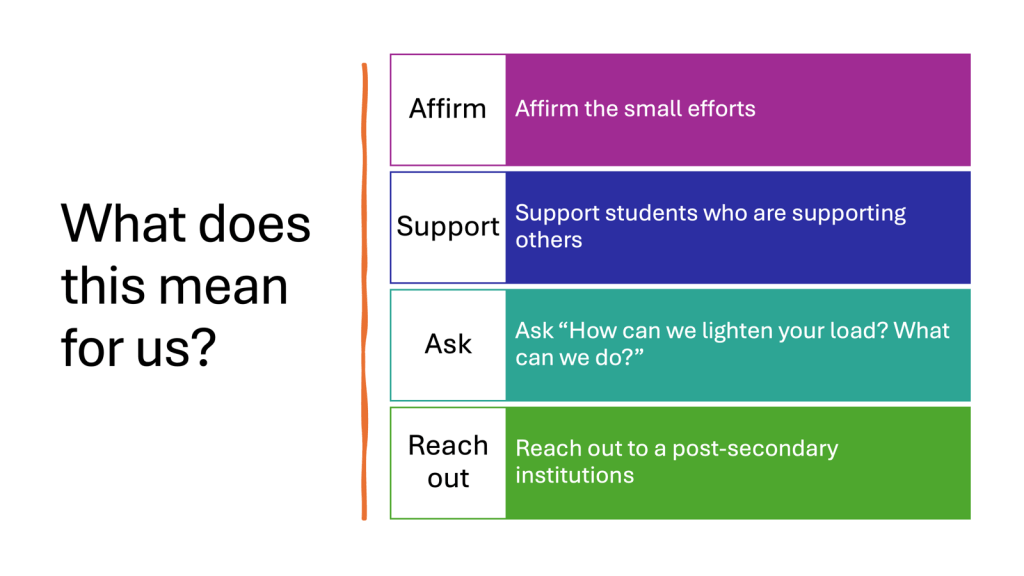
She concluded with a number of suggestions for the audience: she emphasized that small efforts count, and that asking students “How could I lighten your load?” can go a long way. If you want to make a difference, she said you can make connections with students who are already supporting other students and reach out to your local post-secondary institution. If you are an accountant, a lawyer, or if you have an empty room in September for a student whose visa was delayed—there are so many ways to help bear the load together.
Further Questions and Complexities
The panel then opened up the floor for questions. Discussion ensued on multiple levels:
- questioning government motivations for inviting more international students than the system can adequately handle
- the effects of COVID, the restrictions and its upsets
- comparisons with the situation in Australia and elsewhere
- the World Bank, Majority World debt, education as a human right, and the need for grants to poorer countries rather than loans
An international student in the online audience wrote in the chat about how she traveled to Canada and became a victim of domestic violence, requiring major surgery, and the resulting financial strain as she cared for her child while trying to finish her degree. Panelists responded empathetically, noting how gender matters in student experiences. “Young women kill themselves because they are pregnant, and because they arrive with no family structure, no understanding of relationships and sexuality in the Canadian context. The dishonor and shame they carry is too much to bear.”
“Think of this,” said Dr. Karram. “Students can be 17 years old. They need their family links. They need adults in their lives and mentors who will care for them. These stories are harrowing because international students especially are so vulnerable.”
“Here’s a small practical tip that we have learned,” added Chiadika. “If you see a student whose personal hygiene isn’t great, you need to check in with them. It can be a sign of mental illness, or it can be a sign of them not going home at night because they’re working a job, studying, and doing a placement at the same time. You want to watch out for all of these signs of student care and at the same time advocate with the government.”
Then an older white gentleman—a professor in the audience—stood up and said he needed to say something. “Just hearing all this today, I’m prodded to ask for forgiveness from God and international students on behalf of fellow Canadians. Forgiveness for treating you as anonymous economic units. Forgiveness for lying to you about what you would be given upon arriving here. Forgiveness for promising you that things would get better and instead they got worse. And forgiveness for not being there to sustain you when you’re drained of all your personal and financial resources. Would you forgive us?”
Panelists brought back the big picture and spoke of worldview differences, explaining the worldview of scarcity and competition in a global economy, and the way in which the Global North exploits the Global South through brain drain. Such Social Darwinism was contrasted with the Biblical perspective of God’s abundance and the shalom he wishes for all his creatures. It was emphasized that we are all part of a global system and we depend on each other. When one part suffers all are made poorer, and when we keep the common good in mind we all benefit. Our worldview can make all the difference in the world when it comes to how we treat and talk about international students.
Words of Encouragement for Hosts and Guests
Panelists were asked if they had any closing words.
“We need the forgiveness of the students, but we also need to actively respond and do the research that can make a difference.”
“Jesus is our advocate, and we need to be more like Jesus. We need to be advocates for international students and all vulnerable people.”
“Speaking as an international student, we also have a responsibility. Canada is my home now. To paraphrase the prophet Jeremiah, we need to pray for this country, and to contribute our best for the growth and development of this country.”
“One scripture that has stuck in my head this entire year is from the gospel of Matthew. ‘Blessed are the poor in spirit, for they shall see the kingdom of God.’ As I reflect on tonight, there’s been a lot of collective grieving for the way our international students have been treated in this country. This year has been a time of being low before the Lord, and just recognizing that as we sit low, He’s the one who lifts us up. As we sit in these feelings of ‘It’s hard. It’s challenging. It’s difficult,’ there’s that lowness in spirit. But I just want to encourage everyone that blessed are the poor in spirit, for they shall see the kingdom of God. As we look to God, and as we lift our eyes to Him, He also empowers us to be able to take steps, to be able to take actions, to be His hands extended into the world.”
“Speak up. Be positive. International students are not helpless, but agents of change, too. Practice hospitality, tell stories, listen, share the challenges. Be strong, take heart, and wait for the Lord.”
The evening ended with an invitation from Global Scholars Canada. The conversation has gone from the heights of governmental policy to stories on the ground of personal catastrophe. The policies have been written and headlined, but not the stories.GSC has received a grant from a Christian foundation to write up some stories from international students in Canada. Taking security and confidentiality into consideration, we want to write up these stories and post them on our websites. If you know an international student who would be willing to share their story, we would love to interview them and document their journey.
Find more information on this venture here.
The evening ended with a carefully crafted prayer by Dr. Karram that included the following:
- Give us courage to play the role of host to international students and to be intentional in the practise of hospitality. Let us be the reason their loneliness is relieved. Help us advocate for justice. Mold us into more compassionate emissaries of your coming kingdom.
- Give us discernment in the face of global crises, to know when to pray, when to speak out, when to act and when to sit quietly in your presence.
- We cast the burdens of the world on the shoulders of the One who alone is able to bear them up.
Amen
 Sensus Divinitatis
One thought on “The Crisis of International Students in Canada: An Opportunity for Peace in a Troubled World?”