
“Music is not neutral. It can be used in the service of racism, injustice, and abuse. The Olympics are a spectacle of nationalist propaganda, and when nationalism is left unchecked (especially nationalism that is founded on exclusionary principles), it can have dangerous and deadly ramifications…”
- Hannah Willmann

I met Hannah near the University of Ottawa where she works as the Inter-Varsity Christian Fellowship Graduate Fellowship staff worker. When she told me she had just completed a PhD in music history and cultural studies, I recognized scholarship done with deliberate Christian intentions. It is a PhD (!) so the summary below is just an introduction to book-length research. The views expressed here are Hannah’s and do not necessarily represent those of IVCF.
Introduction
In February of this year, the Winter Olympics will be hosted in Italy. In addition to being significant for sport, the Olympics are a strategic opportunity of national pride and identity construction – particularly through the cultural displays at the opening ceremonies. It is an intriguing time for scholars, citizens, and Christians to engage in these conversations about culture and national identity formation – and to be equipped to do so both as followers of Jesus, and as leaders in academic thought. In my recently completed doctoral work, I studied Canada’s Vancouver 2010 Winter Olympics with the goal of understanding how this event contributed to the construction of a national identity.[1] Along the way, I also developed an increased understanding of what it means to engage at the forefront of academic research with the goal of faithful Christian thought and witness, and how the truth of the gospel speaks light to every area of life.
Working Toward Redress
My doctoral dissertation was born out of a desire to understand the role of Indigenous and Settler relations in the process of Canadian national identity formation. My work exists in response to the contemporary dialogue in Canada around the Truth and Reconciliation Commission (a government inquiry into the history and implications of the residential school system which was a government tool to erase and assimilate Indigenous identity into the white Canadian majority). By analysing the cultural portion of the Vancouver 2010 Olympic Games Opening Ceremony, I sought to understand how elements of Canadian national identity continue to rehearse oppressive cultural norms. I situated my work as a response to that of Dylan Robinson, a Stó:lō artist and scholar, whose book Hungry Listening has been changing the way music in Canada and in other colonial contexts is addressed. In that book, Robinson issued a call for scholars of music in Canada to work towards redress, with particular attention to how multicultural and landscape-based tropes serve settler colonialism. He also invited all music listeners to understand their listening positionality in relationship to Indigenous musics, calling for self-reflexivity and a rejection of the hunger and greed he says characterize settler listening.[2]
In this dissertation, I aligned the two points Robinson highlighted (landscape based and multicultural tropes) with two primary qualities of settler colonial activity – elimination (or erasure) and extraction (or appropriation) as defined by Audra Simpson and Leanne Betasamosake Simpson respectively.[3] Within the logic of settler colonialism, landscape-based tropes are frequently used to erase Indigenous presence while multiculturalism functions as an extractive device – appropriating diversity more broadly for the sake of establishing the core national identity. As the case studies in my dissertation showed, the opening ceremony of the Vancouver 2010 Winter Olympics was rife with examples of these techniques.
Part of being a Christian in Canada (and indeed, in many other colonial contexts) involves reckoning with the history of our nation, both the direct and complicit involvement of the church in the destruction of Indigenous life and culture, and participating in the work of moving towards right relationships with our Indigenous neighbours as guests on the land which they believe Creator made them caretakers of. For me, this process was not in conflict with my faith in Jesus, but rather deeply informed by it. Before beginning the analysis, within the dissertation text itself, I situated my approach to this work as a follower of Jesus – acknowledging both the grief and repentance that such a study required (based on the church’s role in the residential school system and the damage that has been done in the name of Christ), but also the hope I have based on the gospel vision of the nations dwelling in peace and worshiping around the throne of God (citing Revelation 7:9 as my motivation). Outside of the text of the dissertation itself, my approach to this work was guided by Paul’s words in 2 Corinthians 5, where he explains that we have been reconciled to God by Christ and thus been bequeathed the ministry of reconciliation. Although this passage underscores my own approach to the work I do in my research and writing, it is also important not to conflate the concept of political and relational reconciliation between people groups with the reconciliation that God makes possible through the work of Christ. Part of our response to Christ’s reconciling us to God is to engage in the world faithfully as part of the larger work of Christ reconciling all things to Himself.
Anti-colonial framing
I framed my work in this dissertation as an effort of anti-colonialism which takes up part of the healing task of reconciliation through addressing past wrongs. While we may not be directly culpable for these wrongs, it is our responsibility to address the injustices which have deeply shaped the society we have inherited. Although some Indigenous writers including David Garneau and Taiaiake Alfred suggest that reconciliation cannot occur where there has not first been “conciliation” (a harmonious relationship), I view anti-colonialism as a step towards conciliation, and reconciliation.[4] Building from a wide range of scholarship, I suggested this working definition of anti-colonialism: “Anti-colonialism is an Indigenous-led process, with different but overlapping and co-intentional implications for both settlers and Indigenous peoples. For Indigenous peoples, it involves taking back, while for settlers, it requires the relinquishing of land, power, and privilege. It is built from responsibility and relationship, for the purpose of Indigenous liberation and shaping our communities through the realization of shared values.”[5]
Working with this definition of anti-colonialism led me to two further key inquiries. How can settler-Canadians relinquish their settler status and operate differently? And secondly, how might we directly oppose the two main goals of colonialism (erasure and extraction)? Indigenous scholars and leaders have already explained that attention to Indigenous presence is one method which counters erasure.[6] Similarly, as I learned, recognizing and reframing one’s position on the land not as settler but as a guest involves moving beyond land acknowledgements towards learning history and stewardship in relationship with Indigenous hosts.[7]
There was not as much discussion in the literature of how to counter the extractive element of colonialism, and thus I proposed self-giving love as the position which will oppose the “mindset of extraction.” Building from the work of bell hooks, Daniel Chua, and many others, I suggested that a posture of love – when defined as giving oneself for the good of another – would lead us away from the self-seeking posture that defines settler colonial practice.[8] Although I did not explicitly state so in my dissertation, it is my faith in Jesus, and His model of self-giving love which inspired this direction with my argument. In addition to offering His life for our sins and the sins of the world, Jesus’ earthly ministry was characterized by caring for the poor, healing the sick, and spending time with those whom society tended to marginalize. He did these things to enact God’s love in the world, and called on His followers to do the same (John 20:21).
Methodology and Application
The methodology which I employed for this dissertation is one known as multimodal discourse analysis or MDA. In MDA the task of the scholar is to take apart the different semiotic modes (music, visuals, texts for instance,) in order to reveal and understand what is being communicated by the underlying ideologies, and then by the narrative as a whole.[9]I will not go into depth on this here, but some of the questions that I asked as I pursued this method were: What is communicated about the relative importance of the individuals/cultures who are represented in this scene via their physical position on stage, their costumes, their engagement with the landscape, and the music that accompanies that? Are there musical/visual/textual elements that have been borrowed from another context? What is their significance in that context and in this new context? What do these artistic choices reveal about the ideologies that govern the construction and rehearsal of our national identity?
Through my employment of this methodology, I developed an integrated analytic framework which combines the techniques of multimodal discourse analysis with the critiques of anti-colonialism. This framework, I suggested, helps to reveal whether the elements of diversity, inclusion, and reconciliation that are presented in artistic contexts are representative of effective anti-colonial activity, or whether they remain in the realm of rhetoric. This framework offers an incisive tool to uncover the underlying logics that govern the arrangement of artistic elements in a multimodal event and beyond.[10]
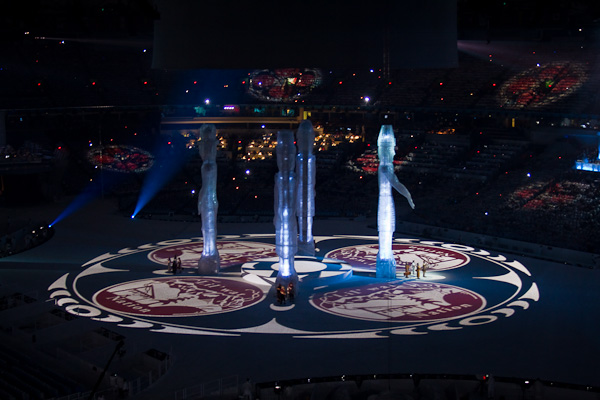
In my dissertation, I applied this analytic framework to three scenes from the cultural portion of the Opening Ceremony of the Vancouver 2010 Olympic Games.[11] As a brief example of what this form of analysis can identify, in my dissertation, I suggested that the most potent example of erasure occurred at the beginning of the second scene of the cultural portion of the opening ceremony. In that scene, the dancers of the Alberta Ballet enter the stage as projections illuminate large vertical banners. I argued that there are two erasures being enacted in this scene: the first is the literal erasure that was used in the animations (as the totem poles dissolve into trees), and the second is the conceptual erasure that defines the narrative of this scene as a whole: that settlers enter a landscape which they assume is empty, and although they may at some level acknowledge the past presence of Indigenous peoples, eventually that presence becomes less and less relevant as the settlers take ownership of the space (which, I suggested, was demonstrated later in this scene through the exuberant dance moves and the use of twentieth-century American music as accompaniment).[12]
The work I undertook in this dissertation serves as a reminder to be attentive to the narratives of nationalism and identity that are being used to shape our cultures, and to attempt to understand the implications that those have for how we relate with our neighbours. As I concluded in my dissertation, “Music is not neutral. It can be used in the service of racism, injustice, and abuse. The Olympics are a spectacle of nationalist propaganda, and when nationalism is left unchecked (especially nationalism that is founded on exclusionary principles), it can have dangerous and deadly ramifications, as our ancestors experienced in the years after 1936 [a reference to the Berlin Olympics and the Nazi propaganda there], and as we read in global news headlines, day after day.”[13] As followers of Jesus, we can call out the good, beautiful, and true elements of culture we see being celebrated and promoted in these national events, but we must also, like Jesus, ensure that we stand with the marginalized and oppressed, listening to them, and laying down our lives for their good.
AUTHOR:
Hannah Willmann is a follower of Jesus, musician, and scholar. She works in Graduate Student and Faculty Ministry for InterVarsity Canada at the University of Ottawa where she obtained her PhD in music and cultural studies. Hannah also holds a Master of Arts in musicology (uOttawa) and a bachelor’s degree in flute performance (Ambrose University). She has presented her research at national and international conferences, including the annual meeting of the American Musicological Society, the Canadian University Music Society, and The International Network for Music Theology. Her research interests also include sacred music and worship practice, particularly in the Anglican tradition. Hannah frequently contributes to music and other ministries at the church she attends, and she can otherwise be found enjoying the Ottawa scenery either via ice skating or cycling, weather permitting.
[1] Hannah Willmann, “Rehearsing Settler Colonialism: Music, Visuals, and Text in the Spectacle of Canadian National Identity at Vancouver 2010,” PhD Dissertation, (University of Ottawa, 2024).
[2] Dylan Robinson, Hungry Listening: Resonant Theory for Indigenous Sound Studies, (Minneapolis: University of Minnesota Press, 2020), 48-49.
[3] Audra Simpson, Mohawk Interruptus: Political Life across the Borders of Settler States (Duke University Press: London, 2014), 12; Leanne Betasamosake Simpson, and Naomi Klein, “Dancing the World into Being: A Conversation with Idle No More’s Leanne Simpson,” YES! Magazine (blog), March 5, 2013, accessed July 20, 2022, https://www.yesmagazine.org/social-justice/2013/03/06/dancing-the-world-into-being-a-conversation-with-idle-no-more-leanne-simpson.
[4] David Garneau, “Imaginary Spaces of Conciliation and Reconciliation: Art, Curation, and Healing,” in Arts of Engagement, ed. Dylan Robinson and Keavy Martin (Wilfrid Laurier Press, 2016), 21–41, https://doi.org/10.51644/9781771121705-003, 30. Taiaiake Alfred, “Restitution is the Real Pathway to Justice for Indigenous Peoples,” in Response, Responsibility, and Renewal. Canada’s Truth and Reconciliation Journey, edited Gregory Younging, Jonathan Dewar, and Mike DeGagné, Aboriginal Healing Foundation, Research Series (Ottawa: Aboriginal Healing Foundation, 2009), 181.
[5] Willmann, dissertation, 26.
[6] Sandrina de Finney, “Under the Shadow of Empire: Indigenous Girls’ Presencing as Decolonizing Force,” Girlhood Studies 7, no. 1 (2014). Josephine L. Savarese, “Challenging Colonial Norms and Attending to Presencing in Stories of Missing and Murdered Indigenous Women,” Canadian Journal of Women and the Law 29 (1) 2017,
[7] Ruth Koleszar-Green, “What Is a Guest? What Is a Settler?,” Cultural and Pedagogical Inquiry 10, no. 2 (2018). I have found the distinction between settler and guest particularly useful as I try to understand Canada’s history, and engage with my Indigenous neighbours. While settlers tend to occupy a land with little attention to (at best) and outright destruction of (at worst) Indigenous presence, guests operate in ever-deepening relationship with their hosts, honouring their presence and history on this land, and looking for ways to build a future together.
[8] Willmann, dissertation, 157-158.
[9] Lori Burns, “Dynamic Multimodality in Extreme Metal Performance Video: Dark Tranquility’s ‘Uniformity.’ Directed by Patric Ullaeus” in The Bloomsbury Handbook of Popular Music Video Analysis, ed. Lori Burns and Stan Hawkins (New York, NY: Bloomsbury Academic, 2019).
[10] A complete discussion of this is available in my dissertation, and a detailed summary is available in the forthcoming publication “Rehearsing Settler Colonialism: Music, Text, and Image in the Spectacle of National Identity” in Indigeneity and the British World: Settler Colonialism, Resistance, and Self-Determination, Jatinder Mann and Alison Clark, eds.Studies in Transnationalism Series (New York: Peter Lang Publishing, forthcoming).
[11] “Complete Vancouver 2010 Opening Ceremony – Vancouver 2010 Winter Olympics” https://youtu.be/MxZpUueDAvc. The cultural portion of the ceremony is from 1:31:14–2:18:48, and the scenes I analysed are from 1:31:48–2:01:01, the scene discussed here is found 1:40:23–1:48:36.
[12] This example is discussed in Chapter 4 of my dissertation.
[13] Willmann, dissertation, 266.
 Sensus Divinitatis