
“This is no weekend war that we’ll walk away from and forget about in a couple of hours. This is for keeps, a life-or-death fight to the finish against the Devil and all his angels.” (Eph. 6:12 MSG)
Most people like the spiritual metaphor of trees. The analogy hints at rootedness, nourishment from water and light, flourishing, fruitfulness, and we have even in my own church talked about “spiritual DNA.” It is all very positive and focuses our lives on spiritual disciplines and growth. Our church spent months on the tree theme, with inspiring sermons that blessed many embodied souls.

Yet something was missing. I said to our preaching team colleagues: “This tree talk is all nice and everything, but it overlooks much of the life of trees. What about disease, parasites, toxic soils, vicious weather, and plain old aging and death of the organism? Life isn’t all rainbows, sunshine, and friendly squirrels. What about drought and floods, fires and freezing rain, bacterial and viral infections, not to mention good old human interference, including chain saws?”
“You preach on that,” they said.
That was my assignment, and this blog is a version of that sermon on Ephesians 2 and 6. My goal was to think about the Biblical equivalent of sin, evil, demons and death. Call it moral pestilence. We need to be aware of these things, because they will tempt you, trick you, and kill you. They will wreck a marriage, destroy good character, ruin a congregation, split a denomination and put formerly friendly countries to war. Evil manifests in those catastrophic malevolent forces that will tear you apart, body and soul, family and city.
This is real, and it is commonplace. Recently I heard the story of deceit, cruelty, and betrayal in a marriage. I also just read Craig Bartholomew at the Kirby Laing Centre evaluate the American attack on Iran using the classic just-war criteria. He notes the attack fails on pretty much every count. The recent film Nuremberg reminds us just how vile we can become, and how insidious evil can be. Should we be shocked at sin and evil, or grimly sober about it all?
Maybe both reactions are appropriate.
Ephesians and the Powers
The book of Ephesians is a New Testament letter that talks a lot about “the powers and principalities.” In fact, commentators note that Ephesians has “a greater percentage of power terminology than any other New Testament book.” A virtual “power motif” runs through this letter to the early church.
Now some people think the notion of spiritual powers like demons are nothing but old pre-scientific myths and nasty fairy tales. Cartoons about devils with pitchforks that we have outgrown in our modern sophisticated imagination.
You know, it’s a modern scientific myth that this material world is all there is because science is supposedly “the revealer of ultimate truth” and what cannot be investigated by scientific tools doesn’t exist and doesn’t matter. Take careful note: it is the cornerstone of any myth to believe you have no myths. A myth isn’t so much a falsehood as it is a powerful, unconscious commitment that frames the world for us in ways we don’t even notice. We have been misenchanted in the modern West to not believe in the spiritual world we cannot measure.

Reformed sociologist Jacques Ellul in his book The New Demons says that there are evil spirits that control so much of our modern life—things like the state, technology, market, science, and we can add consumerism, Christian nationalism, nihilism, and the sexual revolution and more. Money itself is a magnificent magical power in which we place our hope and trust. These all have a sacredness to them, a quasi-religious character that we must resist.
That doesn’t mean demons are just ideological or institutional evils: they are connected to spiritual forces. This is what Paul means when he says in chapter six: “our struggle is not against flesh and blood, but against the rulers, against the authorities, against the powers of this dark world and against the spiritual forces of evil in the heavenly realms.” To be sure, the language for these powers is imprecise and unsystematic through the New Testament. We are dealing with mysterious forces that are both sociological and spiritual. The conflict runs deep.
It is interesting that while our respectable scientific worldview would be shy of any talk of spirits, our popular culture is obsessed with them. The market share of horror movies has doubled since 2013, from 5 to 10 percent. Horror films have become mainstream fare and receive critical acclaim for their artistry.
Here’s a thought: what if horror films are not just entertainment and escape, but a revelation of the world as it is? Monsters, aliens, mental illness—all representing a dark and malicious unknown that prowls in the dark spaces we are not fully aware of?
This is the question I am asking Christians–or anyone with a sensitivity to our moral crisis: do you believe in evil—some spiritual wickedness beyond just protons and planets, quantum particles and quasars? Maybe we see better when we probe into the dark.
Don’t get me wrong. Science has its place (I am a social scientist by trade). But science isn’t everything. We have strong intimations that there is more to the world than just the material world.
Unity in a Polarized World
So. Evil is real and we ought to be wary. Why do I emphasize this? Well, Ephesians other big theme is unity, and Paul presses the church to take courage to tear down the wall of hostility that divides Jew and Gentile and to realize their common inheritance in the Seven Ones: one Lord, one faith, one baptism, one Spirit, one body, one hope, and one God and Father of all.

This is really important these days because we are living in a polarized society and church. Not only the perennial Jew vs. Gentile, but right vs. left, red vs. blue, rural vs. urban, progressive vs. conservative. We have our tribes, our flags, and our slogans. Shiao Chong is a former editor of a denominational news magazine who continues to write on his blog, 3D Christianity, and he most recently wrote about polarization. Polarization, he says, is not just disagreement. Rather:
Polarization is enmity. Polarization is an “us vs them” attitude or posture where “us” is equated with “good,” and “them” is equated with “evil,” where “us” is right and “them” is wrong, where “us” is on God’s side and “them” is demonic. And that we believe that the world is better off without “them.”
Here’s the point: demons are not your political opponents. That would be too easy. The true conflict is a form of spiritual warfare, and it is tearing us apart. Chong says we need courage to stand in-between and be peace-makers. Left-right distinctions are not even consistent political positions over time; they are really just tribal camps, emotional groupings, clustered identities.
Try to think a little independently, or Biblically, and we will all be blessed.
My conviction is that we can find unity in re-positioning ourselves in terms of what we are all against, and I think we can all be unified in being against three things: the world, the flesh, and the devil. To be clear: “our struggle is not against flesh and blood, but against the rulers, against the authorities, against the powers of this dark world and against the spiritual forces of evil in the heavenly realms.” (Eph. 6:12 NIV) I hope we as Christians (at least) can be together on that, for the stakes are high. Heaven and hell hang in the balance.
The World, The Flesh, and the Devil
So where did I get this unholy trinity—”the world, the flesh, and the devil”? Well, it goes as far back as St. Augustine and other Church Fathers. It was probably most popularized in the Anglican Book of Common Prayer, where the written prayer includes the line: “From all the deceits of the world, the flesh and the devil, good Lord deliver us.”
Those of us in the Reformed Christian camp will recognize the phrase from the Heidelberg Catechism, Q&A 127, where we read:
| What is the sixth petition in the Lord’s Prayer? |
| And lead us not into temptation, but deliver us from the evil one. That is: In ourselves we are so weak that we cannot stand even for a moment. Moreover, our sworn enemies –the devil, 2the world, 3and our own flesh 4 –do not cease to attack us. Will you, therefore, uphold and strengthen us by the power of your Holy Spirit, so that in this spiritual war we may not go down to defeat, but always firmly resist our enemies, until we finally obtain the complete victory. |
But where did these Church Fathers all get this phrase? Well, one key text is Ephesians 2: “As for you, you were dead in your transgressions and sins, 2 in which you used to live when you followed the ways of this world and of the ruler of the kingdom of the air, the spirit who is now at work in those who are disobedient. 3 All of us also lived among them at one time, gratifying the cravings of our flesh and following its desires and thoughts.” Paul is talking about the human condition, and its vulnerability to sin, temptation, and the slavery that results. This is for both the Jew and the Gentile, for both the right and the left, the blue and the red.
The world, the flesh, and the devil.

Let’s unpack these three a little more. Notice that none of them are your neighbour or even your political competitor. Maybe a human being could be a carrier, but a person can’t be the world, flesh, or devil. So what are these terrors that cause havoc in our lives?
First, the world. This is the cultural pressure, the external forces of society that distract you from God and his kingdom and turn your focus to such things as consumerism, materialism, systemic racism, discrimination, injustice, political one-up-manship and environmental destruction. This means going with the flow of our sad and sorry technocratic obsessions and its culture of speed and greed.
I remember asking a student majoring in economics when I was a chaplain at Brock University: “What would be a Christian perspective on the foundations of your discipline?” And he replied, “Listen, I don’t make the rules, I just follow them.” He was just 19 years old, but he had already given in to a kind of economic fatalism, and any resistance was lost. What makes a young man lose his desire to make the world a better place and accept the misenchantment of modern money systems?
We could talk about our participation in on-line shopping, the wired virtual world that I’m blogging into just now, and the pressures around sexual identity that pre-occupy institutional life today. Systems that seem to have a life of their own and that capture our attention so much more than they ought–this is the corruption of the world to which Paul directs his warning.
Second, Paul names “the flesh” or “gratifying the cravings of our flesh.” Now we all naturally have appetites for food, drink, sleep and sex. But “the flesh” means the distortion of those appetites—when they run amok into gluttony, drunkenness, sloth and promiscuity. We can add on things like envy, anger, quarreling, vengeance, and so on. “Wherever ‘self’ rears its ugly head against God or other people, there is ‘the flesh,’” said one commentator on this text (John Stott, p. 51). It may even look respectable to some eyes, but in fact, when the flesh is driving you, it is a “horrible bondage.”
I remember another student who used to go to the casino for a little fun. I warned him against it, but he brushed me off. A few years later he was going to Gamblers Anonymous, as it had gotten out of hand. More recently, a friend confessed to me his unwanted porn addiction. I also know of someone who had to sell their house to pay off a gambling debt. This is more than just a little problem of unchecked cravings. The forces of self-destruction just don’t make any sense. We don’t want them, yet they persist like a bad habit.
Finally, the devil. Ephesians says “the ruler of the kingdom of the air, the spirit that is at work in those who are disobedient.” He’s also called the “prince of the unseen world” or the “Prince of Darkness.”
Crafty, cunning, deceitful and destructive, tempter and accuser, he is a fallen angel and the Father of Lies, seeking to plant the creeping doubt: “Did God really say?” Our text says he is the spirit at work in those who are disobedient, who forsake the law, God’s call, God’s design, God.
Think for a moment of the old story of the Sorcerer’s Apprentice, where an ordinary boy is told by the Master Magician two things: clean up, and don’t use magic. Well, the Master leaves, and a temptation sets in: why not dabble just a little? Maybe the Master is too controlling, and doesn’t want us to develop a little independence. A little trial run can’t hurt and could even be beneficial.

We’re back to the Garden of Eden. The apprentice tries a little spell—and we could substitute technology like AI or genetic engineering to modernize the parable—and soon things are out of control, irreversible. Disaster and chaos and carnage ensue.
It takes some imagination, some parables, to help us see the invisible as the real, to imagine a spirit at work in our hearts, prompting us toward manipulation rather than responsibility. Isn’t that how trouble starts? Choosing rebellion and ego and expedience rather than obedience, patience, and trust? We even have this saying, “You make a deal with the devil” to get your way.
Do you believe in a devil, or are you too scientifically materialistic for such an awareness? Have you never been in a culture, a country, a workplace, or a marriage where communications start to misfire, and a certain toxicity sets in, and then some open conflict erupts, and things end up going crazy? Normal life turns into disaster. We see it on the news every day.
And as we watch the fallout on the screen, we get really sober. We all wait for the Master to return and set things right again.
The unholy trinity is real: the world, the flesh and the devil. External, internal, and spiritual evil that represses, oppresses, and depresses us all. These are the analogy to fires and floods, bacteria and viruses, that plague a tree that tries to flourish in its place.
Here is the key for our polarized culture: the line between good and evil doesn’t run between red and blue, liberal and progressive: it runs right down the centre of every human heart. “We have met the enemy, and he is us.” Shiao Chong says polarization is not just a social problem: it’s a spiritual problem because it promotes enmity between people. Yes, even hatred. Don’t give such hatred a foothold in your heart; that is how the first murder disrupted early human society. Yes, I mean Cain and Abel.
This is my argument: we can find some measure of unity in resisting not our brother or sister, but our common tormentors: the world, the flesh, and the devil.
The Beautiful “But”
We can’t end here. Our text today also includes what commentators say is one of the most important “buts” of the Bible. In chapter 2 vs 4, after reading about the scourge of the world, the flesh, and the devil, we have this: “But because of his great love for us, God” – But because of his great love for us, God”… “But” is what grammarians call a “coordinating conjunction” and it is meant to set up a contrast, a difference, or an unexpected outcome.
Well, this is such a wonderful conjunctive contrast, taking us from darkness to light, oppression to deliverance, and despair to hope. One commentator says: this is “one of the most significant, eloquent and inspiring transitions in all literature. It indicates a stupendous change has taken place. It is the change from a doom and despair of the valley of death to unspeakable delights of the kingdom of the Son of God’s love.” (William MacDonald)
The text says: “But because of his great love for us, God, who is rich in mercy, made us alive with Christ”—meaning we are participants in his resurrection, and his victory is also ours. Victory over the powers.
What happens through the cross and resurrection is that Jesus exposes the powers not as the liberating forces of peace they claim to be (think of the Pax Romana of Paul’s day) but as the deceitful, corrupted, and violent forces that they are, and strips them of their primary weapons—sin, guilt, and the fear of death—by publicly defeating them in Jesus’ own resurrection from death. He absorbs their wickedness and responds not with vengeance, but with forgiveness and love. In this context, the devil is already a defeated foe.
“But because of his great love for us, God, who is rich in mercy, made us alive with Christ…”

My NGO, Global Scholars Canada, held a symposium many years ago led by an African American theologian Esther Acolatse who compared the cultural preoccupation with the spirit world in Africa with the materialistic scientific world of the West. “The African worldview is much closer to the Biblical worldview,” she said.
The African worldview is much closer to the Biblical worldview, except in this respect: she says they can be too dualistic—like the powers of evil and the power of God are equal contenders. They become distracted by devils and witches and curses from the key theological moment—the victory of Christ at the cross, and miss out on some of the joy of living in the assurance of the Master’s victory. Jesus reigns with God over all. Fear of witchcraft, demons and curses must not overshadow life too much. Here in the West, we are oblivious to the spirit world.
Unless we are at a classic Pentecostal worship service… or the movie theatre…
Letters to the Devil
I want to end with some thoughts from C.S. Lewis’ Screwtape Letters, as it fits so well with the reading from Ephesians 6 where it talks about putting on the armour of God and being persistent in prayer. He says: “There are two equal and opposite errors into which our race can fall about the devils. One is to disbelieve in their existence. The other is to believe, and to feel an excessive and unhealthy interest in them. They themselves are equally pleased by both errors and hail a materialist or a magician with the same delight.”
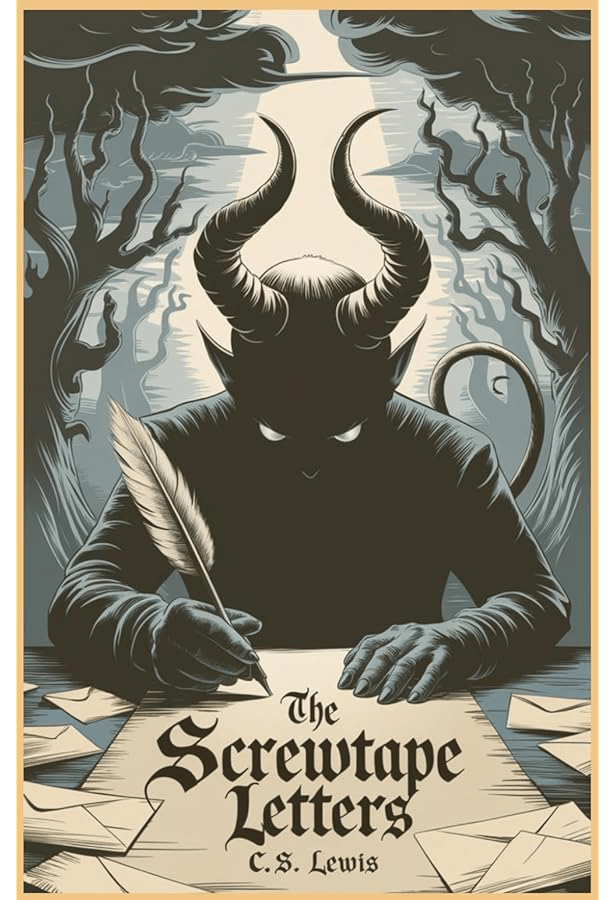
It is a great book, a satire of a senior devil training a junior devil. A great failure occurs in demon school whenever a human turns to God in prayer, and despite all the temptations and tricks, the soul they are taunting slips through their fingers, and the senior devil says a “howl of sharpened famine for the loss re-echoes… through all the levels of the Kingdom of Noise, down to the very Throne [of our Father Below].”
It is a great book, because it does what Jesus did at the cross: unmask the powers, reveal the temptations and their deceit, and keep our focus on the world, the flesh, and the devil and not on particular human beings who we think we disagree with because they belong to a different political tribe.
It also shows their ultimate weakness in the face of prayer and before the goodness of God and his grace.
We need to remind each other of the channels of division and deceit that are so readily on offer, and be fully awake to opportunities to be channels of peace in a world at war. Because, ultimately, we share one Lord, one faith, one baptism, one Spirit, one body, one hope, and one God and Father of all, and by abiding in such, we can indeed become shalom to the world and flourish together.
 Sensus Divinitatis
Thanks Peter. Nice thoughts. And nice to see that you quoted me. 🙂
I think your proposal to return to focusing on “the world, the flesh and the devil” is a good one, although a lot more could be said about each of those than what you laid out. Some updating of the traditional views of those three might be in order.
The devil, for instance, has more tricks than simply casting doubt. Creating literal certainty is also one of his tricks (per the second temptation of Jesus in Matt. 4:5-7). With the flesh, I wonder how much of present-day psychotheraphy insights might be helpful? For instance, Chuck DeGroat talks about trauma and how that impacts our spirituality.
Finally, with the world, have you read Walter Wink and his work on “principalities and powers”? I have only read a little bit of Wink. But from what I have read, it might be helpful in further fleshing out the “systems” of the world that you touched on. I haven’t read Esther’s book that you refered to, so I don’t know if she used Wink at all in talking about the African worldview. But her title certainly brings Wink’s work to my mind.
LikeLiked by 1 person