This guest blog comes from Quinn Goranson, an environmental conservation policy professional with a masters degree in Public Policy and Global Affairs from the University of British Columbia. She has experience working in both international climate and financial policy at the federal and provincial level, respectively. Quinn enjoys being outdoors, building community, and making art. She was one of the three respondents in this webinar.
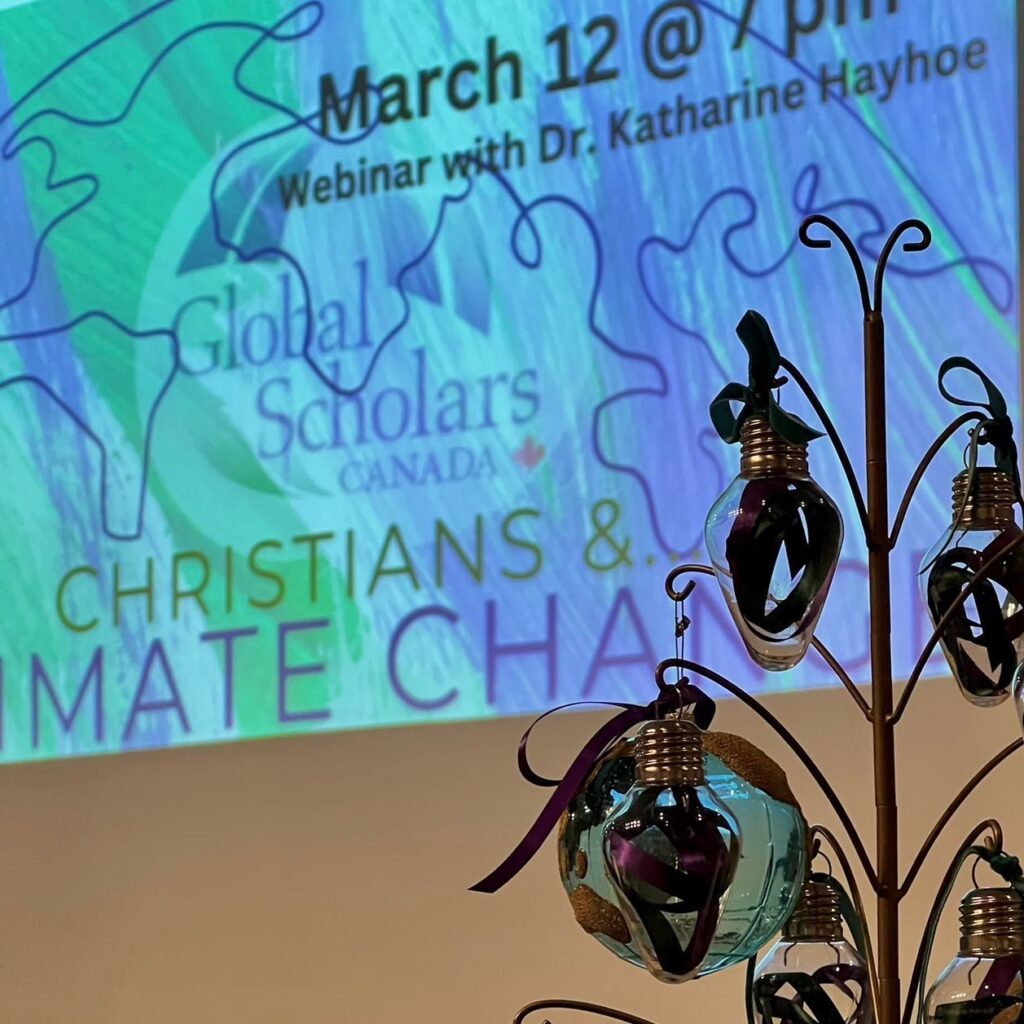
You may have heard of Global Warming, but what about “Global Weirding?” On March 12th, Global Scholars Canada had the pleasure of hosting renowned Climate Expert, Dr. Katharine Hayhoe for an invigorating webinar on Christians and Climate Change.
Quinn at the Golden Waterfall in Lianxin Village, Taiwan.
Dr. Hayhoe is an atmospheric scientist whose research focuses on understanding the impacts of climate change on both people and the planet. She has a long list of accolades, including:
Chief Scientist for The Nature Conservancy, Horn Distinguished Professor, and Endowed Professor of Public Policy and Public Law at Texas Tech University. She has served as a lead author for the Second, Third and Fourth U.S. National Climate Assessments and her work has resulted in over 125 peer-reviewed papers, abstracts, and other publications. (Note: the Nature Conservancy in Canada is called Nature United).
Katharine is also a Christian, and has spent much of her career helping fellow believers see themselves in the climate crisis as not only called to act, but empowered through community to do so. Katharine speaks succinctly and emphatically of the no-nonsense nature of climate science. She uses illustrations of our earth cloaked in unseasonably warm blankets, that trap heat and spiral negative, self-reinforcing environmental impacts, out of control. Our bucket is overflowing, she says, and we must turn off the tap. That means cutting greenhouse gas emissions, not just carbon dioxide (CO2) but other, more potent pollutants, like methane, too.
“Global Weirding” is a phrase Katharine feels more accurately reflects the impacts of a warming global climate as weather patterns become more unpredictable and once rare events like floods and fires become more extreme. Things like environmental degradation and loss of biodiversity from human impact exacerbate disasters and weaken our planet’s ability to respond to and recover from extreme natural events.
While every single living being on Earth is impacted in some way by climate change, people in low-income countries are disproportionately affected specifically by climate-induced drought, crop failures, floods, and storms. Yet, 50% of the world’s poorest produce only 7% of global emissions while the richest 1% of the global population are solely responsible for 15% of total emissions. Climate change is inherently and inextricably a social justice issue. The burden of decades of environmental exploitation is being most acutely carried by those that did not benefit from the resulting development seen from the historic industrial revolution to modern day mineral extraction for electric batteries.
“At its core, climate change is profoundly unjust. It exacerbates hunger, poverty, and even political instability, disproportionately impacting the most vulnerable people of the world, the very ones we Christians are called to love and care for.”
Peter Schuurman, Global Scholars Canada Executive Director
Given this reality, how has the issue of climate change become so political, especially amongst Christians?Katharine shares that for many evangelicals, especially in the United States, statements of faith appear to have become more aligned with their political ideology and only distantly second, to traditional biblical principles and understandings. In a concerted effort over decades to gather Christians under a single, conservative banner; many have forgotten God’s call to ‘care for the least of these’ (Mathew 25:40).
Since the American Revolution, religion, ideology, and politics have become increasingly conflated as politicians began using Christianity as either a justification or a motivation to push their ideological agendas. Katharine references the 1930’s Scopes Trial which saw an American high school teacher prosecuted for teaching evolution in a state-funded school in Tennessee aswell as the resistance to desegregation of schools in the 1970s. Politicians argued for the moral superiority of their agendas to align Christians under their banner, therefore securing support from a very significant portion of the voting population. In this same vein, Katharine spoke of the ‘merchants of doubt,’ a phrase referencing a book by the same name, which outlines the intentional misinformation by the fossil fuel industry and the scientists they employ, to obscure the truth around climate change. Doubt and disinformation is sewed by conservatives and reaped by evangelicals already aligned with the inherent political ideology, to produce statements like “‘thou shalt not believe in climate change’ as if it was a religion to believe in,” Katharine says.
Katharine believes that if we as Christians, want to honour what the Bible says then we should not only be informed, but ready to assist on the front lines of the climate crisis. She says “we have neglected our responsibility in Genesis to “râdâh,” or ‘care’ for every living thing, including our brothers and sisters that are experiencing the direct consequences of our actions.” In this context, “râdâh” refers to the Hebrew word used in Genesis which has often been translated as humanity’s right to “rule” over creation. However, Katherine explained that scholarly manuscript studies of the use of the word throughout the Bible, have shown râdâh more closely translates to “serve”; reflecting servant leadership, lovingly devoted to those in need.
So, where to go from here? Ego enables man to envision himself at the top of a Creation pyramid, exercising dominion over all. Conversely, environmentalists (eco) tend to lose some Christians when they suggest humans have the same role in the universe as single cell organisms. In a more hopeful and balanced diagram, Katharine points to an addendum from Dave Bookless that reflects the theological role of caregiver that God has assigned to all of humanity. We, the entire body, are called to love one another with a devotion that is supportive and interconnected with our shared Earth. We know God’s love runs through it all like an eternal river and being in His image, so should ours.
Dr. Hayhoe’s presentation was followed by enlightening responses from Drs. Henry Brouwer and Magnus Mfaofo-McCarthy.
Dr. Brouwer has taught chemistry and environmental science at Redeemer University for over three decades and has led prominent research on toxicity in the Hamilton Harbour. He has been a spokesperson for the Climate Witness Project of the Christian Reformed Church. Henry highlighted data visualizations of rising global emissions of CO2, methane (CH4), nitric oxide (NO) and nitrogen dioxide (NO2) and emphasized the role human industry has played, including such practises as fracking, oil production, and the production of synthetic fertilizers.
Dr. Mfoafo-McCarthy is a Professor at Wilfrid Laurier in the Social Work department and sits on the board of GSC. He has conducted research in Ghana on the intersections of climate change and disability, and spoke briefly about how rising temperatures in Ghana and increasing frequency of climate-related events like drought, have had grave impacts on individuals with disabilities. This unique vulnerability is too often overlooked in environmental discussions and by policy makers; marginalization is often influenced and reproduced by economic and social disadvantages. Magnus highlighted the issue of accessibility during extreme weather events, and how this can be a major catalyst for higher rates of devastation, especially in places with challenged infrastructure or underfunded/underdeveloped evacuation policies.
My own response acknowledged the at times overwhelming, multifaceted dilemma that is climate change. I looked to highlight the opportunity we have, as people of faith and for those with platforms, to model servant leadership.
While working with Global Affairs Canada as a Climate Policy Consultant with the Canadian Embassy in Hanoi, Vietnam, I interviewed several diplomats and Governmental Aid Organizations, as well as people at the UN and other international organizations on global climate policy. I spoke often with farmers and small business owners regarding their concerns over rapidly deteriorating environments in the southern delta region. Most, if not all, said they know climate change is happening but they do not have the capacity or the resources to provide proper care. My takeaway was a greater conviction to do just that: care.
I asked Dr. Hayhoe: how do we approach this reality — that many acknowledge crisis, but feel powerless in the face of poverty or overwhelmed by political unrest — what can we do on their behalf to inspire action despite, or rather because of, such challenges?
Her answer was simple: talk about it. Use our voices. And if we have the privilege of living in a country where we are able to freely do so, then such is a powerful God-given tool to encourage environmental justice. The Christians and Climate Change Webinar hosted by GSC was a wonderful example of exactly that, with over 80 attendees participating in lively, positive and educational discussions that I am sure continued over dinner tables and echoed through hallways over the following days… just as Katharine intended.
AI generated image.
Together, we can take this first step and promise to continue talking about climate action and creation care as Dr. Hayhoe advocated. Through this lens, I hope you feel encouraged and empowered to participate in these important conversations too.





 Sensus Divinitatis
fine! New Study Reveals Benefits of Cold Showers 2025 enjoyable
LikeLike