

Dr. Andrew (Zhonghu) Yan is our guest blogger here and the newest scholar to join Global Scholars Canada. Originally from China, Andrew has served in various teaching and research appointments in China, Botswana, the United States and Canada. He currently lectures in Philosophy and East Asian Studies at the University of Toronto while serving as an adjunct lecturer at the Canadian Chinese School of Theology at Tyndale University. His vocation is to “build bridges of understanding” between Christianity and Chinese culture.
The first known encounter prompting a comparison between Daoism and Christianity occurred in China during the 7th century. The Church of the East, often known in the West as the “Nestorian Church,” established a presence in China during the Tang Dynasty (618-907 CE). Nestorianism is a Christological teaching associated with Nestorius (c. 386–451), who served as Patriarch of Constantinople in the 5th century. It became a major controversy in early Christianity over how to understand the relationship between Christ’s divine and human natures.
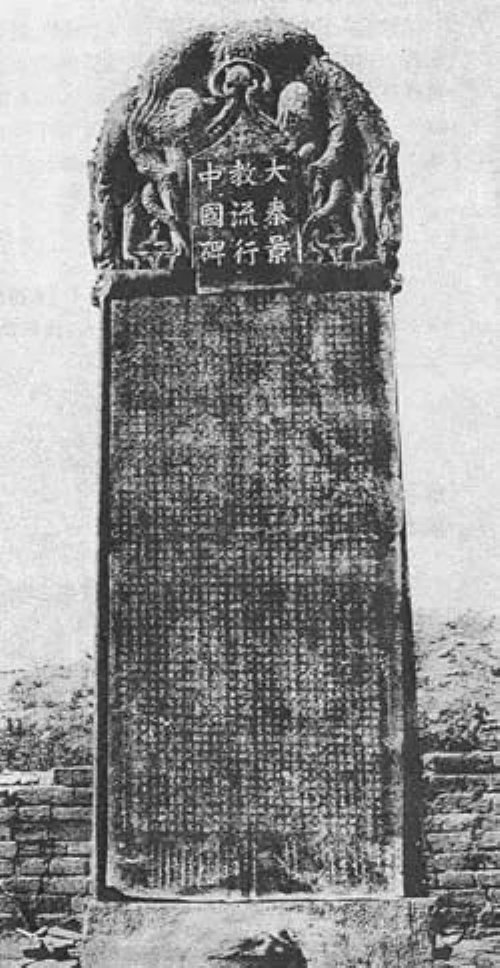
Their most famous monument, the Xi’an Stele[1], erected in 781 CE, provides profound evidence of their sophisticated engagement with Chinese culture, including Daoist terminology and concepts, to articulate the Christian faith. This encounter represents one of the earliest known, documented dialogues between Christianity and Daoism.
1. The Historical Context and Evidence
The primary evidence for this encounter comes from the Xi’an Stele, or the “Nestorian Stele,” a tall rectangular stone slab (about 2.7–3 meters high) mounted on a carved stone base (often shaped like a tortoise, a traditional Chinese stele support), topped with a decorative crown. It is formally titled the Memorial of the Propagation in China of the Luminous Religion from Daqin.[2] The stele’s text, composed in Chinese, recounts the arrival of the missionary Alopen in 635 CE and the subsequent imperial sanction of his religion under the Emperor Taizong. The Nestorian Stele was created to record, explain, legitimize, and culturally integrate Christianity in Tang China, while preserving the identity of its believers.
The text is a masterwork of cross-cultural translation, deliberately employing terminology familiar to a Chinese audience steeped in Confucian, Buddhist, and Daoist thought.
2. Strategic Use of Daoist Terminology
The Nestorian translators did not simply transliterate Christian terms; they sought out Chinese concepts that held resonant meaning. Daoist philosophy provided a rich vocabulary for this purpose.
- The Name of God: Zhenzhu (真主) and Tian (天)
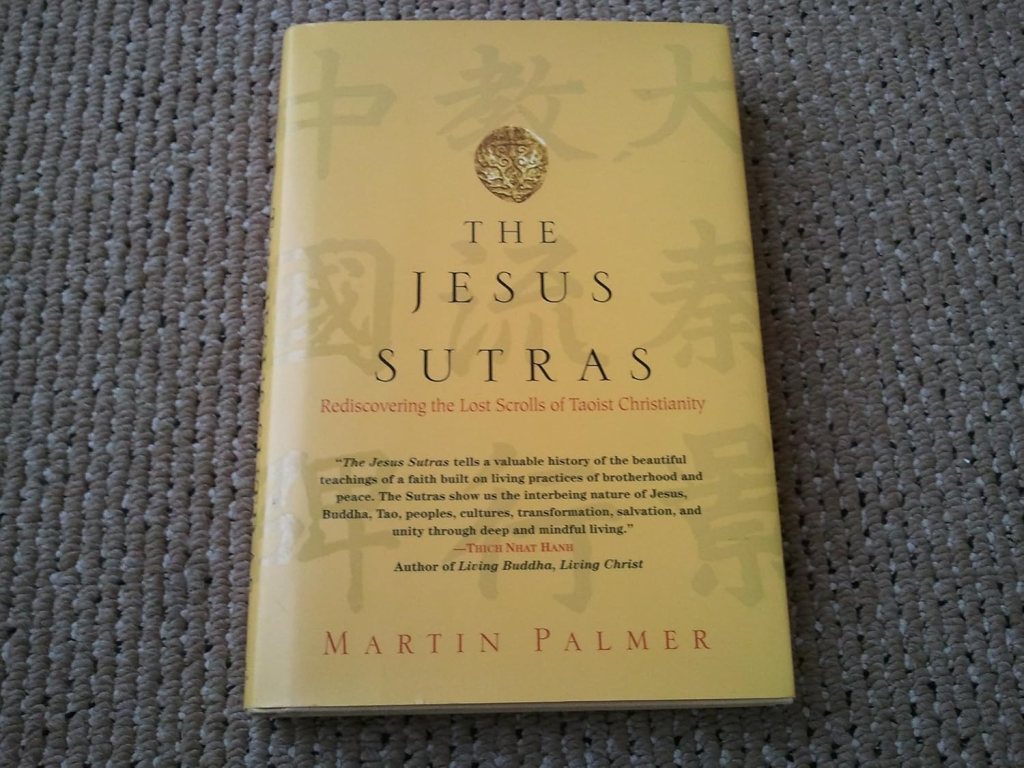
While the stele uses Zhenzhu (“True Lord”) more frequently, a pivotal Daoist-influenced term appears in the accompanying Jesus-Messiah Sutra, one of the Nestorian texts found in the Dunhuang caves. There, the supreme deity is referred to as the Luminous Sovereign of the Unoriginated Origin (无元真主 Wu Yuan Zhenzhu).[3] The phrase “Unoriginated Origin” (Wu Yuan) is a deeply Daoist concept, echoing the Daodejing‘s description of the Dao as the nameless, primordial beginning of all things. - The Dao (道) as the Divine Logos
The most significant adaptation is the use of the word Dao itself to translate the Christian concept of the Logos. The stele’s opening line declares:
“The Dao (道) of True Constancy is mysterious and difficult to name. Its operation is manifest and we make an effort and call it Luminous Religion”.[4]
This identification of the eternal, creating God with the Dao was a strategic theological move. It positioned the Christian God as the ultimate realization of the ultimate reality that Daoist sages sought like Paul did in Acts 17 with the statue to the unknown god. Furthermore, the text describes the Messiah (Jesus) as “the magnificent Dao” who “defined the measure of eight (moral) conditions…threw open the gate of the three constant (virtues).”[5] Here, the Logos-made-flesh is presented as the active, ordering principle of the cosmos, a concept that could be appreciated by both Daoist and Confucian readers and echoes the cosmic scope of Christ that Paul describes in Colossians 1.
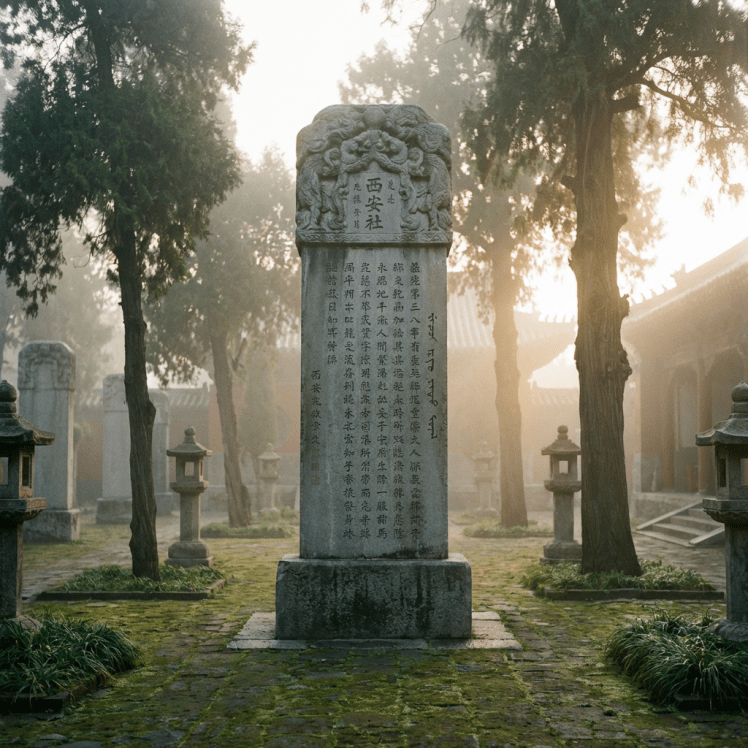
The stele describes the teaching of the Luminous Religion as embodying the Daoist spirit of wuwei (无为) or natural spontaneity. It states that “Having carefully examined the scope of his doctrines, we find them to be mysterious, admirable, and follow the spirit of wuwei ; having looked at the principal and most honored points in them, they are intended for the establishment of what is most important.”[6]
3. Motivations and Limitations of the Dialogue
This engagement was likely a form of accommodationist missiology. The goal was to make the Christian message intelligible and respectable within the Chinese intellectual milieu. By using shared vocabulary, the Nestorians hoped to build a bridge, suggesting that the “Luminous Religion” was not a foreign oddity but the fulfillment of truths that Chinese wisdom traditions had already glimpsed in shadow.
However, scholars debate the depth of this “dialogue.” It was likely more a one-way translation effort than a true, mutual exchange of theological ideas. There is little evidence that the Nestorians substantially modified core doctrines like the Trinity, Incarnation, or Atonement in response to Daoist philosophy. The encounter was primarily linguistic and apologetic, aimed at conversion rather than synthesis.

Conclusion
The Nestorian encounter with Daoism stands as a remarkable historical precedent for interfaith dialogue. It demonstrates an early Christian community’s sophisticated attempt to express its faith through the conceptual world of Daoism, particularly by identifying the Logos with the Dao and employing the language of primordial origins and naturalness. While its long-term theological impact was limited, the Xi’an Stele remains a powerful testament to the possibility of finding a “shared path” between these two great traditions.
It also demonstrates that Christianity came to China even before it came to some parts of Europe, like Scandinavia. Thus Christianity is not simply a foreign religion in China, but has been a part of Chinese history for almost a millennium and a half. If both the West and the Chinese can see that the promised Messiah is not a modern foreign imposition but a longstanding part of Chinese history, efforts in dialogue and witness in Chinese are less about offering a Western religion and more about a retrieval and reinterpretation of a tradition that has already, albeit intermittently, been embedded within China’s own historical experience. Accordingly, the task of Christian articulation in China may be understood less in terms of cultural transplantation and more as an act of historical and theological recovery.
Note: Views on my blog arise in league with my work for Global Scholars Canada (GSC), where I am Executive Director. The writing here, however, does not represent the official position of GSC. GSC supports Canadian Christian scholars to redemptively influence academia and students, especially in underserved countries, for human flourishing and God’s mission. If you wish to support our work at GSC, you can donate at our page and designate it as “General Fund” and sign up for our quarterly newsletter. Thank you!
[1] The stele is now housed in Xi’an Beilin Museum in Shaanxi Province, China. For a picture and brief introduction of the stele, see https://en.wikipedia.org/wiki/Xi%27an_Stele
[2] For original text and English translation, consult The Nestorian Monument of Hsi-an Fu in Shen-Hsi, China, by James Leggue. (Gorgias Press, 2011). The term “Luminous Religion” (景教 Jingjiao) was the name the Church of the East used for itself in China.
[3] The “Unoriginated Origin” is a direct parallel to the Daodejing‘s “The Named is the Mother of all things” but pointing to a prior, unnameable source.
[4] James Leggue, The Nestorian Monument, 9 (Translation modified for clarity). The original Chinese text is: “真常之道,妙而难名,功用照彰,强称景教”. This echoes Chapter 25 of the Daodejing, “吾未知其名,字之曰道,吾强为之名曰大 (I do not know its name. I call it Dao and I make an effort to call it the Great.)
[5] Ibid., 7.
[6] Ibid., 11. The full phrase is “详其教旨,玄妙无为。观其元宗,生成立要”. Translation is modified to capture the Daoist term wuwei.


This is a historical precedent of a culturally sensitive approach to introduce the fundamental concepts of Christianity and more importantly, the confidence to interpret and integrate “native” mindset, the DNA of Chinese philosophical theories that are foundational to cultural, social, and belief systems, and its code of conduct.
Alice Chee
LikeLike