“The mass of men lead lives of quiet desperation,” wrote Thoreau in his famous book Walden, which was published in 1854. But while we might assume that loneliness is as old as death, some are saying it is getting worse. Much worse. I want to explore this trend in some depth and then offer a few suggestions for action that culminate at a table.
In the spring 2023 the US Surgeon General Vivek Murthy declared loneliness to be an “epidemic” and a “major public health risk.” In an 81-page report on the subject he says that half the American population report experiencing loneliness. The World Health Organization, too, has established that loneliness is a “global health concern” and insist that “recognizing and resourcing social connection [is] a global public health priority.”
Amal Abdul Aziz – Flikr
How do we measure an “epidemic”? Thoreau felt lonely in the woods in 1854, and Paul Simon wrote “I am a Rock” in 1965 as a counter-point to John Donne’s poem “No Man is an Island” (1624). Loneliness has been around a long time. Yet they say the experience has become more widespread, and COVID’s push to social isolation played no small role. There are some startling statistics: for example, a Harvard study found that people between 30-44 years of age were the loneliest demographic–not the expected older generation. Angus Reid reported in 2025 that 49% of 18–24-year-old Canadians indicated that they are “often lonely.” Then there is the reality that Statistics Canada reported in 2021 that 29.3% of Canadian homes have a single resident. One in three homes. Gone are the days of multiple generation households, not to mention even the nuclear family for many (4.4 million homes across the country).
I have a Maclean’s article from October 14, 2004 that headlines: “Winnipegger’s Death Goes Unnoticed for Two Years.” His rent and other bills were all on automatic withdrawal. He had little family and few friends. This happened more often during COVID.
Why is this happeningnow? Well, the big picture is industrialization, urbanization, and individualization. Think of the decline in fertility, the rise in careerism and divorce, and the massive migration shifts that have created the multitudes of diaspora around the world. Such things have been hundreds of years in the making. More recently, think of the decline of voluntary associations (Bowling Alone by Robert Putnam argues this already in 2000) and the rise of cell phone use and the ubiquitousness of the screen. Electronic media sets us apart more than it brings us together, and it exacerbates tribalism. We’ve already mentioned COVID, which helped create the phenomenon that became the word of the year for 2025: polarization.
Our world is fragmenting, atomizing, dissipating. “To thine own self be true,” we say, thinking we are blessing someone, but it may carry the shadow of a curse. Truth, like troth and trust, requires other people.
“No sector of American society will have more influence on the future state of our social capital than the electronic mass media and especially the Internet.”
– Robert D. Putnam Bowling Alone
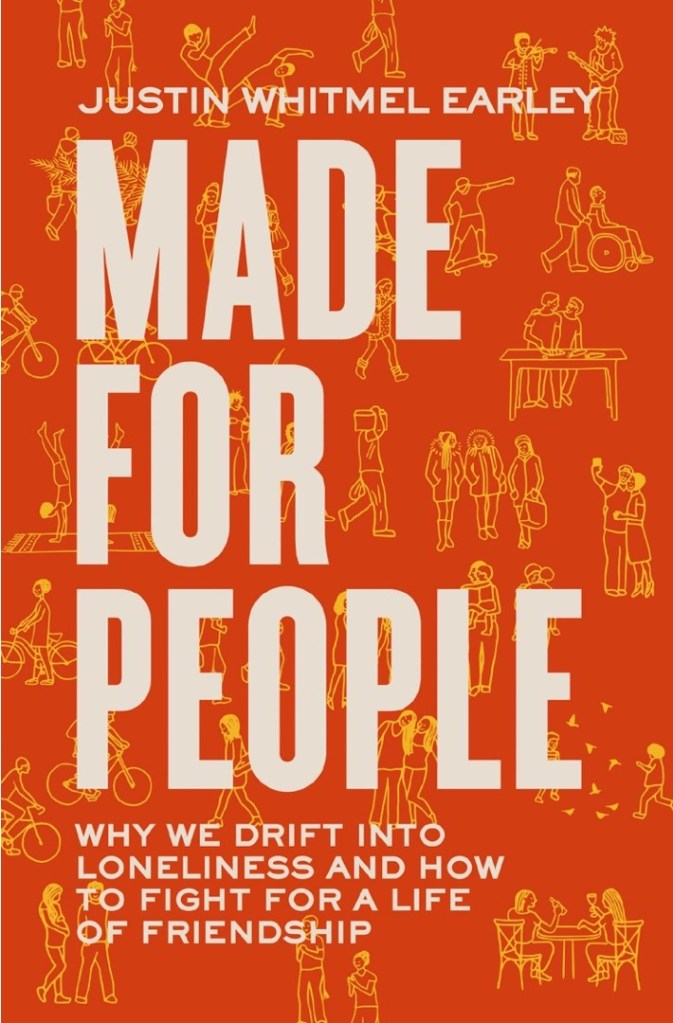
“The current of modern life is to become busier, wealthier people who used to have friends. And mostly you won’t even notice that this is happening,” wrote lawyer Justin Whitmel Early in his book Made for People: Why We Drift into Loneliness and How to Fight for a Life of Friendship (Zondervan 2023). This should be alarming: we don’t even notice this is happening to us–as individuals, as communities, as nations.
Alone is not Lonely
Note that loneliness is not necessarily being physically alone. Solitude is a staple Christian spiritual discipline that involves practising the presence of God and may not include feelings of loneliness. People, and especially social minorities, can be socially stigmatized, marginalized or isolated, and while these forces may exacerbate the likelihood of loneliness they do not determine it. Everyone feels lonely sometimes, even in a marriage, a church, or a crowd.
Loneliness is part of being a human. We come into this world as an individual, and we die as individuals, and that aloneness can be painful at times. Loneliness is defined by the Surgeon General as “a subjective distressing experience that results from perceived isolation or inadequate meaningful connections, where inadequate refers to the discrepancy or unmet need between an individual’s preferred and actual experience.” Loneliness is a bad feeling of being alienated from others, and it increases our likelihood of disease and death.
In the creation account in Genesis, human beings are made one at a time. Adam first. Then God says, “It is not good for man to be alone,” and so he makes a companion suitable for him–Eve. So some form of aloneness existed before any sin came into the story. Something was “not good” in the garden of goodness that needed attention and rectification. The sixth day, and the whole creation story, wasn’t over yet.
Look at it this way: the Genesis account says humans are created in God’s image, and if we agree that a Trinitarian Godhead is the best description of God, then some sort of inter-personal relationship is part of our human coding, our wiring. We were made for covenants with others, including God himself. But still, we are created as individual persons. Aloneness is not a disease, yet we hunger for others. We are best when we are together. We are then more fully who we were intended to be. We are made for the preposition “with” as my colleague Shiao Chong has written so eloquently about.
This “withness” may not be marriage, but marriage is one of the most common ways to be found together with another person, and this usually leads to a family. Yet there are many other ways to be with others, and most of our civil society is dedicated to these kinds of relations. The imposing powers of the government and market have their roles, and they offer workplaces in which we can be known, but the third sector, the social sector, is usually where we find community. And this is the sector of society that seems to be under threat today.
Hiding From Others
It is significant that in the Genesis story, the act that breaks covenant leads to hiding from others. Adam and Eve put on fig leaves to hide from each other, and then they hide from God. I note in most historical paintings of this scene Adam and Eve are hiding together, embracing each other. A more plausible rendition would have them hiding separately–from both each other and God. They wanted to blame someone else for their covenant breaking and that alienates them. They no doubt were profoundly lonely.
Covenant breaking leads to separation and not seeing each other. From rcascoherrera on pixabay.
“Hiding begins as our unwillingness to be seen and then becomes our insistence not to be known—and that is the root of all loneliness,” maintains Earley in Made for Others (p. 17). Paul Tournier, a Christian psychotherapist of the mid-20th century writes evocatively about loneliness in his book Escape From Loneliness (1948). He says loneliness stems from fear and that leads to conflict. “Men fear one another, fear to be crushed in life, fear to be misunderstood… suspicious feelings poison office life… jealousies separate… in a family conflict, each partner always has legitimate complaints to make…” (27). Tournier talks about keeping secrets from each other, and how these silent vows we make isolate us. We make ourselves lonely.
What helps is sharing our burdens. C. S. Lewis famously wrote in The Four Loves: “Friendship … is born at the moment when one man says to another “What! You too? I thought that no one but myself . . .” When we reach out across the chasm between us and others and risk being known, loneliness may fade.
Not everything is within our control, however. As I said earlier, certain social situations can make loneliness more likely. I asked one middle-aged gentlemen who had been divorced for years what his loneliness felt like. He said: “When I am lonely, I feel like nobody cares about me, no one understands me, or even has an interest in my life. Instead of love and concern, there is indifference. It comes down to not being connected in a meaningful way.” He felt dis-regarded. Unseen.
Tournier himself was an orphan–obviously through no fault of his own. He reminisces about his adolescence with sad thoughts:
I withdrew into my own lonely little world, even though I was treated kindly. My daydreams and secret projects only isolated me more from the others. Whenever I met a group of pals, they would change their conversation, out of embarrassment. I felt I was of no importance to anyone and that no one was really interested in me. One day I entered the living room quietly and realized that I was the subject of the discussion. It was an upheaval in my young soul; I could hardly believe it was possible.
Tournier felt like he was someone from a different planet, visiting a community of people who shared so much in common apart from him. Like he was an outsider, an alien.
Church may not be the salve for the wound, either. This is a quote from a 28 year-old bachelor about his experience coming to church Sunday morning.
I stand at the back of the church, glancing over the congregation, wondering with whom I will sit. It’s depressing, knowing you don’t quite fit in. Like you have a disease, a second-class citizen of the kingdom. And during coffee fellowship afterwards, I found it awkward trying to find a place to stand where I didn’t feel conspicuous. I would stand around sipping coffee for awhile after the service, and then slip into my car and charter myself home to a sandwich in the loud quiet of my apartment. Church can feel like a closed circle.
I wrote that myself, some 30 years ago when writing a paper on the subject of loneliness for a psychotherapy course I was taking as part of my M.Div. degree. Church life can be a balm for loneliness, and it usually is. But it can also be a place where its sting is felt more acutely.
Turning to the Table
I’ve facilitated a few talks on this subject, and when it came to offering words of hope, one friend said, “We can’t think our way out of this.” I think what he meant was that this is a time for action, for changing how be behave, how we live as neighbours, and how we practise being Christian community.
After Adam and Eve are banned from the Garden of Eden, God makes covenants with them and their family–even with Cain. Then we see more covenants being made, between God and Noah, Abraham, Moses, and David, and between so many of the characters that fill the pages that follow. Making loving commitments to work toward the shalom of the world seem to the redemptive response to the alienation of sin in the Bible. Making promises and then doing our best to be true to those commitments–even when others are not. This is a risk and an act of faith and hope.
I did not get married until I was almost 34 years old. There were many lonely moments. But there were also some great experiences of people who drew me in and blessed me, and many of these people remain close to my heart today. Older couples who had me over regularly for a meal. Mentors who made monthly commitments to have coffee or a run with me once a week or once a month. There were groups I organized myself–often with peers or younger folks that I remember fondly.
One interesting Ted Talk speaks of “anchors of connection” and I would interpret this as promises we make to each other for intentional, regular meetings or events–from prayers around mealtimes to annual weekends with old friends. Rituals and routines that bring us together. This may mean stopping default rituals we have that turn us to our phones and screens. Covenant breaking did not end with Adam and Eve.
Most basically covenant making means reaching out and forming bridges and bonds with others–not to make exclusive clubs but to make groups of people who are working toward some social good. In Christian terms, we might say toward the kingdom of God–relations of playfulness, beauty, trust, justice, and peace. If Jesus demonstrated anything in his ministry, it was the practise of bringing people together for the instruction, healing, and feeding of those in need. His supreme act was one of service and sacrifice, that left him deserted, betrayed, and forsaken by God himself–a loneliness within the Trinitarian Godhead itself. Yet, this brought life–abundant life for others. We see this carried on seamlessly in Acts, where the early church shared everything together and worked to meet the needs of others–healing, instructing, and eating together.
This kind of community will include friendship, food, festivals, and fun. We know churches like this, and Christians often make jokes about pot-lucks, picnics, rummage sales and talent shows. I’ve heard of such things as “men’s sheds,” friendship benches, and intergenerational game nights. Banquets are certainly Biblical, and people can be endlessly creative with their ideas, including a bowling alley in one church basement, inter-faith potlucks, and Christmas Light shows for everyone.
It is not all frivolity either. There are deacons helping those with material needs, elders praying with the distraught, and pastors doing their visits and referring some people on to specialized counselling or therapy. I’ve heard a local church starting a special “care ministry group” made up of lay people. I had a professor who insisted there was an “order of widows” in the early church of Acts–a group of women who were busy with good deeds. Our own congregation has a “Clothing Closet” and we have hosted Collective Kitchens and so much more. the examples are plentiful.
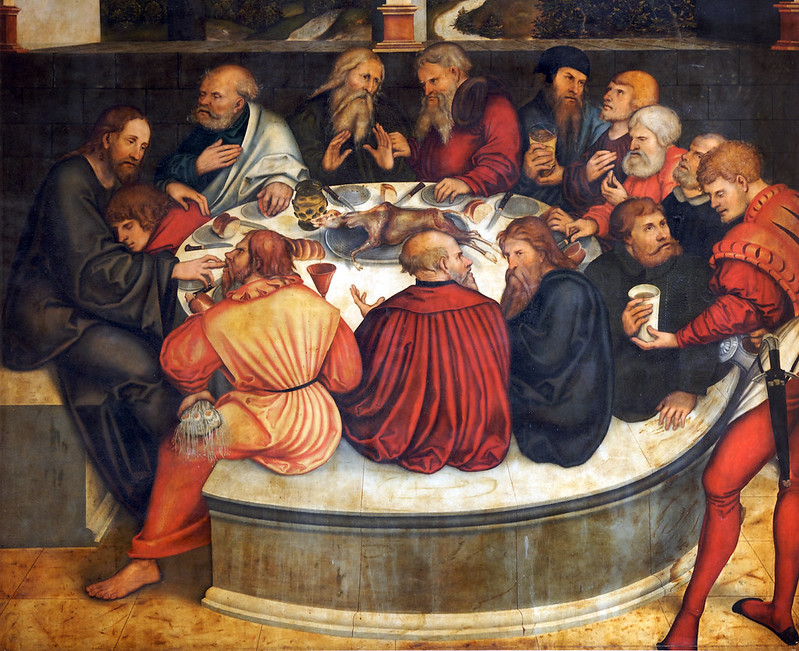
Reformation altarpiece by Lucas Cranach the Elder (1472-1553) in the Stadtkirche St-Marien, Wittenberg. From Nick Thompson, Flikr.
Let us not forget Sunday mornings and small group ministries. I have argued elsewhere that the table is as good a symbol of Christianity as the cross. In fact, the table, when representing the Lord’s Supper, includes the cross. We Christians are to be a people of the table–the place where we prepare and share food, talk about our secrets, and make friends. The kingdom of God is like a shared table, where we are first seen, and then become known. At best, it is the place where we are recognized and we do not hide.
Church is one part of that third social sector I mention above. Family, neighbourhood, hobby groups, advocacy agencies, sports teams, musical concerts–there are so many places where our loneliness can be assuaged. Yet the church has a calling to be a group of people who are sent out to gather people together for a good purpose. We have the open table, a place for those feeling worn out and weary to find rest, find peace, find friendship, and find a spiritual home.
At least I hope your church can be such a place; and if not, maybe you can make an alternative. No man or woman should be an island. That should be a covenant to live by.
Note: Views on my blog arise in league with my work for Global Scholars Canada (GSC), where I am Executive Director. My writing here, however, does not represent the official position of GSC. GSC supports Canadian Christian scholars to redemptively influence academia and students, especially in underserved countries, for human flourishing and God’s mission. If you wish to support our work at GSC, you can donate at our page and designate it as “General Fund”. Thank you!