
I’ve recently blogged about Nicholas Wolterstorff’s autobiography In This World of Wonders. Wolterstorff has had an incredible “learning” career (as he puts it in the subtitle) and has been a brilliant philosopher with a great legacy. What jumped out to me in the book is his constant reference to special friends at each stage of the journey. Although it is a long self-meditation that includes reference to his many accolades, the narcissistic factor doesn’t seem to surface. However, the dividing line of his life, he says, is the death of his son—who died mountain climbing in Austria in his twenties (his grief became the booklet Lament for a Son). His memoir reveals a rich, gifted, and servant-hearted life that left a number of thriving institutions in his wake. While he no doubt has some personal weaknesses, his life comes across as he titles it: a world of wonders.
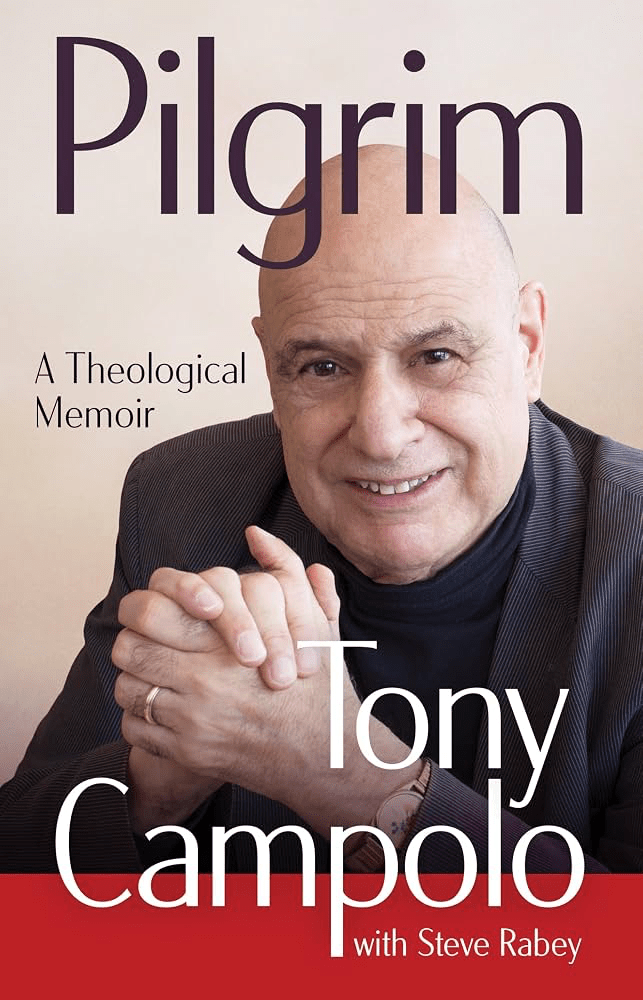
Tony Campolo died in the fall (Nov. 19th) of 2024 and he was a significant influence in my life as he, too, was a sociology/religion professor, chaplain and pastor. His memoir is called Pilgrim and it’s an easy read—almost a little superficial as it deals with some thorny issues in just a quick paragraph or two. Campolo was partly the reason I went into urban ministry for all my university summer jobs and partly what kept me pursuing sociology. I’ve seen him speak maybe 5-10 times over the decades and he is a powerful, funny, and arresting public speaker. He knew how to tell a story, and he learned how to preach from black pastors in his neighbourhood. I own about 7-10 of his many books and even had a VHS or two of his at one point. Some of this autobiography is lines straight from speeches I heard decades ago. He sure knew how to entertain—and convict—a crowd.
His early books like We Have Met the Enemy and He is Partly Right (1985) and Sociology Through The Eyes of Faith were accessible academic books (1992) that opened up my imagination. It seems after that time he focused more on popular books. As his distance from his experience teaching at the University of Pennsylvania increased he got more interested in the controversies of evangelical culture wars, and I think something was lost, even as much else was gained in his position at Eastern University, a Christian college. One thing was consistent, and that was his theological concern for the poor, the outsider, the oppressed. He stood up to power: to big money, to big oil, to bigotry. And he had a laser focus on Jesus, especially his teachings about money, materialism, and “success.” The best of sociology and a Baptist theology.
Looking back, part of me wanted to be Tony Campolo. A leaner, Canadian version of Tony Campolo. Not so much anymore.
The recounting of his life seems a little bit like self-justification at times. Like he’s trying to prove his evangelical membership card, and convince the reader of his personal integrity. It is also ironic that his original vocational prayer in 1985 was to influence 100 young people to serve in mission, and while the number is probably more in the tens of thousands today, his two children (coincidentally, named Lisa and Bart) are not self-identifying as Christians at this time. His son Bart is in fact an outspoken atheist and a “humanist” university chaplain. He wrote a short book with his father–one in which they debate the value of religion and the reality of God called Why I Left, Why I Stayed: Conversations on Christianity Between an Evangelical Father and His Humanist Son (Harper 2017). I appreciated the read and and the window into their differences, but I don’t think anyone wins in debate book like this.

I couldn’t help but wonder: does Campolo’s 300-500 speaking engagements a year play a role in the fact that his son now believes the Father of the universe is absent? I’m not saying there is a direct causal relation there, and I am not blaming Campolo. But did that absence of father from home play any role in the vast distance in worldview that grew between them? I realize there are no guarantees in child raising!
Campolo admits he leaves few close mentees behind (although the influential Shane Claiborne might be one). He lived in his own limelight (although 16 or so of his 50 books were co-authored in some way). In sum, I read the memoir with some ambivalence. He was a hero of my younger self, and I was hoping for something more. More what? Maybe something more confessional? Should autobiographies be part confessions of our failures along with the accomplishments?
Maybe my disappointment, too, arises from the fact that I am much more wary of celebrities in the last decade. You can read more about this disillusionment elsewhere on my blog and in my books, especially Blessed are the Undone.
An additional factor in my distancing from Campolo was his Baptist and really almost Anabaptist take on culture. My own neo-Calvinist commitments to common grace, a culture-transforming ethic, and a proper place for prosperity–what I would see as a more discerning take on culture–didn’t jive with his “Christ against culture” approach. Much of his schtick was oppositional–to institutional church, capitalism, and conservatism. For example: did he write on a Christian perspective on the arts? Not really. He focused more on ethics, politics and economics. He would also benefit from Christian Smith sociology of sociologists (for example The Sacred Project of American Sociology).
I suppose I read Campolo’s autobiography much more critically because we were close at one time. There was a time when I wanted to shake his hand, ask him a question after the show, and hope that something of his charisma would be transferred to me. He had personality, faith, and talent.
The celebrity life, however, even for a revered Christian, is fraught with temptations and tricks. Cary Grant famously said: “I pretended to be somebody I wanted to be until finally I became that person. Or he became me.” I suspect the latter is true, that the persona took over the person. “Everyone wants to be Cary Grant. Even I want to be Cary Grant,” he added. I suspect that Campolo, too, got lost in his persona, and as I evaluate this memoir, I suspect he was lost in defending that persona. That celebrity shadow must be a significant layer in this account of his life. He went to the nursing home with doctors’ orders to stop the speaking tours. He was highly resistant and petulant about it, insisting on soldiering on. Yet he began to ask: “Who am I?” as he lost his independence and faculties. The last pages tell of how he got 10-12 people together in the nursing home to listen to him preach Sunday mornings in a side room. He just couldn’t set aside the public speaking role. He needed to be up front. In my reading of it, there is something sad about that.
I didn’t know about this–or I forgot about it–but he talks about his “Heresy Trial” that was instigated by Bill Bright’s accusations in the 1980s. Chuck Colson told him to have a real public trial to resolve it. So he did: it was chaired by J.I. Packer and debated by various other celebrity Christian teachers. In the end, he says he was exonerated, but he admits the conclusion was that while not a heretic, he was “methodologically naïve and verbally incautious.” I sense he eventually took the critique to heart, but his recollection seems to emphasize the exoneration more than the indictment that came out of it. We all have a shadow side: your shadow is just more large and public with a large public figure.
Incidentally, former Canadian megachurch pastor Bruxy Cavey had a somewhat similar “heresy trial,” led by Gospel Coalition leader Paul Carter. The conclusion of his public trial, after many intense conversations with Paul Carter, was: “he’s not a heretic. He’s an Anabaptist.” Christians can be so quarrelsome sometimes! It is hard to avoid our polarized and politicized climate, and if I could sympathize with celebrities for a moment, it can be lonely at the top. You become a target for disgruntled people’s vitriol, envy, and aggression. Fame has its price, and Cavey has felt the weight of that in deeper ways of late.
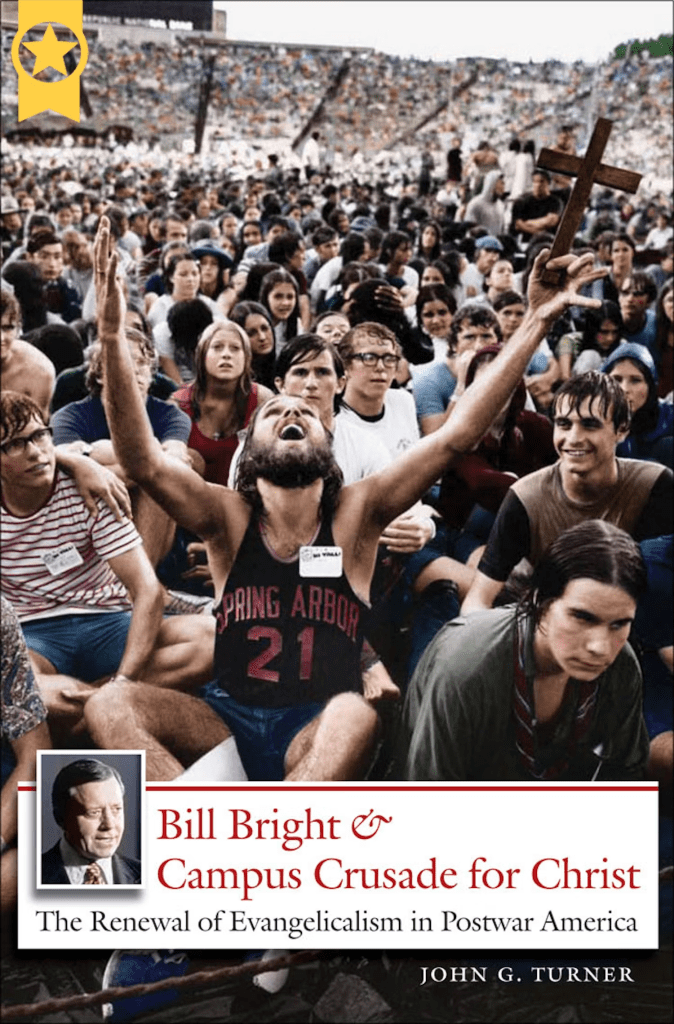
What also bothers me about Campolo’s memoir is that I have a scholarly book on the biography of Bill Bright by John Q. Turner called Bill Bright and Campus Crusade for Christ: The Renewal of Evangelicalism in Postwar America. I peeked in the index, and the one page on Campolo says that in his later years Bill went to reconcile with Campolo (and a bunch of other folks he dissed in his younger years! There were apparently a few!). Sadly, Campolo never mentions this restoration in his memoir, and Bill is left as the villain in the chapter on this season of Campolo’s life. That seems disingenuous to me, but we obviously don’t have all the facts–only two biased versions of them!
As I suggested earlier, as Campolo’s career continued, he got deeper and deeper into the culture wars in the USA. He became a champion of the “Red-Letter Christians” that were supposedly against the other American Christians and more about Jesus. I’m no fan of Christian nationalism, but I fear the vortex of polarization is hard to avoid, and it warps us all.
Another thing: I didn’t know Campolo ran for Congress in the 1970s. He didn’t make it, obviously, but he sure tried hard. He was just larger than life in many ways. Confidant to Bill Clinton, prophetic gadfly to Gulf and Western (oil), and darling of Compassion Canada and World Vision—he was an American evangelical star. Yet, also maybe a little lost in the brightness of his own popularity and then in his own role in the public controversies of evangelicalism.
For example, one of the most significant pieces of the story is his change of mind around gay marriage, which was instigated by his wife Peggy’s long-standing advocacy for LGBTQ folks. He says he changed his mind in a moment in the middle of a talk they were both giving on the subject. It is quite a compelling story. He lost many opportunities to speak after that, but he also gained a few. Controversy also fosters more attention. Do you even lose sight of what your motivations are when you are a public figure? What is genuine conviction, and what is going to get you in the news cycle tomorrow?
Did I mention I have been a little disillusioned with celebrity Christian leaders?
Writing an autobiography is a tricky thing: you may reveal more than you thought you were revealing. There are temptations to self-justification (getting in the last word before you die!) that ought to be resisted. You don’t give your critics’ best arguments. Naming real people and family members can be sensitive, and they may see things quite differently from you.
Tony Campolo was a role model of a sociologically informed public Christian leader for me in my younger days, and I was really looking forward to this book. Reading it was like a journey down memory lane. He was quite aged as he wrote this memoir (he needed a co-author to help him with the project), and so maybe I ought to be more gracious. I’ll end by saying that I’m glad to have known, read, and listened to Tony Campolo, and I’m also glad to have reflected critically on his life. He was a hero, and as we must all recognize–a flawed human one. Pilgrim might just be the right title for his memoir, as for any pilgrim, progress is never the whole story.


Hi Peter,
Excellent overview thanks for sharing. It is a good reminder for us to be humble and be careful how we judge people. / Martin
Martin
LikeLike